
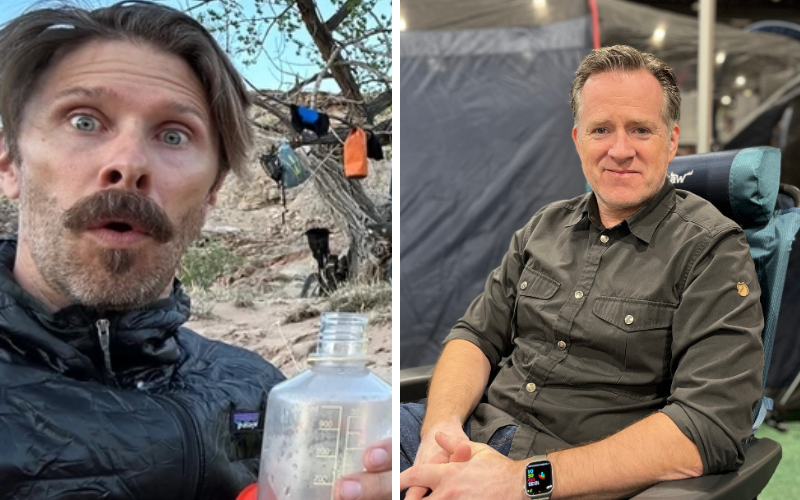
For the outdoor industry, 2025 wasn’t just another year on the calendar — it was a gauntlet. From shifting consumer demographics to the ever-present tariff turmoil, brands and retailers alike faced a landscape that demanded agility and grit. Amidst the noise, The Rock Fight podcast cemented itself not just as a source of entertainment, but as a critical voice for the trade.
Co-hosts Colin True, Eoin Comerford, David Karstad and Shawnté Salabert have spent the last twelve months dissecting the industry’s highs and lows with a level of candor that is rare in a business often bound by politeness and PR strategies. For them, the podcast’s growth mirrored the industry’s need for unfiltered conversation.
“This past year definitely has gone up a level,” True said when reflecting on the show’s trajectory in an interview with SESO. “When we’re at GOA Connect, we know we’re with our people. But even then, we’re starting to get emails from people who aren’t really in the industry, but just like knowing about the brands and learning about it. It’s a fun show, so they follow along.”
While the podcast grew, the industry itself faced significant headwinds. But according to Comerford, the doom and gloom predictions didn’t quite materialize as expected.

“The term I would use (for 2025) is surprisingly resilient,” Comerford said. “Given just everything that’s been thrown at the industry… if you told me all of those things, I would have said, ‘Oh shit, we’re going to be down 10%.’ And I think we’ll actually, from a retail perspective, we’ve come in flat to up a couple of percent.”
True and Comerford dug into the trends that defined 2025, the industry’s complicated relationship with AI, and what they expect to see as we head into 2026.
The Rock Fight has had a big year. How have you been feeling reflecting on 2025 when it comes to the show?
Eoin Comerford, co-host, The Rock Fight: The crazy thing to me is how many people tell us that their Slack channel on Monday morning is about The Rock Fight. Or Colin and Dave did an episode with Matt Sutton from Columbia about their “Engineered for Whatever” campaign, or maybe it was actually when we first covered it, that was played for an all-hands meeting at Columbia.
Colin True, co-host, The Rock Fight: It was a rally with the whole company, and they played a clip from our podcast. When things like that happen, you’re like: Jesus, really?
When you first launched, you said you wanted to recreate the conversations that you used to have at Outdoor Retailer. Is that still what you’re aiming for?
Colin True: We’ve abandoned a little bit of the community stuff. I always liked that stuff because it kind of kept a little bit of an air of authenticity. We’re not just here to talk about the business part of it. But then when you start weighing that against time and production, and what we are doing, the value to our listeners and what our advertisers are really going to gravitate towards, we decided to go more in on the business side of it. But I still think that we are having the conversations that people aren’t having out loud.
Eoin Comerford: Our industry just has a history of being, certainly, politically correct. And we only say nice things, at least publicly, whereas in the past, in the back room or at the bar, we’re like, “What the F is going on with those guys?” And the journalistic landscape around the industry has taken a hit, obviously, over the last five to 10 years. You know, a lot of what we see out there today in terms of news coverage, is basically sort of warmed over PR, warmed over press releases. I would actually say, Kate, you are doing some of the best reporting out there that’s actual journalism in the industry. But there’s not a lot of true journalism happening. And I wouldn’t call us journalists by any stretch, but I do think we are filling that void where people aren’t really talking about the real stuff that’s happening.
What are your favorite episodes? What are you most proud of this year?
Eoin Comerford: I wouldn’t say that they were my favorite episodes, but I would say that in terms of people commenting, our tariffs coverage actually was important.
Colin True: Those were our most-downloaded episodes. That was the top, people wanted to understand what was happening.
Eoin Comerford: Then I would say, I genuinely enjoy the time that I spend with the other two idiots, right?
Colin True: We won’t call (Gear Abby host) Shawnté (Salabert) an idiot.
Eoin Comerford: Although I’m beating her in Words with Friends – just FYI. The most fun shows are the ones for an award.
Colin True: Yeah, the top five lists are the best ones we did this year. There’s an educational piece of it. But it’s also a good hang. That’s what I enjoy when I’m listening to a podcast.
Did you have any guests that surprised you this year?
Eoin Comerford: On our 2025 awards, which we’re recording later today, Lloyd Vogel is going to win the most overexposed person. But that was actually one of my favorite episodes to listen to. It was Justin, Colin and Lloyd talking about brands you’ve never heard of. But just the joy with which Lloyd talks about these brands, and the discovery of it all with Colin and Justin – it was great.
Colin True: I really like my conversation with (Patagonia VP of Global Product Footprint) Matt Dwyer a lot. That definitely exposed me for being a soft interviewer. But also, I liked the things that he said in that interview. I’d called out Patagonia for being a little slow to talk about the PFAS thing. Matt made some incredible points. He’s the science guy. He’s the fabric guy. And he’s like, “Look, we tried a long time ago to just remove PFAS, and what we found is that all of our garments failed because you can’t just do it. You basically have to redevelop all of these fabrics.” From a content perspective, that was a really good conversation.
How would you describe the state of the outdoor industry after this year?
Eoin Comerford: The term I would use is surprisingly resilient, given everything that’s been thrown at the industry, from the tariff turmoil to the attack on public lands to declining tourism and everything that the current administration has really thrown up as roadblocks to the industry. But I think it talks to a weakness within our industry, which is that we are an industry for affluent old people more than anything. And that’s great for now, but I’m not so sure it’s great for the future.
Colin True: When I look at the entire industry, I think it’s always been healthier than people want to say that it is, especially if you spend a lot of time on LinkedIn. Those people are going to tell you the industry is terrible and needs a change and it’s all awful.
People are always going to want to go outside, so there’s always going to be a need. And if a brand goes away, somebody else is going to come in and take its place.
It’s also an industry that massively underachieves because they don’t recognize the upside of what we can do. I’ll speak for (co-host) Dave (Karstad), since he’s not here. On the brand side, why did we go on and on about (Columbia’s) “Engineered for Whatever” marketing campaign or Mammut’s mountain rescue team campaign? Because somebody tried something that was fun and different and in line with popular culture.
AI has started popping up in marketing and all over the place. Are you seeing that emerge as a big theme that’s playing out in outdoor?
Eoin Comerford: The outdoor industry typically hasn’t been on the vanguard of any tech innovation. It’s just not what we do. So are people adopting AI to write marketing copy and to optimize their marketing spend, or in HR, etc.? Yeah, but not to any extent that’s different from any other industry, or any other maybe consumer-facing industry.
One that I like is a company called Remark, which creates an AI for a company that pulls together all of their institutional and consumer knowledge to create this agent — not just a chat bot, but a true knowledge agent to be able to help consumers. So I think that those sorts of things are interesting.
And the next step of that would be kind of a persona-based AI for retailers, especially online, to help people on their journey to get outside, help them put together packing lists, help them answer their questions about getting outdoors, what they need, what’s the best gear for them, what’s in their gear closet today and what they could add.
Colin True: The outdoor industry is largely a collection of hippie lefties who don’t want the world to end, and Skynet’s real, and all that kind of stuff. However, I think there’s a very much a head in the sand point of view on AI. And it’s coming, it’s here, it’s happening, and it’s kind of on all of us to figure out how to work with it.
Eoin Comerford: The commentary that I hear that resonates with me is, you’re not going to lose your job to AI. You’re going to lose your job to somebody who uses AI better.
On the gear side, what has been the most exciting innovation that you’ve seen this year?
Colin True: Should we count in and say “trail running” at the same time?
Eoin Comerford: Has there been a super exciting innovation? Maybe I just missed it.
Colin True: The big eye opening for me on the gear side was maybe understanding more of the cottage industry, the smaller brands, like what Lloyd’s doing at Garage Grown, and a lot of direct consumer brands. Lems is a good example. After getting involved with them and starting to realize the size of what they have grown that brand to be behind the scenes, almost entirely direct-to-consumer, and now they’re really making a push towards wholesale. We’re in a world now where there are lots of small brands who are able to keep the lights on, make money, and some of them grow to a sizable level.
Eoin Comerford: Alpha is having a moment too. People are saying that’s new and exciting, even though it was new and exciting 10 years ago.
Colin True: I had lunch with a guy who used to work for me when I was at Polartec. He’s still there, and I’m like, “Dude, Alpha’s having a moment.” He’s like, “Yeah, man, it took a minute.”
What is your biggest lesson you’ve learned this year that you’ll take into 2026?
Colin True: People like top five lists? No, that’s a good question. The show started as Colin’s outdoor hot takes, and now it’s been 430 episodes. It’s still the spirit of what we wanted, which was a sports and pop culture podcast for the outdoors, and now, more specifically, the outdoor industry. We deliver that, and we’re open to criticism, but we’re also not afraid to share our opinions.
Eoin Comerford: The lesson I learned is that we have a voice on the pod. What I hope doesn’t happen is that we get too serious about that and start to edit ourselves out of responsibility to the industry. Hopefully we can keep doing what we’re doing.
This interview has been condensed and edited for publication. Kate Robertson can be reached at kate@shop-eat-surf-outdoor.com.


