
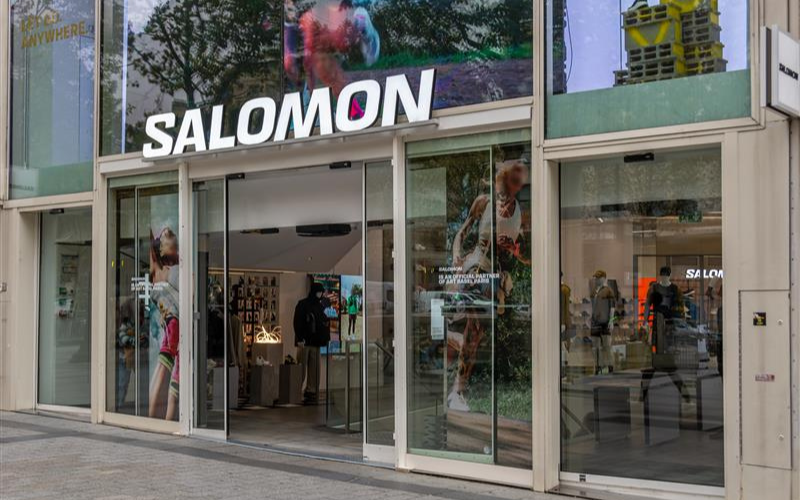
Amer Sports closed out 2025 with strong momentum across its portfolio, but the parent company of Arc’teryx and Salomon is preparing investors for a more moderate growth trajectory in 2026 as it accelerates investments in Salomon’s expanding footwear business.
The company’s fourth-quarter revenues increased 28% to $2.1 billion, capping a year in which group sales grew 27% to $6.6 billion. Full-year adjusted operating margin expanded more than 150 basis points to 12.8%, with double-digit growth across all segments, regions, and channels.
“Fourth quarter was a great finish to a breakout year for Amer Sports led by our flagship Arc’teryx brand and rising star Salomon, which surpassed the $2 billion sales mark,” CEO James Zheng said on an earnings call Tuesday.
Net income in Q4 was $131.5 million, up 752% year-over-year. For the full year, Amer’s net income was $427 million, a 489% increase.

For 2026, Amer Sports is projecting reported revenue growth of 16% to 18%, which includes a 200-basis-point benefit from favorable foreign exchange at current rates. Adjusted operating margin is expected to reach 13.1% to 13.3%, representing the low end of the company’s long-term target of 30 to 70 basis points of annual improvement.
The more conservative margin outlook reflects a strategic decision to accelerate investments behind Salomon’s soft goods opportunity, particularly in footwear and apparel, as the brand gains traction with younger consumers globally.
Amer CFO Andrew Page, Arc’teryx CEO Stuart Haselden and Salomon CEO Guillaume Meyzenq joined Zheng on the call and discussed:
- Store opening and wholesale plans at Amer brands.
- Regional results, strategies and product highlights.
- The appointment of former Helly Hansen CEO Carrie Ask to the Wilson CEO role.
Wholesale Strategy Takes Shape
Amer executives provided details on the company’s wholesale strategy across brands, particularly for Arc’teryx footwear and Salomon in North America. Overall, Amer wholesale increased 18% in the fourth quarter, while direct-to-consumer increased 38%. For the full year, DTC increased 15% and wholesale increased 41%.
While DTC has been Arc’teryx’s focus, Haselden said wholesale is emerging as an important channel for the brand’s footwear, Veilance sub-brand and women’s categories. The brand is building a sales team in Portland, Ore., as part of its footwear business unit and engaging with specialty run accounts and big box retailers on a premium, technical positioning.
In the fourth quarter, Arc’teryx wholesale increased 37% and DTC increased 34%, with a 16% omni-comp driven by higher full-price selling.
For Salomon, Meyzenq emphasized an omnichannel approach as critical to becoming a major sneaker brand in the U.S.
“We know that if we want to become a large sneaker and footwear brand in the U.S., we absolutely need to partner with the key players,” Meyzenq said. The brand has renewed its partnership with REI and is working with Nordstrom, Dick’s Sporting Goods and running specialty shops, taking a “door by door, city by city” approach with close partnerships.
Arc’teryx Extends Growth Streak
Arc’teryx continued its strong run in the fourth quarter, with the Technical Apparel segment, which also includes Peak Performance, increasing 34% to $1 billion.
All regions posted strong double-digit growth, led by Asia Pacific, Greater China, the Americas and EMEA. Arc’teryx opened 15 net new stores in the quarter, including a flagship Alpha store at Rockefeller Center in New York City and mountain town locations in Aspen, Colo., and Park City, Utah.
“We continue to envision Arc’teryx as a truly global brand with significant runway in all major markets, and we’re encouraged that the brand is generating double-digit omni (channel)-comps across all four regions,” Zheng said.
Women’s was the fastest-growing category in the quarter, up more than 40%, with particular strength in ski and insulation products. The Atom SV jacket and the new Andessa down jacket resonated with consumers. Footwear also grew nearly 40%, driven by the Norvan LD 4 trail shoe and the Kopec hiking shoe.
Arc’teryx’s adjusted segment operating margin expanded 160 basis points to 25.9%.
Looking ahead, Arc’teryx plans to open 25 to 30 net new stores in 2026, with the largest number coming in North America and China. The brand is projecting 18% to 20% revenue growth with segment operating margin of approximately 22%.
Arc’teryx also made key leadership additions, including Avery Baker as its first chief brand officer and Tobia Prevedello as head of EMEA.
Salomon Surpasses $2 Billion Milestone
Salomon crossed a major threshold in 2025, with revenues surpassing $2 billion as the brand grew 35% for the full year. Amer’s Outdoor Performance segment, which includes Salomon, Atomic and Armada, posted fourth-quarter revenues up 29% to $764 million.
The growth was driven by continued strength in Salomon footwear and apparel, supported by double-digit expansion in winter sports equipment despite lower snow levels in the Alps and Rockies. Direct-to-consumer sales for the Outdoor Performance segment increased 55%, led by new doors and higher productivity in Asia Pacific and Greater China. Wholesale increased by 17%.
“The popularity of Salomon footwear continues to inflect globally, and we are doing everything we can to ensure we are well-positioned to fully develop this large opportunity over time,” Page said.
Salomon opened 33 net new shops in Greater China in the quarter, bringing the total to 286 doors and adding nearly 100 new stores in 2025. The brand also expanded in Asia Pacific, opening eight net new stores to finish the year with 113 Solomon stores, including partner locations.
In North America, Salomon’s momentum accelerated with strong order books for Spring/Summer and Fall/Winter 2026. The brand opened its second New York store in Williamsburg, Brooklyn, and plans to open seven to 10 new shops in the U.S. this year.
In Europe, Salomon opened its first-ever office and showroom in Paris and continues to expand its Epicenter strategy in key cities including London, Milan, and Madrid.
Meyzenq outlined several factors driving confidence in Salomon’s growth trajectory:
- Global sports-style momentum continues, with the brand connecting with women and younger consumers through franchises like the XT-6 and the new XT Whisper.
- Performance and running lines are gaining traction in specialty run channels across North America and EMEA.
- The brand’s epicenter strategy of opening flagship stores alongside elevated wholesale distribution in key metro markets is working, he said, particularly in Paris and London.
Strong demand from European consumers is driving reorders and sell-through. North America growth is accelerating, though the market remains much smaller compared to Europe or Asia.
Salomon also made a key leadership addition, appointing Heikki Salonen as its first-ever creative director. Salonen joins from MM6 Maison Margiela and previously worked at Diesel.
Salomon Investments Impact Margins
The strong growth at Salomon came with a margin trade-off in the fourth quarter. Outdoor Performance’s adjusted segment operating margin declined 490 basis points to 6.2% as the company made the decision to accelerate investments into the brand’s soft goods opportunity.
The investments included marketing campaigns around XT Whisper, gravel running, and the Milan-Cortina Olympics; accelerated retail expansion, especially in China; and increased investment in talent and operations, including higher incentive compensation, new talent acquisition such as the creative director, and the new Paris hub.
“The strong sales and profitability profile of the broader Amer portfolio gives us the flexibility to accelerate resources behind the large Salomon soft goods opportunity while still delivering great results at the group level,” Page said.
Meyzenq said the investments are bringing tangible benefits including a 15-point increase in Salomon’s global brand awareness since 2023, including a more than 15-point increase in Paris and a 10-point increase in London.
In 2026, Outdoor Performance is expected to deliver 18% to 20% revenue growth with segment operating margin of 14.5% to 14.8%. While the company will continue investing heavily behind Salomon, Page noted the segment should return to modest year-over-year margin expansion beginning in the first quarter.
Former Helly Hansen CEO Appointed Wilson CEO
Amer announced Carrie Ask as Wilson’s new brand president and CEO, effective March 1. Ask is a former U.S. Navy officer with executive experience at Helly Hansen, which was acquired by Kontoor Brands last year. Ask has also held roles at Levi’s and Nike.
The Ball & Racquet segment reported 14% revenue growth in the fourth quarter to $337 million, driven by soft goods, baseball, and golf. Soft goods doubled in 2025 and now represents approximately 15% of segment revenue.
For 2026, Ball & Racquet is expected to grow 7% to 9% with segment operating margin of 4.7% to 5%.
China Momentum Continues
Greater China remained a bright spot for Amer Sports, with revenues increasing 42% in the fourth quarter to $544 million. For the full year, Greater China grew 43% to $1.9 billion.
Zheng noted positive consumer trends during Chinese New Year across Amer’s brands and the broader sports market, though he cautioned it’s too early to declare the momentum definitively bullish.
Arc’teryx, Salomon, and Wilson all continue to expand retail footprints in China. Salomon opened a renewed flagship store in Chengdu’s Taikoo Li district, while Arc’teryx opened a ReBIRD repair center at Songhua Lake.
Tariff Impact Minimal
On tariffs, Page said the company remains confident in managing through various scenarios given its relatively low U.S. exposure, strong brand portfolio with pricing power, and clean balance sheet.
“We continue to expect an immaterial impact on our group P&L from higher tariffs in 2026,” Page said. The two businesses most impacted will likely be Ball & Racquet and winter sports equipment, but the company’s position hasn’t changed following recent Supreme Court and presidential decisions.
Balance Sheet Strengthens
Amer Sports ended 2025 with net debt of $291 million and a leverage ratio of 0.3x, reflecting $730 million of operating cash flow for the year. In January, the company announced a redemption of $80 million of its outstanding senior secured notes.
Inventories increased 33% year-over-year, slightly elevated compared to 27% sales growth, primarily due to earlier receipt of seasonal Arc’teryx merchandise, higher goods in transit from greater use of ocean shipping versus air freight, foreign exchange translation and the addition of Arc’teryx Korea inventory following the recent acquisition.
The company expects inventory growth to normalize beginning in the second half of 2026.
First Quarter Outlook
For the first quarter of 2026, Amer Sports expects reported revenue growth of 22% to 24%, which includes a 500-basis-point benefit from favorable foreign exchange. Adjusted gross margin is expected at approximately 59%, with adjusted operating margin of 14% to 14.5% and adjusted diluted earnings per share of $0.28 to $0.30.
Page noted that should strong trends continue and better-than-anticipated demand materialize, the company is well-positioned to deliver financial performance ahead of expectations.


