
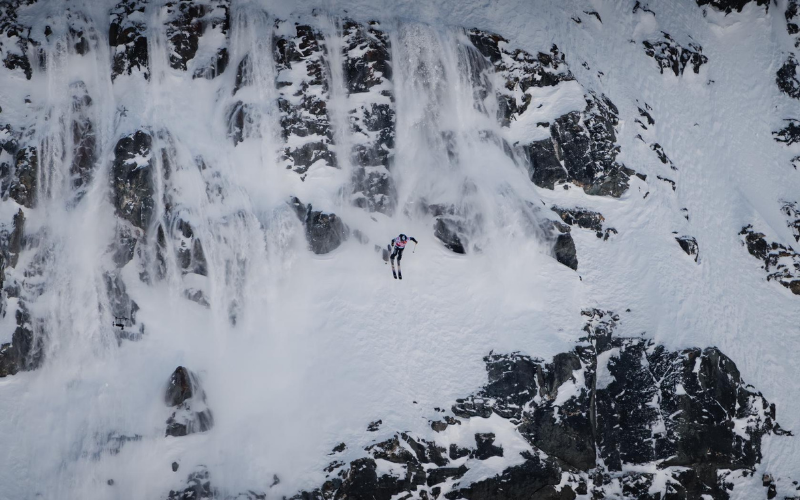
The FIS Freeride World Tour (FWT) proudly welcomes the decision by the International Olympic Committee (IOC), announced today in Lausanne, Switzerland, to include freeride skiing and snowboarding on the Alpes 2030 Olympic Winter Games program. Freeride will make its Olympic debut in 2030, a first for a sport built on natural terrain and judged on the line a rider chooses.
The inclusion of Freeride in the Olympic program marks a defining moment in the sport’s evolution and recognition at the highest level. It reflects Freeride’s growth from a small competitive scene into a worldwide discipline with a fast-expanding base of athletes and fans.
“I’m really stoked Freeriding is now part of the Olympics. This is such a huge opportunity for all the athletes and the entire sport. The energy surrounding the Olympics is truly unlike anything else so I can’t wait to see it all go down!” said Mia Jones (Truckee, California, USA), 2026 FIS Freeride World Champion and 2026 FWT Champion.
As the home of competitive Freeride, the FWT has shaped the sport’s development for three decades, from the creation of the legendary Xtreme Verbier in 1996 to the inaugural FIS Freeride World Championships in 2026. Today, the FWT provides a structured pathway for athletes through four competition series, from Junior and Qualifier events to Challenger competitions and the elite Freeride World Tour, giving riders of all ages and abilities the opportunity to participate and progress within the sport. Now Freeride shares in the Olympic dream for current and future athletes.

The FWT ecosystem includes more than 10,000 licensed riders worldwide and hosts more than 300 competitions annually across four continents. This pathway nurtures the next generation of Freeride talent and drives the sport’s continued growth.
“It’s a moment of joy for the entire freeride community, and the result of three decades of commitment and dedication alongside an incredible team. My first thoughts go to the riders, from those who first believed in this discipline and helped build it, to the young athletes who can now dream of an Olympic medal. I think too of the organizers and everyone who has grown this sport over the years, and of all the partners who trusted us throughout the journey. Whatever the stage, the spirit of freeride remains,” said Nicolas Hale-Woods, FWT Founder and CEO.
“It is clear why Freeride’s combination of raw excitement on stunning natural terrain is an appealing addition to the Games. Above and beyond that, Freeride is a success story on the development level: within a couple of decades, the discipline created a structured pathway for athletes to compete, from the junior level all the way to the elite,” commented Alexander Ospelt, FIS President.
Olympic inclusion will create new opportunities for current and future generations of Freeriders. Competing at the Olympic Games will allow athletes to showcase their skills on the highest stage in sport, represent their nations, and inspire new audiences worldwide.
Comprising four events, it will provide an Olympic opportunity for 44 athletes (22 women and 22 men, skiers and snowboarders) to compete at the Olympics for the first time.“Competing in Freeride at the Olympics is the dream, honestly. It would be an honor to represent Team USA, but beyond that it would be massive for the sport overall. Now that it’s officially on for 2030, I’m super excited to put a lot of my energy into qualifying,” shared Toby Rafford (Sun Valley, Idaho, USA), the 2026 FIS Freeride World Tour Vice Champion for Ski Men and FWT’s 2025 Rookie of the Year.
Looking ahead to the Alpes 2030 Olympic Winter Games, the FWT remains committed to the growth, accessibility, and global development of freeride, and to helping shape an exciting new chapter in the sport’s history.
“Our team of passionate skiers and snowboarders, including myself, are dedicated to keeping the soul of Freeride. Progress in sport built by those who love it, will always be best. Every day, we aim to enhance Freeride opportunities for the current and future generations with this moment marking a pivotal point in Freeride history,” said Nicolas Hale-Woods, FWT Founder and CEO.”
“Our job is to protect what makes this sport so special and develop the next generation of Freeriders throughout the Americas. This moment is bigger than Olympic inclusion, it’s an opportunity to define what this sport stands for, and for us to ensure that the values that built it are the ones that carry it forward,” shared Meg Hourihan, President of the IFSA Board.
For more information on freeride’s path to the Alpes 2030 Olympic Winter Games, including updates on the qualification pathway as they are confirmed, visit: freerideworldtour.com/olympic-integration/
What’s Next? FIS, national federations, the Olympic host and more will collaborate on a detailed roadmap for the Olympic Games. This includes venues, event formats, athlete quota details and qualifications, compliance with Olympic rules (anti-doping, governance, safety), promotions and media capability, and more. To learn more about Freeride’s path to the Olympics and the sport of Freeride, check out the Freeride x Olympics Fact Sheet here.
About the Freeride World Tour
FWT Management SA is based in Verbier, Switzerland, and has been organizing premier sports events globally in mountain resorts since 1996. The company founded the Xtreme Verbier, an iconic event in freeride skiing and snowboarding and, in 2008, it turned this single competition into a prestigious series of worldwide events, called the Freeride World Tour (FWT). The company has since grown to include multiple competition series that fall under the FWT brand – including FWT Challenger, FWT Qualifier and FWT Junior – with events across all formats taking place in Europe, North America, South America and Oceania. Since December 2022, FWT is part of the International Ski and Snowboard Federation (FIS). Discover more at www.freerideworldtour.com


