
Watch a Replay of the Webinar Here
Key Takeaways:
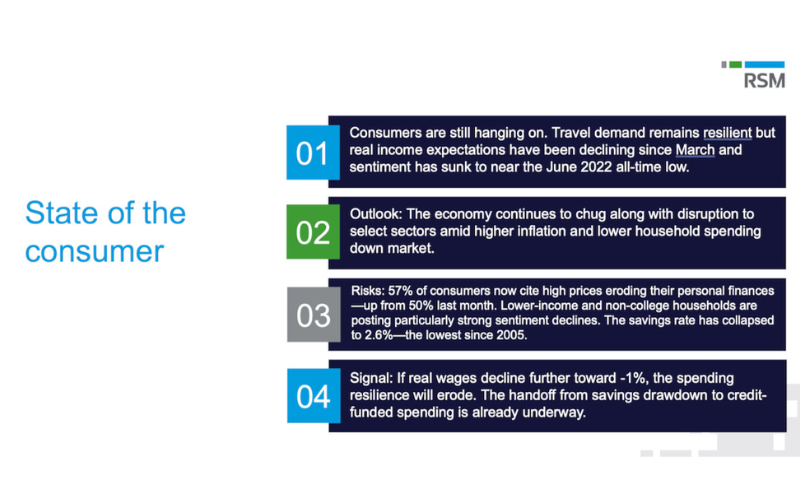
- RSM economists say the economy is holding up on paper but splitting sharply by income, with lower earners running out of room as inflation outpaces wages.
- Companies that paid IEEPA tariffs may be sitting on real refund money. Two client examples pulled back $4.8 million and $7.2 million, and RSM says even small claims are worth filing.
- California’s SB54 and SB707 are pushing sustainability out of press releases and into SKU-level paperwork, with textile reporting requirements arriving as early as 2028.
RSM US LLP joined Shop Eat Surf Outdoor for a recent webinar, “Tariffs, Tightening Margins and the AI Advantage: What Brands and Retailers Need to Know Now,” bringing together four specialists to break down where the economy stands heading into the second half of the year, how brands can pursue tariff refunds, what new sustainability mandates mean for product lines, and how AI is starting to change the way supply chain decisions get made.
The Economy Is Holding Its Breath on the Strait of Hormuz
Kevin Depew, Deputy Chief Economist at RSM, opened with a plain question underneath all the data: is the economy actually okay? His answer was that it depends entirely on who you ask.
RSM’s baseline forecast holds GDP growth, the broadest measure of economic output, at 2.1% for the year. Inflation, measured by the Fed’s preferred PCE index, is expected to stay a full percentage point above the central bank’s 2% target even in the rosiest scenario. Both numbers sound stable. What is not stable is who is feeling the squeeze.

Depew called it a K-shaped economy, meaning two very different experiences branching off the same starting point. Households in the top two income brackets are still traveling, eating out and spending freely. The bottom three brackets are not so lucky. Wages have technically kept rising, but once inflation is factored in, those “real wages” are actually falling, meaning paychecks buy less than they used to even though the number on them looks fine.
Consumer confidence has sunk to near an all-time low, and 57% of consumers now say high prices are eating into their finances, up from 50% just a month earlier. The national savings rate has dropped to 2.6%, below the rate of inflation, which means the typical household is losing spending power even while trying to save.
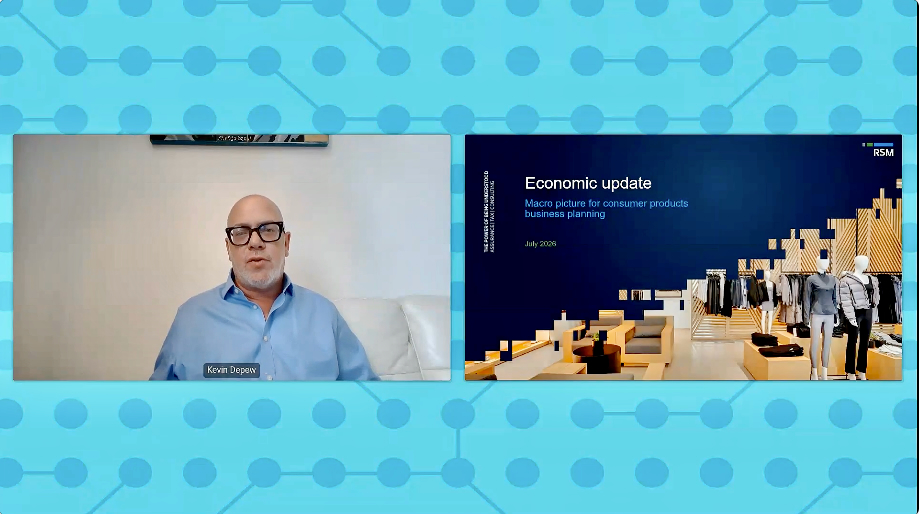
Kevin Depew, Deputy Chief Economist at RSM, during the SESO webinar.
Much of the near-term outlook, Depew said, hinges on how quickly the Strait of Hormuz reopens and how fast oil prices come back down. Until then, he said, “it’s almost like someone holding a beach ball underwater. If anything positive happens with developments with Iran, with anything that’s geopolitical in nature, then you’re going to release that beach ball and the economy is going to be much more positive.”
He was also careful to put the word “recession” in context for a room full of operators who lived through 2008 and 2020.
“When we talk about recession, we’re talking about something much more moderate and modest in its impact than the past two you may be familiar with,” he said.
Depew left attendees with three numbers to watch as an early warning system, all signs that bond investors are losing patience with the cost of financing the federal government:
- Two-year Treasury yield above 4.3%.
- Ten-year Treasury yield above 4.5%.
- Thirty-year Treasury yield above 5%.
Tariff Refunds Are Real Money, and the Clock Is Running
Jodi Ader, trade advisory services senior manager at RSM, made the case early that tariffs have outgrown the compliance department.
“Tariffs are not just a trade compliance issue, which is how many consumer product companies have viewed that in the past,” she said. “They’re a business issue that truly does impact sourcing, cash flow, profitability and strategic decision making across the organization.”
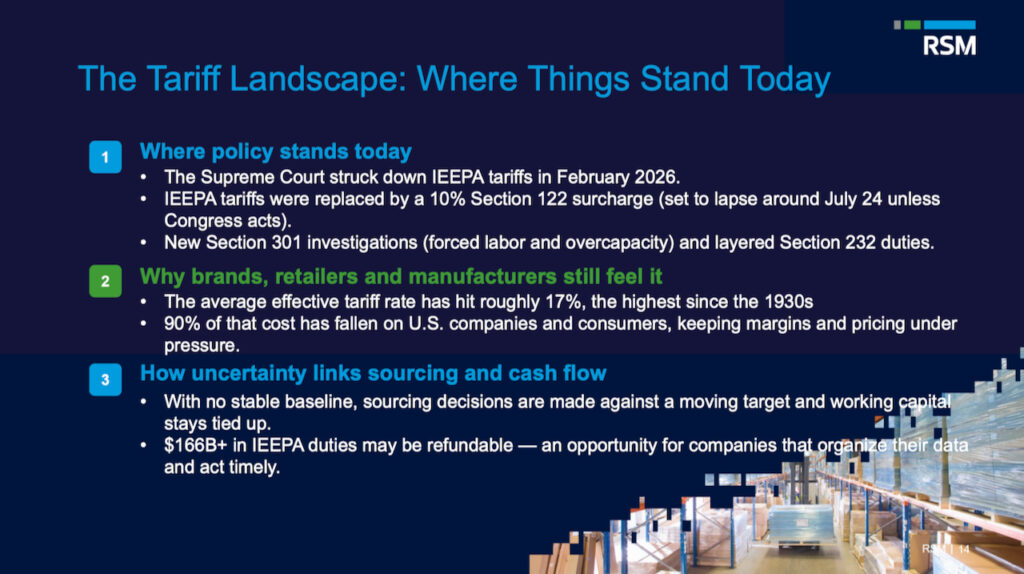
She walked attendees through the fallout from the Supreme Court’s February ruling striking down IEEPA tariffs, which were quickly replaced with a 10% Section 232 surcharge, alongside continued Section 301 investigations. Effective tariff rates remain elevated, and Ader said companies with the right data and documentation in place may be able to recover previously paid duties, in some cases with interest.
The recovery mechanism is the Customs and Border Protection ACE portal, which has rolled out in phases. Phase one, covering unliquidated entries, opened April 20. Phase two, covering entries flagged for reconciliation, launched June 29. Phase three, covering finally liquidated entries, is still pending and may require some companies to file suit in the Court of International Trade.
So far, more than 125,000 claims have been accepted through the portal, with billions of dollars in refunds approved.
Slide courtesy of RSM.
Ader shared two client outcomes to illustrate the scale of what is on the table. A retailer that reviewed its tariff exposure recovered more than $4.8 million in refunds plus interest, then used the same review to shift sourcing to lower duty countries like Guatemala and Vietnam, projecting more than $1.5 million in additional annual savings going forward. A second retail company secured $7.2 million in refunds within months of starting its review, easing near-term cash pressure while also exposing gaps in its import data processes.
Company size, Ader said, is not a barrier to filing. She pointed to a client that had paid only about $75,000 in tariffs and still found the recovery process worthwhile.
“Even if someone’s only paid $100,000 in tariffs, why not get it back?” she said. “We have a lot of clients that are in that sort of boat. It is worth the squeeze.”
She closed with three questions she recommends executives ask their organizations:
- Do we know our total tariff costs?
- Have we evaluated refund opportunities?
- Are we making sourcing decisions based on yesterday’s tariff environment or tomorrow’s?
EPR Moves from Marketing Claims to SKU-Level Proof
Samantha Rustja, sustainability associate at RSM Canada, framed the shift happening in sustainability regulation in one line: “Accountability moved from what a company says to what a company actually makes.”
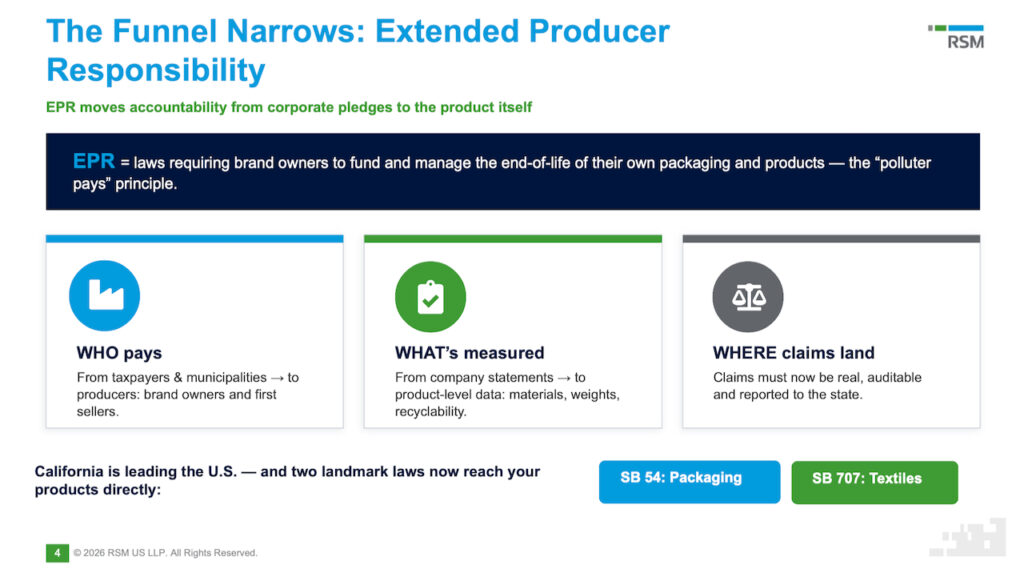
For years, she said, sustainability was a story companies told through corporate reports and voluntary pledges. Extended producer responsibility, or EPR, changes that by making producers financially responsible for what happens to their packaging and products at the end of their life, and by requiring proof at the product level rather than the company level. Seven states have now passed packaging EPR laws, with the concept originating in the European Union before arriving in the United States.
Rustja focused on California’s two relevant statutes. SB54, the Plastic Pollution Prevention and Packaging Producer Responsibility Act, took effect in May and requires companies to register with Circular Action Alliance, the designated producer responsibility organization for packaging. The annual supply report covering all packaging sold into California was due May 31. Companies were also required to submit 2023 baseline data on plastics sold into the state as the foundation for source reduction goals running through 2032, with individual reduction plans due August 1.
Slide courtesy of RSM.
SB707, the Responsible Textile Recovery Act, is the first textile EPR law in the country. It applies to producers selling apparel, bags, backpacks and home textiles into California with global turnover above one million dollars. Registration with the designated textile PRO, Land Bell USA, became mandatory July 1, though reporting requirements are not expected to begin until at least 2028. Rustja said fee structures are still being finalized but are likely to be based on material streams and recyclability rather than product category alone.
Her bottom line for brands still treating sustainability as a talking point: “Sustainability isn’t something that can be thrown around anymore. It’s becoming these real product-level claims that you need to be able to prove.”
She recommended four steps for brands:
- Map products and SKUs to covered categories.
- Determine registration and compliance obligations.
- Build the data infrastructure needed for SKU-level reporting.
- Turn compliance work into a broader sustainability strategy.
AI Is Already Reshaping Forecasting, Inventory and Procurement
Jake Winquist, supply chain and operations principal at RSM, closed the session with a reminder that supply chain has become a boardroom conversation rather than a back office function.
“COVID kind of made supply chain sexy again,” he said. “Supply chain needs to be more of a strategic partner across our enterprises, and I really truly do feel that the last several years, it’s really become a truth.”
He pointed to four areas where AI is delivering measurable results in consumer goods supply chains today: demand forecasting enhanced with outside economic data, which he said is driving forecast accuracy improvements of 10% to 30%, inventory and SKU optimization, procurement and supplier risk mapping that now extends into tier two and tier three suppliers, and AI assisted sales and operations planning.
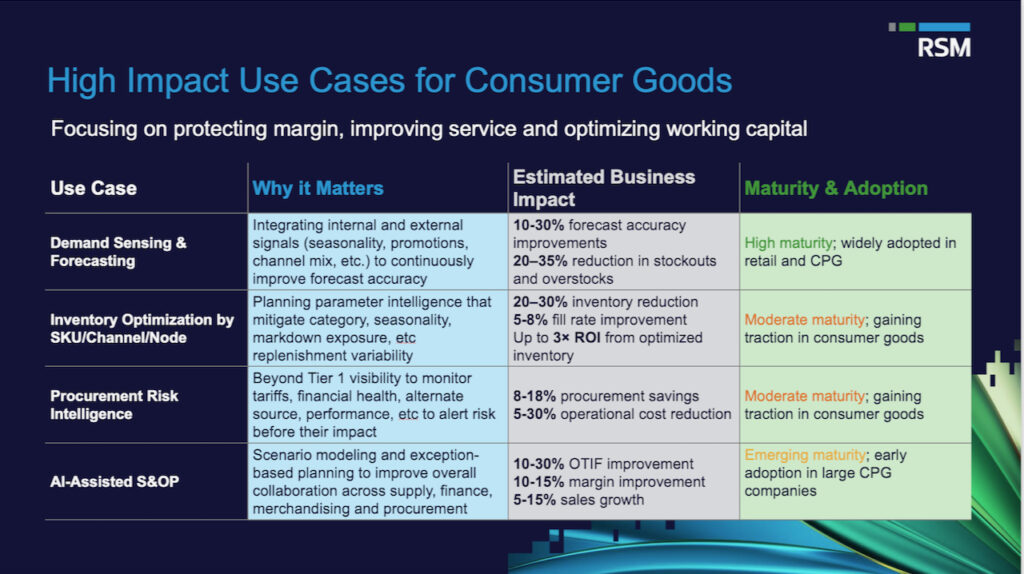
Slide courtesy of RSM.
The supplier risk mapping example landed as the session’s sharpest moment. A national retailer thought it had solved a packaging shortage by lining up a backup contract manufacturer, only for RSM’s mapping tool to reveal that both the original and backup manufacturers relied on the same tier two packaging supplier.
“While the client thought that they had made a big win by identifying an alternative vendor, actually it was the same root cause issue that they’re running into,” Winquist said. “It was kind of an interesting, a bit of an aha moment for them.”
His advice to executives evaluating where to start was to look inward before shopping for new tools.
“Before we buy AI, what do we already have?” he said. “Those systems are constantly being updated, constantly looking at their AI native capabilities. So ask yourself, what do we already have and what are we not leveraging before we go out and buy?”
He left executives with questions to ask before scaling AI adoption further:
- What AI capability already exists within our current ERP, CRM and product lifecycle systems?
- Where in the business is AI needed most?
- Do we have the right data foundation in place?
- Is there rigor in our decision-making framework, including thresholds and approval processes?
The session closed with an audience question on how tariff refunds flow between importers and retail customers. Ader said the importer of record receives the refund first and shares it with retail partners on a case-by-case basis, with some importers retaining a portion to cover the administrative cost of pursuing the claim.


