
Key Takeaways:
- Lindsay Hubley, Senior Vice President of Emerald’s Sports and Outdoor Division, said moving the show to August and to Minneapolis addressed a timing conflict that had pushed independent retailers away from OR for years.
- Wild Reach’s early creator connections on the show floor translated into tens of thousands of people engaging directly with product content within hours of the doors opening.
- Hubley said the show had verified 400 retailers on site by the end of Day One, with a full day still to go, and that the team’s next goal is reaching 750 to 1,000 retailers at future shows.
By 4:30 on the first afternoon of Outdoor Retailer’s Minneapolis debut, Lindsay Hubley was pulling numbers up on her phone. She wanted to get them right before saying them out loud.
“So, on the show floor so far, we have made, as of 4:30 on Thursday, Day One, 691 creator connections with brands,” said Hubley, Senior Vice President of Emerald’s Sports and Outdoor Division. “This basically taps into a combined audience of 21.2 million people, and that all happened within, I guess we opened at 10, so within the last six hours.”
Bringing 150 content creators to the show floor is just one of the many changes Hubley and her team have brought to Outdoor Retailer. Hubley has spent roughly two years rebuilding Outdoor Retailer into the show that opened this week in Minneapolis.

Full disclosure: Shop Eat Surf Outdoor and Outdoor Retailer share the same parent company, so this account is not a solely neutral one. But I have watched Hubley and her small, scrappy team try to reimagine a show carrying decades of legacy and just as many — very vocal — competing opinions about what it should be. That is not a small thing to pull off. I wanted to hear directly from her how the pieces came together, and whether the numbers were bearing it out.
Editor’s note: Read our larger story about Outdoor Retailer 2026 with reaction from brands and retailers here.
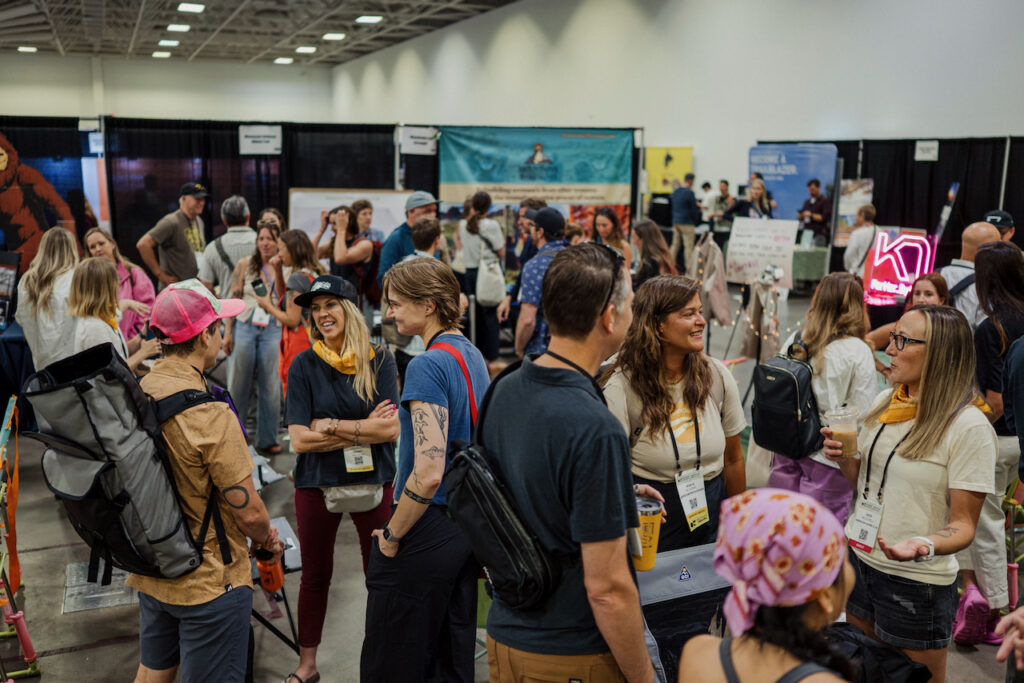
There was lots of buzz and energy on the show floor on Day One. Photo by Tim Aukshunas, courtesy of Outdoor Retailer.
Rebuilding Around the Retailer, Not the Calendar
The strategy started roughly two years ago, Hubley said, and it began with retailers, not brands.
“The way that I saw this show build back is that we had to build it back for the actual stakeholder that was going to be walking the floor, the attendee,” Hubley said. “That would be the retailers, that would be the reps, that would be essentially media.”
Timing turned out to be the real obstacle. Big box retailers can send buying teams to a show almost any time of year, she said, but independent shop owners rarely have the staffing to be out of the store whenever a show happens to land.
“For the small indie shop, they don’t have the staffing to be out of the office in different timeframes,” Hubley said. “August came up multiple times. Outdoor Retailer used to be in August years and years ago.”
She said the show had shifted into a June timeframe around 2013 or 2014, and the longer it stayed there, the more it collided with the buying calendar independent retailers were already following through Grassroots Outdoor Alliance and regional shows.
At the same time, Hubley said Outdoor Retailer had drifted away from being a buying event and toward something closer to a trends and discovery event, with fewer retailers actually writing orders on the floor.
“It became less of a buying event,” she said. “It became more of an event that you looked at future trends. You had sell-through conversations. You talked about discovery and product innovation and what’s next.”
Hubley said she also saw a new home as necessary to relaunch the show’s identity and mission. Essentially, it needed a fresh start all around.
“We needed a new host city, and that’s how we came up with Minneapolis, which is a substantial outdoor recreation state,” Hubley said.
The city’s response was immediate, and officials worked closely with the OR team under tight time constraints to make it happen. That culminated with the warm welcome OR received this week in its new home, including a visit from Mayor Jacob Frey on the show floor on opening day.
“They have totally welcomed us with open arms,” Hubley said. “The city was very happy to even be considered on the list of cities to host such a prestigious event, which in their eyes is still the national trade show for the outdoor industry.”
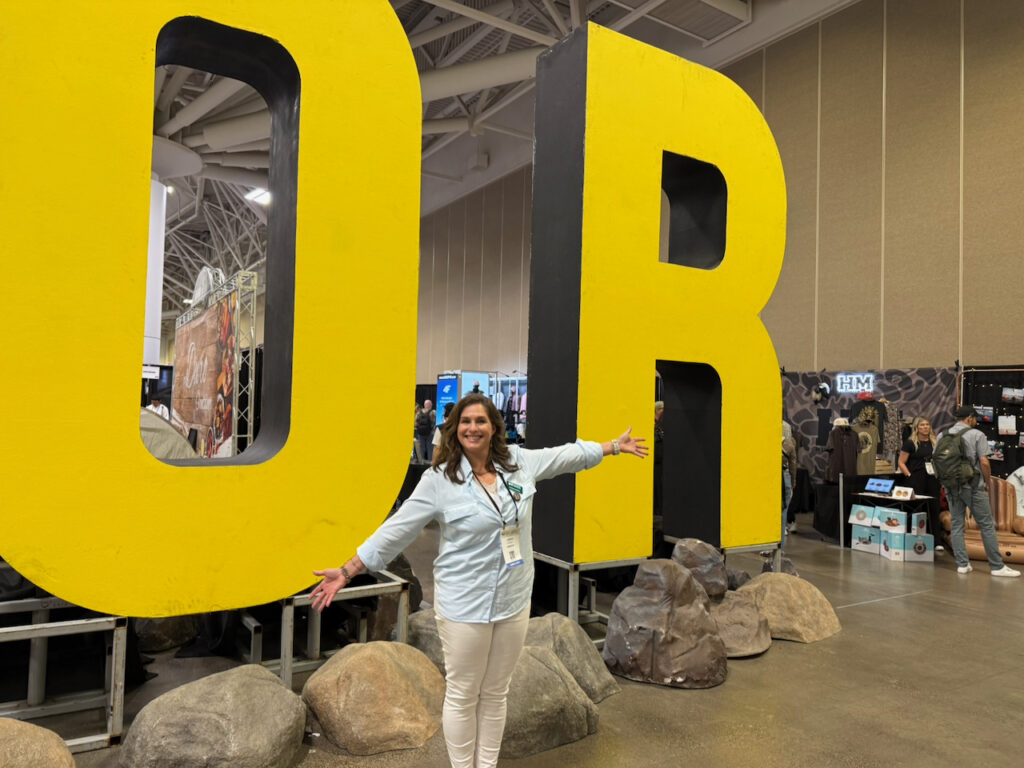
Lindsay Hubley, Senior Vice President of Emerald’s Sports and Outdoor Division. Photo by SESO.
A Return to the Show’s Original Idea
The redesign also reached back to Outdoor Retailer’s earliest days. The original show launched in Reno, Hubley said, in 1982, built on the idea that new products needed a place to be seen, largely by young, up-and-coming brands.
“Let’s take it back to its roots. We need to take it back to the way that it originally started,” Hubley said. That thinking was reinforced, she said, by conversations with people actively shaping the market today, including Lloyd Vogel of Garage Grown Gear, an e-commerce site focused primarily on ultralight backpacking gear from smaller brands.
The small brand pavilion built with Garage Grown Gear and Founded Outdoors became one of the most visible results of that thinking, and one of the most visible changes on the floor this week. Hubley said the format came directly from a conversation with Vogel, who pointed out that most new and upcoming brands really only have one or two products they want to showcase.
“So having a big 10-foot-by-10-foot, or even a 5-by-10 booth, they’d have trouble filling it out. That’s how we came up with this 3-by-3 space.”
Some brands built their own displays from scratch, she said, including one designed as part of an intern contest at a participating company. Around 60 brands filled the pavilion in Minneapolis, all young and upcoming names.
“Those are the innovative products that actually fuel the future,” Hubley said. “Even though we built back on discovery and smaller brands, even if you’re a mid-tier brand or a bigger brand, we want to be the place where you launch a product.”
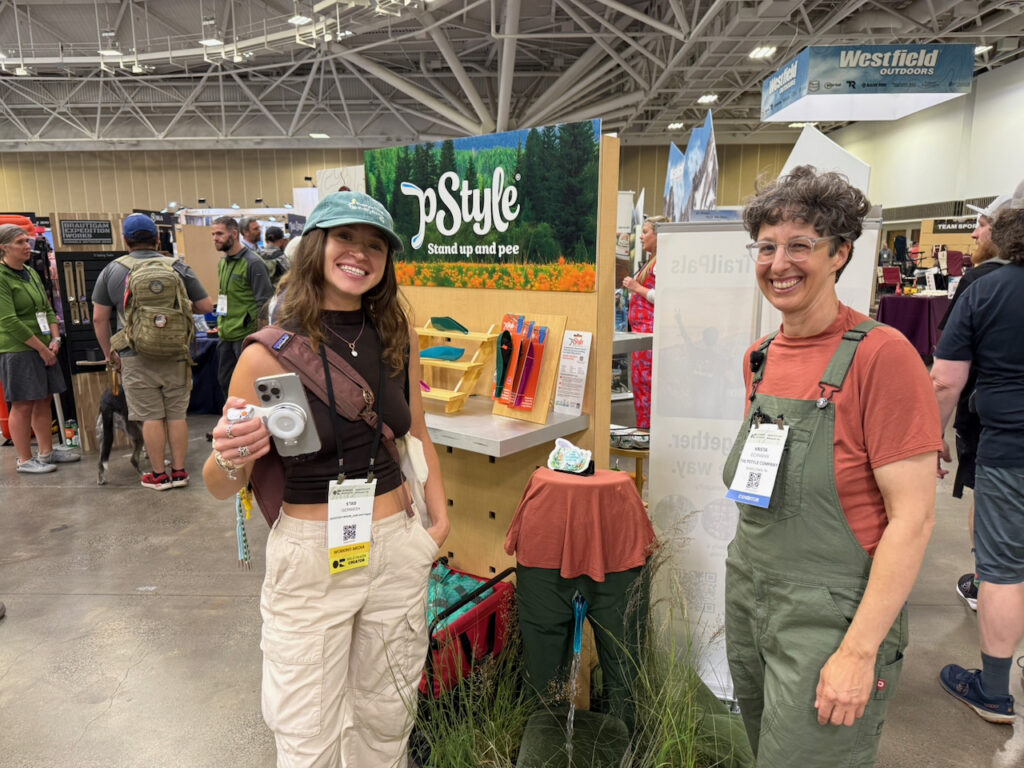
Content Creator Stas Germash of @goeverywhere_doeverything interviewing Krista Eickmann of The PStyle Company. Photo by SESO.
Why the Show Bet on Creators
The Wild Reach Initiative, the show’s creator program built with Popfly, came out of a different set of conversations with industry insiders, Hubley said. For years, the show had heard the same suggestion repeated: just open the doors and let consumers in directly.
“The reality of doing that is that when you’re trying to have a very sophisticated plan with exhibitors that need value in their booth space, you can’t just let a consumer come in, because it degrades what that exhibitor is paying for,” Hubley said. “You need to control the quality of what’s coming through the door (attendees).”
Wild Reach was built instead on a model closer to how electronics show CES treats creators, as a kind of media outlet in their own right. Hubley said Outdoor Retailer once had roughly 200 traditional media outlets attending the show through 2018, a number that shrank considerably as print and other media outlets consolidated or shut down.
“We have to have a way that we’re reaching the end consumer. We’re feeding the funnel,” Hubley said, describing the thinking behind the program. The original Wid Reach goal was 10 million combined followers across participating creators. “We actually amassed the ability to get almost 15 million followers through the program, which is substantially higher.”
The idea, she said, was for creators to treat brand booths like product launch events.
“You could feel it on the show floor,” Hubley said. “They’re so excited to be a part of rebuilding this show.”
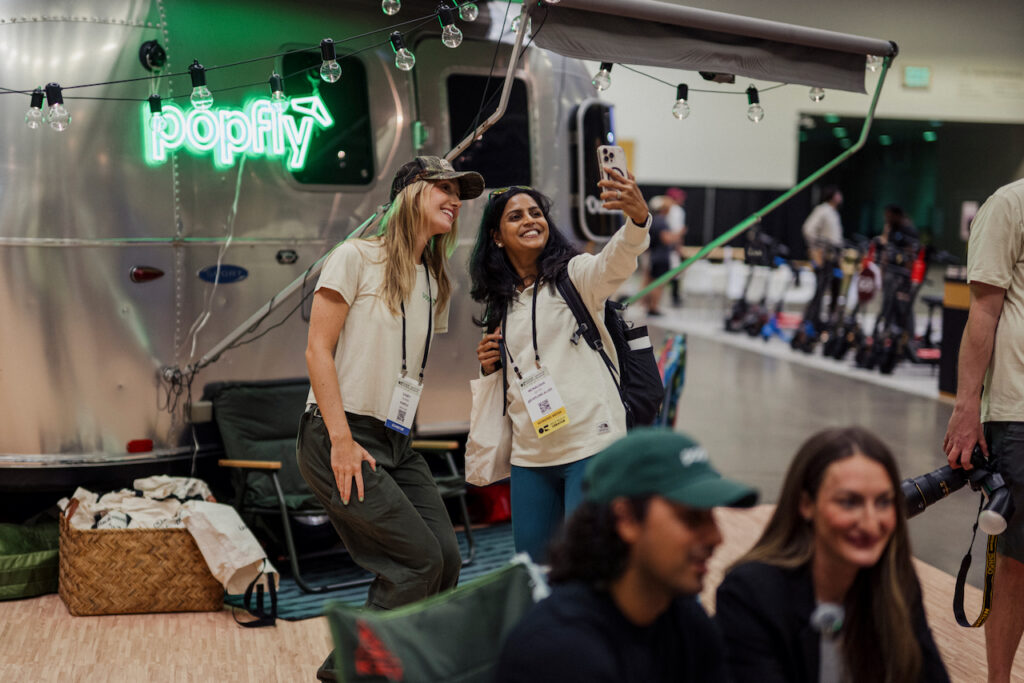
Content creators in the Popfly booth. Photo by Tim Aukshunas, courtesy of Outdoor Retailer.
The Numbers Behind Day One
That energy showed up quickly in the data. Through a live dashboard from Popfly, the show’s creator partner, Hubley said 46,000 people had engaged directly with product posts, photos, and launch content on Day One alone, liking, commenting, or asking where to buy.
“It’s also a very engaged audience,” she said.
Retailer attendance told a similar story. By the end of Day One, the show had verified 400 retailers on site, already ahead of expectations with a full second day still to go.
“It definitely exceeded our goals so far, and we expect to get to where we told the industry we thought we could,” Hubley said.
Two hosted buyer programs were built specifically to support independent specialty retailers, which Hubley described as central to the show’s mission.
“We believe in investing in indie retail because it is the backbone of the industry,” she said. “They are the launch point for a lot of these new and upcoming brands and discovery brands, because let’s face it, these upcoming brands may not be ready for an REI or an Academy or something that’s bigger.”
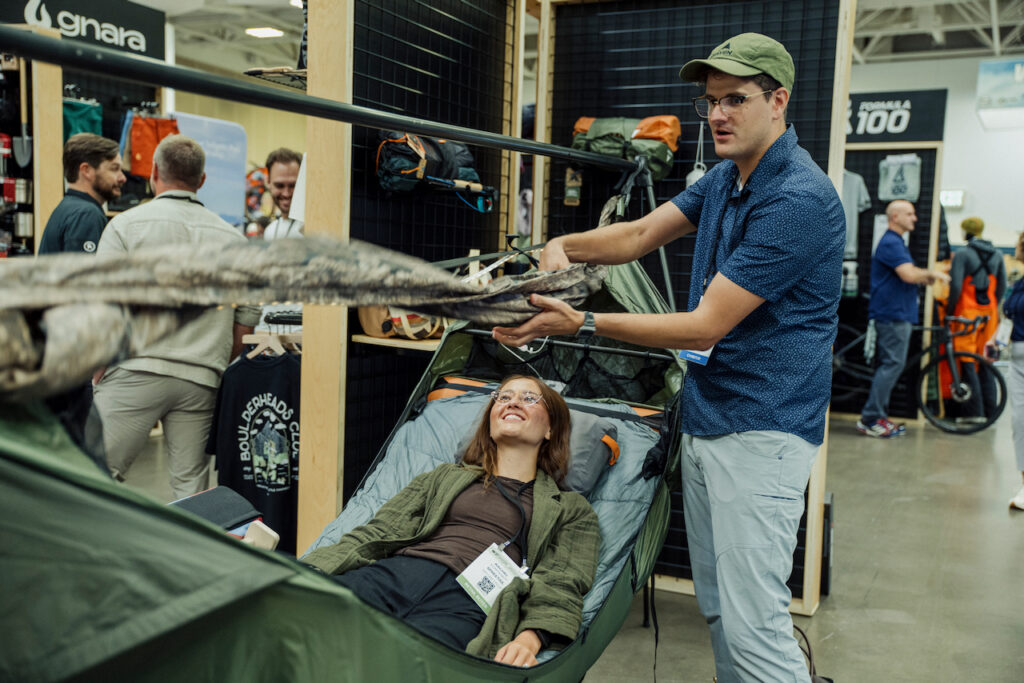
A retailer trying out product at Outdoor Retailer 2026. Photo by Tim Aukshunas, courtesy of Outdoor Retailer.
Rebuilding Trust Took Longer Than Rebuilding the Format
Not everything about the rebuild came together as quickly as the pavilion or the creator program. Hubley said some decisions made before she joined the show were complex and left reputational issues to work through with brands across the industry.
“We’ve had to rebuild a lot of personal, reputational issues with many brands,” Hubley said. Over roughly the past 12 months, she estimated having about 600 individual conversations with associations, buying groups, regional partners, independent reps, and brands ranging from small to large.
Early on, the show also brought on an advisory group and a Leadership Village made up of industry figures to help guide investment decisions. That group included Peter Sachs, an outdoor industry veteran and former general manager of LOWA Boots; Mike Massey, founder of the commerce platform Locally; and Sunny Stroeer, an athlete and co-leader who organized education content across all three days of the show, including Industry Day, among others.
“When we’re going down the wrong path, they speak up and definitely tell us,” Hubley said. Stephen Regenold, founder of Gear Junkie, she said, was especially instrumental in shaping how Wild Reach was built, since it departed significantly from how the show had traditionally worked with media.
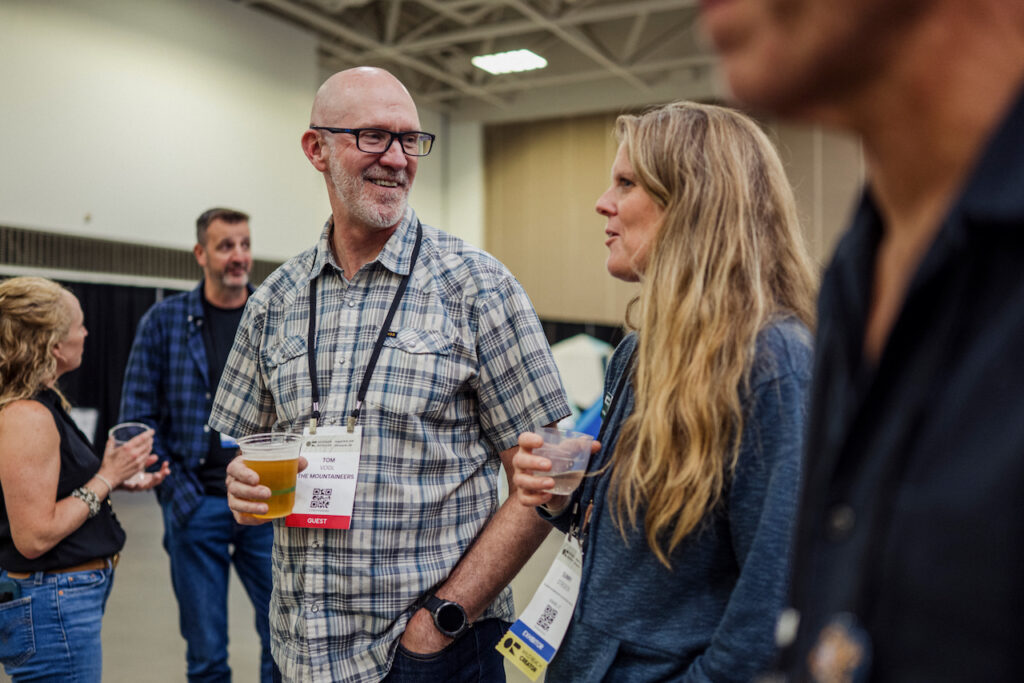
Sunny Stroeer, right, part of the Outdoor Retailer Leadership Village, helped organize the education program at the show. Photo by Tim Aukshunas, courtesy of Outdoor Retailer.
What Comes Next
Looking ahead, Hubley said the show is weighing expansion into new categories, including potential partnerships with paddle associations and a return of a bike component.
“If we end up with 600 retailers on site after the show is over, that’s not good enough for us. We need to get to 750. We need to get to 1,000,” Hubley said. She added that the show plans to expand its hosted buyer and scholarship programs for independent specialty retailers, invest further in Wild Reach, and work to bring more mid-tier and mid-size brands back to the floor.
The show’s education programming drew a strong turnout in its first run as well.
“We brought on industry experts to actually come in and help us redesign all of the education, all the Industry Day programming,” Hubley said. “We invented the Retailer Playbook to basically show our commitment to indie specialty retail, and that was highly curated education that was important to train retailers on best practices and how to move their businesses forward.”
“We had 573 people attend Industry Day,” Hubley said of the day before the show floor opened. “They were very engaged.”
Asked what she hoped OR would become, Hubley kept the answer simple.
“We want to build the trade show of the future,” she said, “a gathering that is built on showing what’s next.”
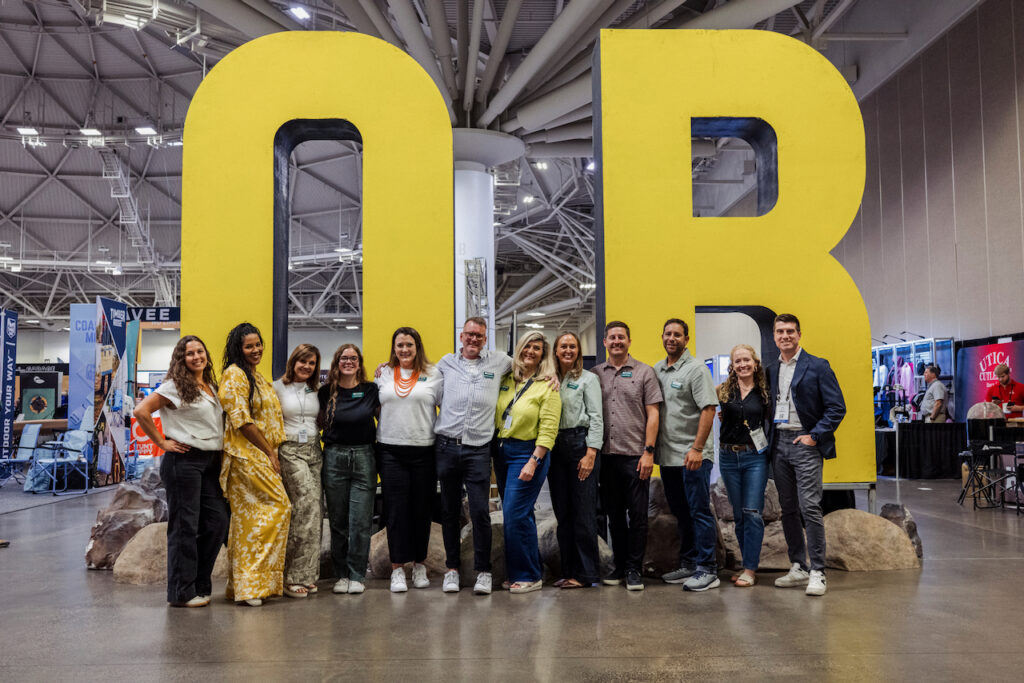
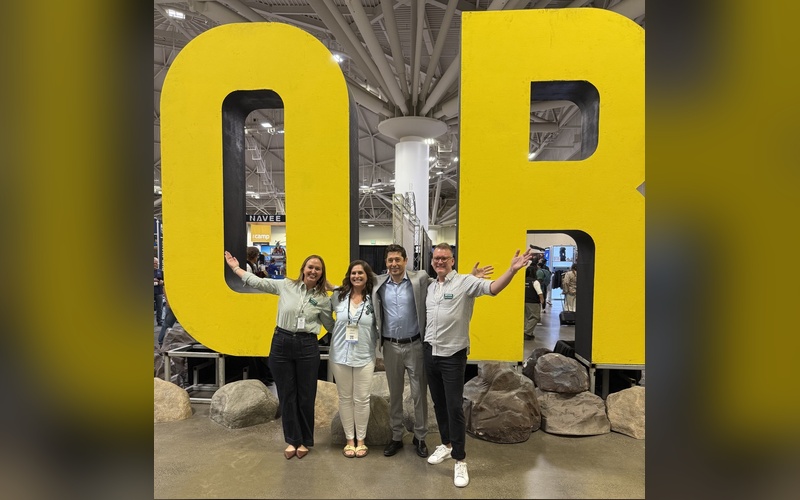
The larger Outdoor Retailer and Emerald team that worked on the event. Photo by Tim Aukshunas, courtesy of Outdoor Retailer.


