
Key Takeaways:
- Eoin Comerford argued emerging brands, not established players, drive the outdoor industry’s real innovation.
- He laid out what brands owe retailers to make a wholesale partnership actually work.
- He challenged retailers to commit real shelf space and buying dollars to new brands, not just lip service.
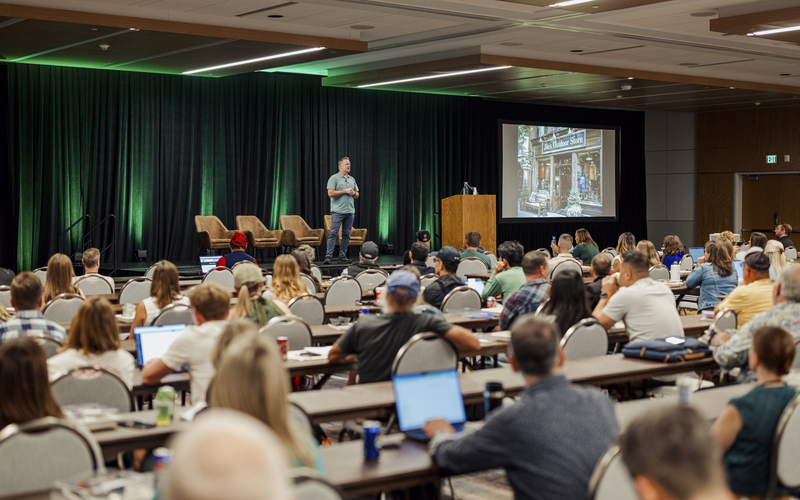
Eoin Comerford, founder of Outsize Consulting and former CEO of Moosejaw, opened his keynote address, titled “The Importance of New Brand Discovery,” at Outdoor Retailer’s inaugural Retailer Playbook Lab Keynote Luncheon with a parable about a fictional retailer named Joe, who built a beloved outdoor shop in 1996 on a loyal customer base and knowledgeable staff.
For years, business held steady even as the assortment barely changed. Then online shopping caught on, and Comerford said regulars started coming in to check their size on a pair of boots, only to order the same pair online for a discount instead of buying it at Joe’s. Last month, Comerford said using his fictional story, Joe’s announced on Facebook that it was closing after 30 years.
“Joe had a great customer base. Joe had a great location right downtown. Joe had great staff, great service,” Comerford said. “But what Joe was missing was newness, was constantly evolving his assortment to inspire and excite those outdoor enthusiasts in his community.”

The New Brands Nobody Saw Coming
Comerford built his case for newness on four brands, each one an oddball idea that became a category leader.
He remembered walking an Outdoor Retailer aisle in Salt Lake City around 2012, at the height of the industry’s minimalist, zero drop moment, and stumbling on a Hoka booth full of shoes that looked nothing like the rest of the floor.
“It looked like a clown shoe. It was insane,” he said. “I remember thinking, you’re gonna roll your ankle in that thing, and it must weigh a ton. And you picked it up, and it was like a cloud.”
Comerford told his team on the spot that they had to carry it, precisely because it was new, exciting and different. The people behind the design had come out of Salomon, he noted, but Salomon itself never built the shoe, because doing so would have meant walking away from a supply chain built around a completely different bet.
Hoka’s oversized cushioning now shows up on the wall of practically every run shop in the country.
Backpacking stoves, Comerford said, had barely changed since the Iron Age, aside from swapping an open fire for a gas burner, until Jetboil looked at how much fuel was escaping around the sides of a traditional stove and asked why backpackers were still hauling multiple canisters and heavy pots for no good reason.
The fuel-efficient system it introduced in 2001 is now standard gear on backpacking trips.
CamelBak, he said, came out of pure improvisation. Its founder, an EMT and competitive cyclist, filled an IV bag with water, stuffed it in a tube sock, and strapped it to the back of his jersey with the tube running over his shoulder during a 100-mile bike race because water bottles alone weren’t going to cut it.
That fix on the fly is the reason retailers now dedicate whole walls of the store to the hydration category he created.
And Gnara, formerly known as SheFly Apparel, came from founder Georgia Grace Edwards noticing a problem nobody else in the room had thought to solve.
Working as a guide in Alaska, Edwards found herself cutting back on water so she wouldn’t have to break away from the group and strip off layers just to use the bathroom in the field, to the point that she was becoming dehydrated. That was the problem her brand’s GoFly zipper was built to solve.
“Multiple times people have said, what, nobody came up with this before? It seems so obvious,” Comerford said. “Well, yeah, it’s obvious when a woman hiker is the one who’s thinking about it, as opposed to someone who isn’t.”
Why Newness Pays Off for Retailers
Carrying brands like these, Comerford said, tells a customer that a retailer is genuinely engaged with the industry rather than stocking whatever the store down the street has too.
With roughly 4,000 square feet to work with, he said, every product on the floor is a decision. Playing it safe with the obvious assortment is itself a decision, just not a very discerning one.
Comerford pointed to his own run leading the Moosejaw Outdoor Accelerator as an example of a program built on that instinct, admitting the motives were part principle and part self interest.
“By bringing new brands to our industry and to our customers, we looked cool,” he said.
Why Retailers Matter to Brands
The flip side, he told the brands in the room, is that good retailers are storytellers who can sell a product far better than a fleeting digital ad ever could, and wholesale gives an emerging brand the shipping scale, and eventually the margin efficiency, that direct-to-consumer alone can’t provide.
What Brands Owe Retailers: Sharing Margin, Not Giving It Away
Comerford described the retailer relationship as a partnership with real obligations on the brand side, starting with margin.
“You’re not giving margin. You’re sharing margin, so you can both succeed together,” he said.
He pointed out that retailers need that margin to cover payroll, rent, utilities, insurance and marketing, and asked how many retailers in the room were “swimming in margin” at 20% plus net income. He got the silence he expected.
Comerford also pushed brands to know their contribution margin by sales channel, something he said almost none of them can answer when he asks. A healthy wholesale channel, he added, is usually more profitable than DTC or Amazon once the real costs are counted.
Protecting That Margin
Protecting that margin once it’s offered matters just as much. Walking through the math on a hundred-dollar product at a 50% wholesale price, Comerford showed how a 20% off code on a brand’s own website can wipe out 40% of a retailer’s margin dollars the moment a customer decides to buy direct instead.
His advice: dangle free shipping or a gift with purchase instead of a blanket discount, and put a minimum advertised price policy in place, but only if it’s enforced.
“The only thing worse than no MAP policy is a poorly enforced MAP policy,” he said, “because the only person that’s going to get hurt is the good player that actually read it and abides by it.”
Comerford also warned against folding MAP terms into dealer agreements, calling that a fast way to invite antitrust trouble.
Operations, Education and Sell-Through
On operations, he asked for the basics: a clean spreadsheet with MSRP, SKU, UPC and wholesale price, delivered on the schedule a retailer has already built a season around. Comerford pushed brands to invest in staff education, whether through a rep, a tech group or a founder clinic.
“The sale is won or lost on the floor,” he said.
He also encouraged brands to promote their retail partners’ locations directly on their own e-commerce sites, pointing to how Black Diamond Equipment surfaces nearby dealer inventory on its product pages. Sending a customer to a local store, he said, tends to boost both wholesale and direct sales, since seeing a brand on a respected retailer’s shelf builds the trust that closes the online sale anyway.
What Retailers Owe Brands: Real Open-to-Buy Dollars
Comerford asked retailers to set aside a real slice of open-to-buy for new brands rather than photocopying last year’s order and padding it for growth.
“I can do that with an Excel formula. I don’t need you for that,” he said. “I need you to be in there figuring out what that 10 or 20 or 25% newness is going to be.”
Front of Store, Not the Back Rack
Where that product ends up once it arrives matters too. Too many retailers, he said, buy a new brand and bury it in the back of the store.
Comerford held up Gear Head Outfitters as the model instead, showing a photo of the retailer’s front window built entirely around one emerging brand’s full line and color story.
“New brands are the jewelry of the store,” he said. “You decorate the store with new brands.”
Committing Beyond a Single Season
He also asked retailers to explain their buying decisions, both to staff and to customers, rather than shrugging off a new brand as unremarkable. Comerford pushed retailers to commit to more than a single season, since a brand’s first season on the floor is often more about education than sales.
Comerford also criticized the practice of putting new product “on wheels,” where a rep guarantees a retailer can return anything unsold with no strings attached.
“I hate that with that passion,” he said. It gives a retailer zero reason to actually push the brand.
His preferred alternative is stock balancing, where a brand swaps a retailer’s slow color or size for a better seller at season’s end, keeping both sides invested without the empty guarantee.
A Shared Commitment
Comerford closed with a direct appeal to the room to keep pulling in the same direction.
“I’m excited about the future of our industries. I’m excited about the brands that are here today. I’m excited about the retailers that are here today. And if we work together, retailers and emerging brands, we can really create a vibrant and healthy outdoor industry.”


