
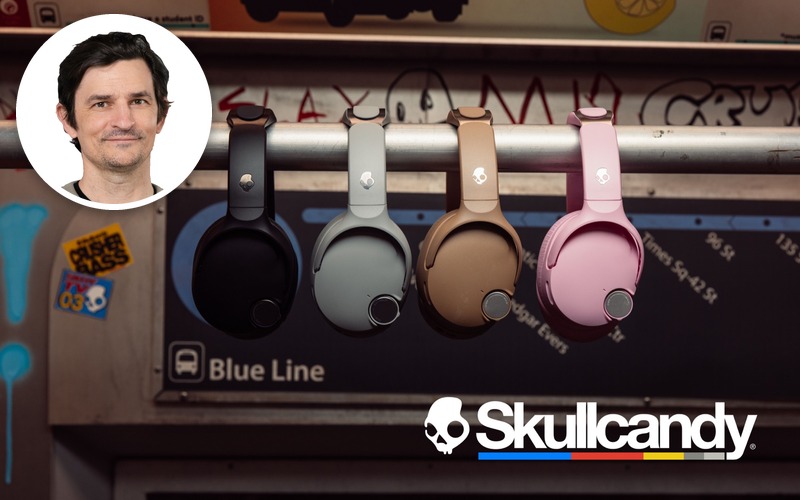
Key Takeaways:
- Bose Corporation announced this week that it has acquired Skullcandy from a fund managed by Mill Road Capital Management.
- Skullcandy CEO Brian Garofalow overhauled his leadership team and refocused the brand on young boardsports consumers.
- Garofalow says Bose brings engineering depth, global reach, and room to grow into new categories.
Just a few years ago, Skullcandy had disappeared from the conversation in boardsports. Nobody talked about it, and core retailers didn’t carry it or think about it. The brand had also lost its way with youth culture.
When Brian Garofalow became Skullcandy CEO in January 2023, the problems went beyond the brand.
“The company was in a pretty bad financial place,” Garofalow said. “The culture was in a pretty bad place. The balance sheet was in a pretty bad place. So, it really started with people.”

Less than four years later, Bose Corporation announced this week that it has acquired Skullcandy from a fund managed by Mill Road Capital Management, a Connecticut-based private investment firm. Financial terms were not disclosed. Skullcandy will remain a separate brand within Bose’s Premium Consumer Audio business and will continue to be based in Park City, Utah.
Garofalow, a skateboard and action sports industry veteran, spoke with SESO the day after the announcement about how his team rebuilt Skullcandy, how a technology partnership with Bose became an acquisition and what comes next.
Founder Rick Alden launched Skullcandy in Park City in 2003. The company went public on the Nasdaq in 2011, and Mill Road took it private in 2016 after a bidding war with mobile accessories maker Incipio. Skullcandy’s slide from the core market followed a push into big box stores.
From his earliest meetings with Mill Road, Garofalow said, the owners wanted to bring the brand back to its former glory, return the business to its peak, and modernize it.
Starting With People
Garofalow changed nine of his 10 direct reports in his first four months, bringing in several executives from the boardsports and active lifestyle industry.
Justin Regan joined to run marketing. Dave Appel, a longtime snowboard and footwear engineer with consumer electronics experience, came on to run product. Adam Ainbinder, the former Chief Financial Officer of TravisMathew when it sold to Callaway, became CFO.
Jeff Shine came on to lead U.S. sales. Evin Catlett joined from Salomon to run direct-to-consumer and Skullcandy’s Amazon business. Garofalow also brought a general counsel with him from Igloo.
Skullcandy promoted from within as well. Andrew Carter moved from a director role to Chief Operating Officer, and Christianna Donnell stepped up to head of HR.
Narrow the Scope to Broaden the Appeal
The team built its strategy around a phrase it still uses: Narrow the scope to broaden the appeal.
“Skullcandy had turned into we’re trying to be everything for everybody,” Garofalow said. “It was very vanilla, just went pretty low price point in broad distribution channels. Packaging looked like it could have been Sony or Samsung or something. It was really, really boring.”
The new strategy centered every decision on one consumer.
“We want to really, really have a myopic focus on the consumer, and for us, that was going to be the young, active consumer rooted in boardsports,” Garofalow said.
Appel and the product team retooled the entire product line on a short timeline, despite long lead times and silicone shortages. Regan refocused the brand, rebuilt relationships with athletes, brought in a new creative director and made Skullcandy bright, fun and irreverent again.
On the sales side, Skullcandy began making product specifically for specialty retailers.
“We started making some specialty product for specialty retailers,” Garofalow said. “Not a large business for us. Had very select partners, but it was really a marketing channel for us. This is who we are. What’s important to us. We want to make sure that consumer has something special, and those shops get something special.”
Rebuilding the Business
Behind the scenes, Carter retooled the supply chain, global logistics, and sales operations and negotiated with Skullcandy’s contract manufacturers, working closely with Ainbinder. The company put a lot of effort into direct-to-consumer, and a little margin expansion there freed up some capital to invest in the brand.
Then came tariffs.
“I think we re-forecasted the business eight times in 12 months because you had no idea what you were doing two weeks from now,” Garofalow said.
Garofalow add that Donnell’s work on company culture, along with employees seeing the company win, helped the team get through the tariff period. Skullcandy still grew in 2025.
“We paid pretty significant bonuses, and our retailers grew with us too, which is great,” he said.
Skullcandy also refinanced and paid off a large amount of debt. The company was very profitable and debt-free when it sold, Garofalow said.
From Marketer to CEO
I’ve known Garofalow for more than 20 years, going back to when I was a reporter at The Orange County Register and he was a PR guy in his early 20s at Sole Technology. I’ve always thought of him as a marketer with deep roots in skateboarding, and I told him I was surprised when he made the leap to CEO. Turns out, he had his own doubts.
Steven Scheyer, Garofalow’s board chair at Igloo, became board chair of Skullcandy and recruited him as CEO.
“I told him I don’t think I’m ready for it, and he said, ‘No, you are, and I’ll be there. I’ll be there with you, and I won’t let you fail,’” Garofalow said.
Scheyer had seen Garofalow’s work at Igloo, where he ran the direct-to-consumer business and got “a theoretical MBA” under then-CEO Dave Allen, who mentored him. Garofalow has owned P&Ls for direct-to-consumer businesses since about 2004 and holds a business degree.
How the Bose Deal Came Together
The Bose relationship began in December 2023, when Garofalow visited the company’s Framingham, Mass., offices at Bose’s request. Bose has 1,500 engineers but commercializes relatively few products, Garofalow said, and it had created the Sound by Bose program to put its technology in other brands’ products.
The first result was the Skullcandy Method 360 ANC with Sound by Bose. Bose’s own earbuds can cost $300, Garofalow said, while the Skullcandy earbuds sold for $99.
“There’s an interesting brand cachet that comes with that of just, oh, this product must be good and premium because it has the Bose name on it,” he said.
Skullcandy has since released two more Sound by Bose products, most recently a version of its flagship Crusher over-ear headphones that launched July 15. All three are performing very well and make up a meaningful part of the business, Garofalow said. The two companies’ engineering teams have worked together for a couple of years.
That commercial success led to a sale process. Skullcandy hired an investment bank and ran a competitive process for about 12 months, and Bose was the winning bidder.
“It’s literally the best possible outcome for the brand, for the business, most importantly, the people here,” Garofalow said.
Bose is privately held. Founder Amar Bose, an MIT student and later professor, left a significant part of the company to MIT in a trust, which controls the business, Garofalow said.
“They don’t talk a lot about what financial metrics are we going to be held to this minute,” Garofalow said.
The timing of the sale came down to Mill Road’s investment cycle. Skullcandy sat in Mill Road’s Fund II, which had held the company for 10 years, and it was time to realize a return for the fund’s limited partners, he said. Mill Road did much better than expected, Garofalow said, though he had hoped to hold the business one more year.
What Bose Brings
Garofalow said Skullcandy runs a lean product development organization and will gain access to some of the world’s leading audio engineers. Bose also makes products in categories Skullcandy doesn’t, including aviation headsets, car audio systems, and premium home audio, where it owns McIntosh and Sonus Faber. Garofalow said Skullcandy can learn from those businesses. He said he’s also excited about using Bose’s global footprint to expand distribution to more places around the world fairly quickly.
What Changes and What Doesn’t
Skullcandy will roll into Bose’s premium consumer business unit, which today includes the Bose products sold at Best Buy. The brand will remain independent and based in Park City.
“Everything the consumer sees, we’re only going to be a better version of ourselves,” Garofalow said.
Some back-office functions will be integrated.
“We don’t necessarily need to show up to the same account with two different sales forces on two different days and two different product lines, things like that,” Garofalow said.
For now, the focus is on delivering results during the holiday season before any integration work begins.
Garofalow said retailers should be optimistic about the acquisition.
“They’re going to get better products that will provide a better consumer experience, and we’re going to be able to do more of it bigger, faster, better,” he said.
What’s Next
Garofalow expects Skullcandy to grow faster under Bose.
“We’re going to be up about 20% this year, and we’re one of the fastest-growing brands in the category that has scale,” he said.
Skullcandy sells headphones, earbuds, some gaming products and a small Bluetooth speaker line. Garofalow said he thinks the company will enter new categories.
“Expect more of the things that we do well and some interesting new things that can bring more audio experiences to people,” he said.
After the sale closed, Garofalow had a moment with Chief Information Officer Mark Hopkins, a 17-year Skullcandy veteran and the only direct report who stayed in his role through the leadership overhaul.
“Man, I’ve been here for 17 years and seen it all. And yesterday was the single best day I’ve had here,” Hopkins told Garofalow.


