
For nearly 30 years, the X Games were the place where action sports athletes could become household names: snowboarders like Kelly Clark and Shaun White, skateboarders like Tony Hawk and Elissa Steamer, and BMX legend Dave Mirra.
But in 2022, private equity firm MSP Private Capital bought a majority stake in the business, effectively taking it over from ESPN, which retains a minority stake. After a few years to ramp up, the new owners rolled out a new approach in 2026 with the MoonPay X Games League (XGL). Instead of one X Games event each summer and one each winter, the league now holds three events in the XGL Summer Season and three in the XGL Winter Season.
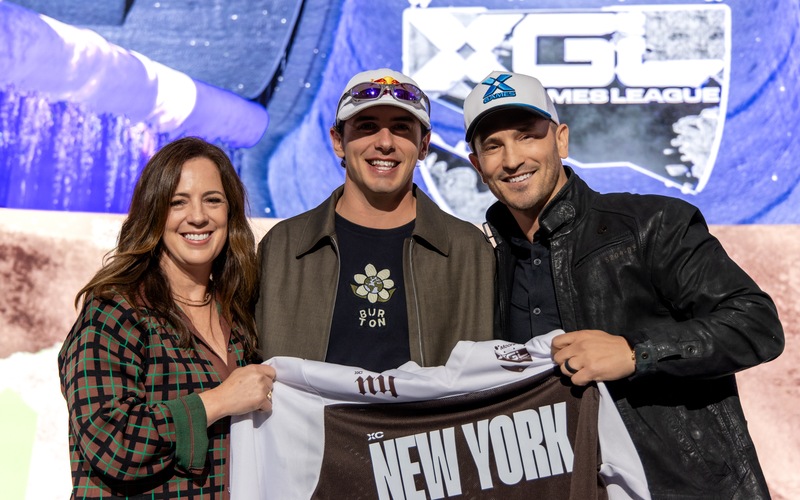
The new approach has turned an individualistic set of disciplines into a setup that resembles any other team sport. Club owners pick their athletes at seasonal drafts, general managers run the day-to-day businesses, and the points athletes earn during an event contribute not just to their own success, but to that of their teams.
For an organization with three decades of doing things one way, it was a risk. But as the X Games League heads into its Winter Season, its second season in the new format, management, athletes, and observers are cautiously optimistic.

Athletes Weigh in at the Winter Draft
“At first (I thought), ‘I’ve got to get my head around this,’ and it’s taken a minute,” snowboarder Torah Bright said.
Bright, who won multiple gold and silver medals in X Games Superpipe in the early aughts, attended the XGL Winter Season draft in Los Angeles in September. She echoed a number of her peers at the draft, who shared similar early doubts along with optimism.
“But maybe the X Games needed a bit of invigoration,” she said. “It’s new for our scene, but I think we can keep it and we can keep the creativity there.”
A Boon to Business?
Jeremy Bloom, who became X Games CEO in 2024, is counting on just that.
The biggest lesson so far, he said, “is that you can modernize the structure without changing what makes action sports special.
“Action sports are built around individuality. We never wanted to turn skateboarders, BMX riders, skiers and snowboarders into traditional team-sport athletes. The individual medal still matters. Personal style still matters. Progression still matters. What the league adds is consequence around those individual performances.”
For Bloom, who is himself a former professional skier and football player, viewership of the XGL Summer Season suggests that the line he and MSP are walking might just pay off.
“On the audience side, 18.3 million unique live TV viewers and 78.5% year-over-year growth are obviously strong,” he said. “But the statistic I keep coming back to is the 7.5 million people who watched more than one stop. That gets closer to what we are trying to build.”
That 78.5% reflects viewership growth from summer 2025 to summer 2026.
New Sponsorship Inventory
The X Games chief is also bullish on the commercial possibilities. The league format, he said, has opened up a myriad of new opportunities, especially in sponsorship.
“We have created entirely new categories of inventory. Team ownership didn’t exist before. Team-specific sponsorship didn’t exist. Season-long integrations are more valuable than selling against isolated weekends. We can build merchandise, hospitality, local activations, and year-round content around permanent teams rather than rebuilding everything event by event.”
A Paycheck Regardless of the Podium
Those opportunities have also changed the equation for athletes in significant ways.
For the first time, XGL team athletes earn a salary and have their travel expenses covered, regardless of whether they make the podium. Winning, of course, earns more, but the baseline costs are covered.
“For the people who are at the top, they don’t need the money,” said Sharalee “Haze” Hazen, General Manager of XC Los Angeles during the XGL Summer Season. “They’re doing it for the love of the game. And then there are people who are doing it for the love of the game who don’t get compensated for it.
“What I saw from summer is that this opportunity is opening up doors and exposure that you couldn’t pay for.”
Hazen pointed to the difference between XC Los Angeles skaters Tom Schaar, a 27-year-old who has competed in the X Games for more than a decade, and Mia Kretzer, a 12-year-old phenom from a single-parent household.
For an athlete like Kretzer, the league’s financial support was “life-changing,” Hazen said.
“That meant that both Mia and her mom’s travel were covered. They didn’t have to worry about pulling in money from places if they were to get an invite.”
Learning to Be a Team
The changes for athletes extend beyond the financial model. In an arena where individualism is everything, learning to be part of a group effort, not to mention leading one, was also new territory.
For XC Los Angeles, team bonding was key. During the Summer Season, the team took a group road trip to Sacramento, stopping to skate along the way.
“The coolest moment for me was when we were driving up to Big Sur, and Lauryn Hill came on,” Hazen said. “It was this multi-generational thing that everyone knew, and it brought everyone together.
“When I think of inclusiveness, it comes in many forms. And in that moment, it came through music, where everybody — didn’t matter what language you spoke, what age you were — we could all relate to music. And it was such a fun thing to see that this is so much bigger than sport.”
Bloom saw that shift from individual pursuits to team efforts play out during Summer Season competitions.
“Athletes adapt to having teammates remarkably quickly,” he said.
“(BMXer) Daniel Sandoval is a great example. In New Orleans, he competed injured and finished fourth in BMX Park. In the traditional X Games model, a fourth-place finish largely disappears from history. In the League, those points helped XC New York win the championship by just 10 points on the final run of the season and earn a $500,000 team championship purse.
“The biggest reward,” Bloom said, “was seeing the new structure create meaning where it never existed before.”
Lessons Learned from Summer
The XGL Winter Season gives the league a chance to apply what it learned from the inaugural Summer Season. Hazen, who returns this winter as General Manager of XC Park City, discussed some of what she learned about team management.
“As a GM, my job is to support my athletes, through thick and thin,” she said. “There were many hugs given and maybe a few tears shed after, if (an event) didn’t go the way that (the athlete wanted it to). It’s an interesting learning of, how do you react to the athlete with this acknowledgement, but also: take your time, I’m going to be over here, and then we’re going to move forward.
“It’s this intersection of, ‘I have a job to do, and I have 20 people that require my time in addition to parents and agents and coaches and ownership,’ it’s this whole spider web of connection. …Put simply: the energy matters.”
Room to Grow
On the business side, Bloom is taking lessons with him, too.
“There is still enormous room to grow,” he said. “We need much stronger team fandom, more local connection between clubs and their markets, better merchandise, deeper storytelling between competitions, and more international digital distribution.
“We also need to keep experimenting with the competition itself. Fans don’t owe us their attention, so every format, broadcast window, and piece of content has to earn it.”
What’s Next for Winter
The XGL Winter Season kicks off Jan. 29 at Buttermilk in Aspen, Colo., followed by an event in Calgary, Canada, Feb. 19-21, and the championship in Ruka, Finland, April 9-11. Forty skiers and snowboarders will compete across four clubs. For Bloom, the Winter Season is the league’s chance to further prove itself.
“The opportunity is to scale thoughtfully,” he said. “We want permanent teams with real identities, fans, and commercial value. We want owners investing in the growth of those clubs. We want stronger global media distribution, more host markets, more sponsorship opportunities, and a much deeper year-round relationship between athletes and fans.
“But the competitive idea remains very simple: make every X Games result matter beyond a single weekend.”
Even with all of the business changes, potential revenue streams, and new athlete affiliations, for some in the action sports community, the original X Games concept is the one that matters most.
“We all love snowboarding because we’re able to express ourselves as who we are, and our individual style,” Bright said. “And that’s not going anywhere.”


