
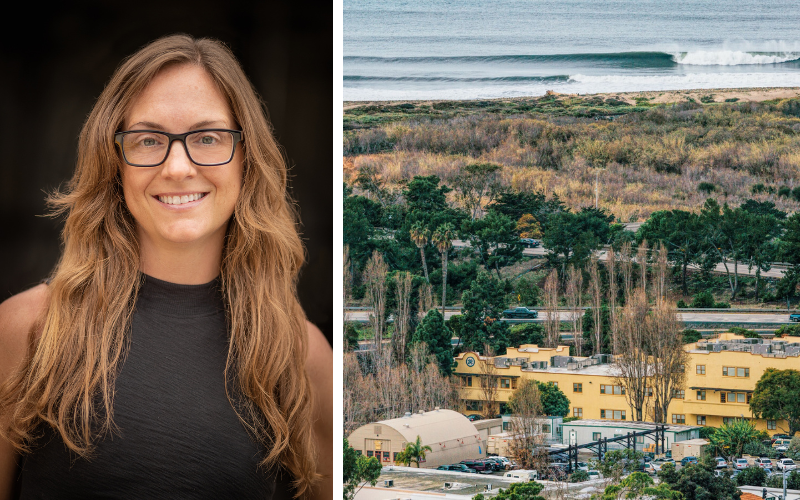
Even though she had already spent many years in the outdoor industry, Jenna Johnson said it felt like a homecoming the first time she visited the Patagonia campus in Ventura, Calif., in late 2010.
“It was this feeling of, ‘Oh, these are my people,’” Johnson said in an interview with SESO. “This is a group of people who are just as obsessed with building the best product as I am, and particularly for the climbing community.”
Getting to know the people at Patagonia, combined with her obsession with perfecting outdoor gear, marked the beginning of a new chapter in Johnson’s career. Over the next 10 years, Johnson climbed the ranks from product line manager (alpine) to eventually becoming the company president in 2020, where she leads Patagonia’s apparel and equipment business.
Johnson explained what values and skills helped drive her career, how Patagonia has changed in recent years and why the company’s recent Work in Progress report — which details what the company has achieved thus far in sustainability and circularity, as well as the massive amount of work still left to do — is something the whole company takes pride in.

A Foundation Built Outdoors
Johnson’s connection to the outdoors began long before she entered the professional world. Growing up abroad, with a father who worked for Caterpillar and a mother who instilled a passion for community service, she spent her formative years climbing trees and exploring forests. Going to high school in Indonesia, she said language barriers forced her to observe and understand people differently, honing her empathy and observational skills — qualities that would later prove invaluable.
Despite considering marine biology or nonprofit work, Johnson pursued a business degree, seeing it as a versatile tool. Her first outdoor industry job was at Feathered Friends, a climbing shop in Seattle, and she quickly fell in love with the close-knit community and customer relationships unique to specialty retail.
“You get to be really close to the customer,” Johnson said of specialty. “You get to help them in a tailored and personalized way to be able to find exactly what they need for the cool adventure that they’re going on.” The best part, she said, is when they come back and talk about how the adventure went. “That’s been advantageous to me, especially in the work at Patagonia, because relationships and the way that we think about the dynamic of being in business to serve our customers is at the foundation of everything that we do.”
Later, Johnson worked in brand management at Cascade Designs and in sales at Purdy Associates, which later became Waypoint Outdoor.
“But I knew that I was passionate about product and that I wanted to work with a brand that I believed in deeply,” Johnson said. “And so when Patagonia called me to ask me if I was interested in talking to them about a product line manager role for their Alpine line, it was like, the perfect moment.”
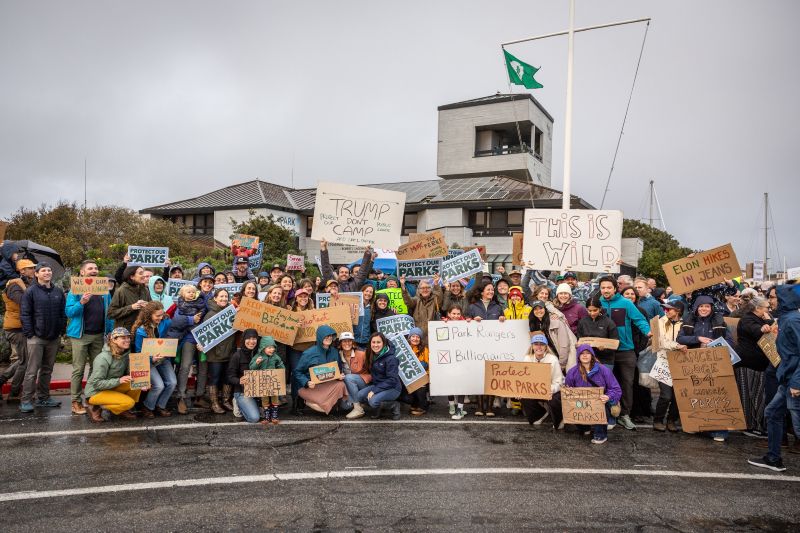
Patagonia employees at the Protect Our Parks rally at Channel Islands National Park’s Visitor Center in March 2025. Photo courtesy of Patagonia/Tim Davis.
Building Product at Patagonia
At Patagonia, Johnson was immediately immersed in building products for climbers, alpinists and general adventures in the mountains.
“Even though I hadn’t built product before I came into that role, I had spent a lot of time around gear, so I knew a lot about what people wanted and needed,” Johnson said. “I had this deep commitment to building the best product, because the climbing community is my community.”
She learned to extend that commitment to other areas she was less familiar with because product is the starting point for all relationship-building at Patagonia, she said.
“It’s how we build trust. It’s how we build loyalty. It’s how we show the value of quality,” she said. “It’s how we then build these relationships with people in order to be able to ask them to do things above and beyond, like join activism efforts with us, sign petitions with us, and be part of a community that’s having bigger and bigger impact.”
Having that product expertise has also been practically helpful as Johnson has taken on more work in digital and storytelling. Listening to the customer, the global sales team, and customer service reps all play a major role in the work she’s leading. And the process of learning to build product well can be applied to different aspects of the business, she said.
Johnson pursued an executive MBA while working at Cascade Designs, and she learned how to take in a lot of information, log it, and have a system to put it to use later. Because she was working while going to school, she could put what she was learning to the test in real-life situations — often discovering that she had to customize it for Patagonia, and in some cases, do the opposite.
“It was really valuable to be able to play with that in real time, and directly helped me when I came to Patagonia, where, basically we do everything the opposite way of everything I learned,” she said. “It was good that I had already begun the process of learn, undo, put it in a different way, because then I could show up at Patagonia and be ready to do that all day, every day.”
In September 2020, amidst the uncertainty of the global pandemic, Johnson was promoted to lead the apparel and equipment division. The company was able to bring together designers, line managers and other employees to field test products outside, but much of the work was done remotely — shipping fabric to different designers and doing fit sessions with models over video calls.
“We couldn’t travel to the factories to make sure that production was flowing and that everything was great,” Johnson said. “We had to adapt to make sure that our processes, our questions, were sharp and on point and got to the most important pieces, so that at the end of the day, even though we couldn’t come together and be hands on, we could build really high quality product that we could continue to give to our customers.”
Patagonia’s processes also streamlined during this time, and the company had to stop redesigning and producing new products. Because of the lead time on new and redesigned gear, that meant even when the pandemic ended, Patagonia products initially felt less robust. Now, the company has returned to its usual cadence of new and redesigned products, Johnson said, while at the same time reducing duplicates and shrinking the line by approximately 10%, which has improved productivity and made it easier for customers to shop.
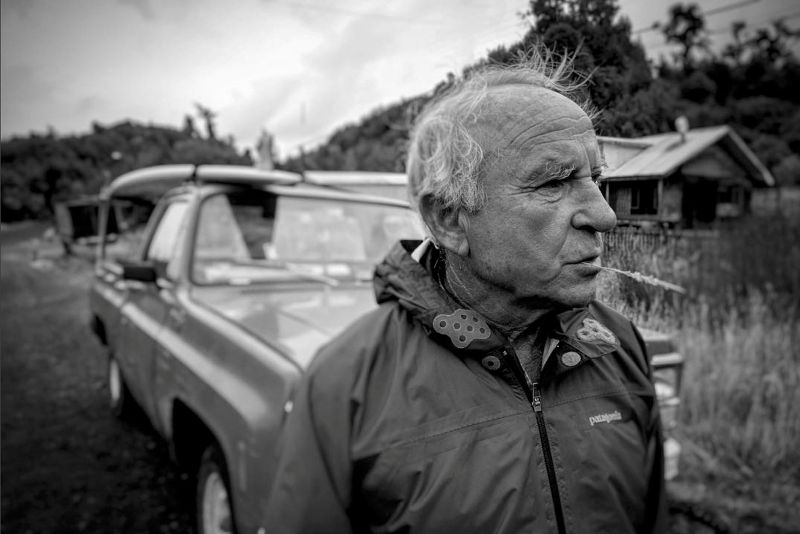
Patagonia founder Yvon Chouinard. Photo courtesy of Patagonia/Jimmy Chin.
Values-Driven and Transparent
The other major change at Patagonia since the pandemic is its ownership structure, where the business now gives away all of its dividends to the Holdfast Collective, which passes them on to environmental organizations that are doing important work.
The company has always been outspoken and direct about its commitment to protecting public lands (Johnson implores outdoor brands to join Brands for Public Lands, for example), the environment and developing more sustainable practices. The most recent example is Patagonia’s Work in Progress Report, a comprehensive document detailing Patagonia’s social and environmental impact. The report, written with a pragmatic and honest tone, lays bare the company’s successes and, just as importantly, its shortcomings.
The report discloses everything from greenhouse gas emissions — which increased by 2% in FY25 due to shifts in product assortment — to the fact that only 39% of factories in its supply chain pay a living wage, significantly missing the 2025 goal of 100%. It’s an admission that Patagonia, despite its mission to “save our home planet,” is still a part of the problem. As CEO Ryan Gellert states in the report, “If we don’t clean up our mess, we’ll be history.”
Johnson said she’s proud of the report’s holistic nature and the collective effort it represents. For her, it’s an authentic reflection of the company’s values and a tool to hold itself accountable. It also serves as a call to action, highlighting areas for improvement, such as developing end-of-life solutions for products to achieve true circularity.
“This is heavy. This is big work. It’s really hard,” Johnson said. “There are no silver bullet solutions. Being pragmatic in that way allows us to unpack and find better solutions than we could if everything was glossed over in a marketing campaign.”
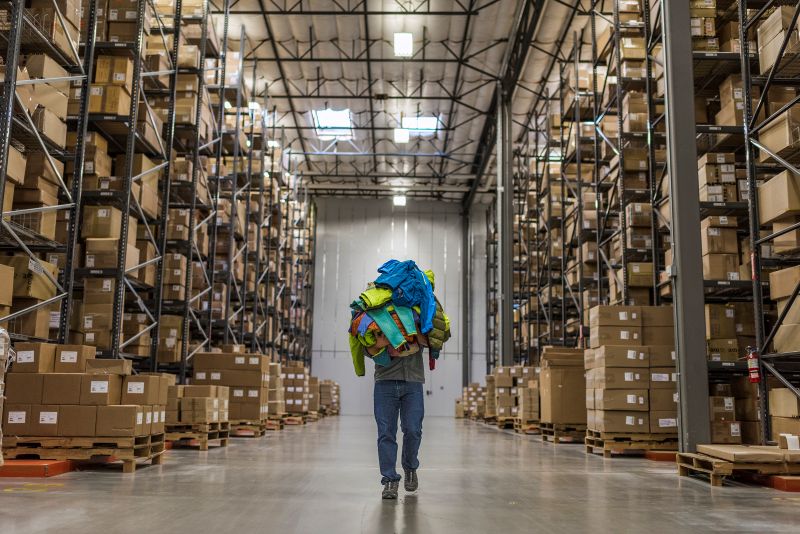
Not all gear sent to Patagonia for repairs or recycling can get a second life. The ones that are too dirty or destroyed are piled up in the company’s distribution center in Reno, Nevada. Photo courtesy of Patagonia/Ken Etzel.
Advice for Growing Your Career
For those in the outdoor industry who are curious about working at Patagonia or following a similar path to Johnson, she emphasizes the need for a problem-solving mindset and creative, outside-the-box thinking. She values employees who aren’t afraid to challenge the status quo and who bring innovative solutions to the table. It’s this combination of practical skill and visionary thinking that allows individuals to not only succeed but also drive the company forward, she said.
That said, Johnson never had big aspirations to become president at Patagonia. And while she sees value in having career goals, she’s been motivated by the projects and people she’s worked with along the way.
“For me, it’s how do I connect with my values so that I’m bringing my best self and I’m passionate about the work? Because I know that I’m better when I’m passionate about the work that I’m doing, and I can do that surrounded by a lot of amazing, great people,” she said. “That’s really been my drive. That’s what’s motivated me.”
Kate Robertson can be reached at kate@shop-eat-surf-outdoor.com.


