
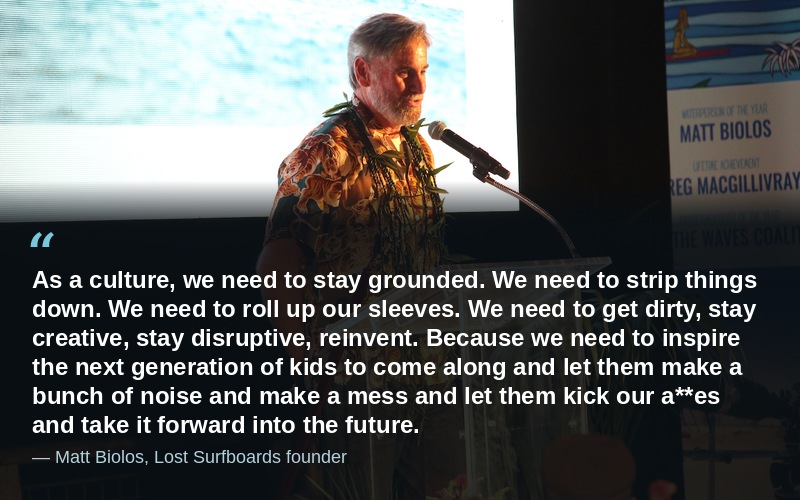
Matt Biolos, founder of Lost Surfboards and known industry-wide as Mayhem and for his rebellious, contrarian outlook, accepted SIMA’s Waterman of the Year award on Friday night at the 2026 Waterman’s Ball, held at The Ranch at Laguna Beach. Biolos was introduced by shaper Rusty Preisendorfer, who described how they met and how they eventually became friends.
“A lot of people think he’s a grump,” Preisendorfer said to laughter. “He’s a pussycat.”
Below is Biolos’s acceptance speech in full, lightly edited for clarity.
A Surprise Introduction
“Thank you very much, Rusty. It makes it more special to have this happen. This is a surprise, I didn’t know Rusty was going to be here, to get it presented to me by one of my idols. It’s pretty heavy duty.

“It’s been a long night, so I don’t want to go on too much. First off, of course, I want to thank SIMA and the board. Seems like this year they kind of picked the bad guy.
“I want to thank my wife, who’s here, and all four of my kids. My wife of 25 years. There’s a special young man here, Kolohe Andino. He’s probably the most influential surfer. A lot of special people here.
“I was pretty nervous when Paul (SIMA President Paul Naude) called me and said the board had nominated me, or agreed on me, to get this honor. I’ve never thought of myself as a waterman. I mean, I’m a surfer like most all of us here, but I’m more of a factory man. I get up in the morning, I get hopped up on coffee, and I walk around a surfboard factory. Been doing it for 40 years. Thirty-nine years, really, but it feels like more. That’s what I do.
“I didn’t make my name in the water like so many of the people who’ve gotten this honor. I was always the kind of guy who sat in the background and worked really hard trying to be precise and creative and effective for the real watermen, and waterwomen, the athletes up front. I kind of prefer the dark, dusty hallways to being out in the limelight. I guess I don’t get to do that right now, kind of up in lights.
Growing Up in Southern California
“I’m a product of Southern California culture. I grew up in the eighties. It was an amazing time, (for) a lot of us here, just the clash of new wave and punk rock, and KROQ blasting on the car radio, and the magazines, and the life-size, larger-than-life surf heroes plastered in those pages with bright colors and impactful surfboards with so much garish design. They’re all dressed in aggressive, forward, creative clothing, and there’s girls everywhere and parties. It was just an amazing time when I was growing up. It really influenced me.
“I went to Huntington Beach for the first OP Pro. I was just turning 13, 1982. I was there with my best buddy Paul and about 100,000 of our close friends. I saw Cheyne Horan do a 360 in the little barrel into the shore break to win it, and I was just like, this is it. I want to be a part of this. This is what I want my life to be.
“I knew darn well right at the start I wasn’t an athlete. That wasn’t my way in. I just figured I’d have to find my own way into this life. Growing up as a kid, I was always a little more interested, honestly, in the design and the marketing and the colors, the surfboards, the writing, and the ads that were made by these incredible creative brands at the time. More so than the surfing, in some way. Just the whole art of it, the whole creative process. I didn’t call it those fancy names then, but I was just enamored by that. Obviously, surfing’s fun, but it was just part of it. The California lifestyle, surfing and partying and running around going crazy with your friends.
“But foremost, as a young man, it was 1980s punk rock records, albums, punk shows, those flyers they used to make to get you to go to the shows at night. That really influenced me. Then clash that together with the new wave colors and Echo Beach and all these bold, brash surfers of the time. It was just a great mix, and it set me off on what I wanted to do.
Sneaking In the Back Door
“I just knew I couldn’t go in the front way, so I had to sneak in the back way. I made a surfboard, and it was a horrible shape, a horrible color that I put on it. I walked into Herbie Fletcher’s surf shop and factory down in San Clemente. I was 17 years old and I never left. I got my way into the surfboard world through the back door, and I worked with underground, unknown craftsmen. Guys who were, like Greg (filmmaker Greg MacGillivray) said, better than him, more talented than him. You surround yourself with talent and creativity, even if it’s unknown guys walking these dusty halls.
“At that time, not only the unknown craftsmen, but these incredible legends, Herbie would bring in all these icons. Mike Hynson and Reno and all these crazy, famous guys who built this world we’re in. At the same time, it was just a melting pot of hot shots, Christian and Nathan and Matt Archbold and Dino Andino, Kolohe’s dad, and all the hot, modern, cutting-edge guys walking in and out of the factory. I got to soak it all in and be a part of it and do whatever I could to make everyone happy, while at the same time staying up really late at night starting to do my own thing.
“I slowly started learning how to do everything, shape and paint, glass, all that. I started thinking about ideas and branding and my logos, how to make it into something I could make a living off of instead of just eating Top Ramen and 7-Eleven hot dogs.
Meeting Mike Reola
“But I didn’t do it alone. Not long after that, Mike Reola showed up. He got a job working in the front of our factory, in the surf shop, Herbie Fletcher’s shop. Mike said, what you’re doing is rad, you’re doing a good job, it’s chaotic, crazy, destructive, this little brand you’re trying to build, but it can be a lot more than what you think it is. And I can help you do that. This was the late ’80s, early ’90s.
“So, we started working on it together. He had a vision before I did. He really convinced me it could be more than just another guy making surfboards on the corner for local kids, that we could take it beyond a local, punk rock, underground, snotty little thing into something that could be known around the world. So, it was like, okay, let’s do it.
“The two of us started building it from nothing. We had no money. We had no team. We had no experience. Most of the time we didn’t even have a car between the two of us. We rented this little ramshackle house, this tiny little shotgun shack, as you’d call it, and proceeded to try and build a business. We knew we didn’t have much going for us, so we knew we had to make some noise. We had to cause some mayhem.
“The kitchen was our front office. My bedroom was the art department. Mike’s bedroom was admin. We had a homeless man as a butler, he lived out back in the kitchen. We put a skateboard ramp in the back, and underneath it was our warehouse. I could ride my skateboard to the factory, to the Herbie shop, shape boards all day, come home, and Mike would have these social experiments going on in the living room. Hot shot teenage surfers, and the girls they brought over, and a video camera, and whatever other derelicts wanted to show up. We just made a little magic happen. People wanted to be a part of it, and it slowly grew from there.
“That little living room was where all the magic went down, and it just kind of got more and more known, and things elevated, and we elevated. We just kept going.
From Getting Kicked Out to Getting an Award
“Fast forward 35 years later, and we’re no longer the drunk, raging, 21-year-old kids with a little booth at Surf Expo getting kicked out for being too crazy. Now we’re the gray-beard guys up on the stage getting awards from SIMA and Rusty Preisendorfer.
“But we have to be careful. We can’t rest. I don’t believe in resting. I’d say sleep when you’re dead. But you can’t get lazy. Thirty-nine years later, still striving to stay creative. Creativity is king. Remain disruptive, keep reinventing yourself, keep pushing forward.
“We were like the anti-pro-surfing brand, and somehow it just kept working and working and working. We became like the definitive pro surfing brand. I’ve been fortunate to work with so many of the best surfers over the last 25, 30 years, just watching it evolve. And like I said at the start, staying in the background for the most part, unless I get thrust up on a stage.
A Challenge to Stay Disruptive
“I think we all, not everyone here is in our little industry anymore, but I think we all have to stay on our toes. We have to keep that spirit. We have to stay edgy and creative and aggressive.
“There’s a short song by Jack White of the White Stripes that I really like, called ‘Little Room.’ The idea of it is that you’re working in your little room, working on something good, and if it’s really good, you’re going to end up needing a bigger room. But when you get that bigger room, you might just sit there not knowing what to do. You might have to think about how you got started, sitting in your little room.
“The point is, as a brand and as an industry, you don’t want to let things get away from you. You want to keep them tight. You want to hold your cards close. As a culture, we need to stay grounded. We need to strip things down. We need to roll up our sleeves. We need to get dirty, stay creative, stay disruptive, reinvent. Because we need to inspire the next generation of kids to come along and let them make a bunch of noise and make a mess and let them kick our asses and take it forward into the future.
“Thank you.”


