
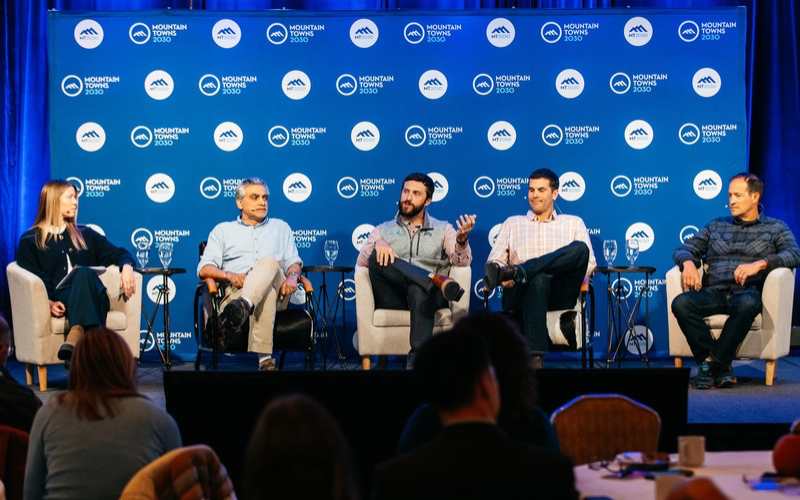
Following the most challenging winter for mountain towns in 50 years, more than 500 local leaders, municipal sustainability experts, ski resort executives, nonprofits, and business leaders from over 60 mountain communities and 50 ski resorts gathered in Sun Valley, Idaho, for the sixth annual Mountain Towns 2030 Climate Summit. The organization announced a suite of new resources designed to accelerate climate solutions, strengthen community resilience, and help mountain towns adapt to a rapidly changing future.
The annual two-day Summit brings local stakeholders together to hear from some of the world’s leading climate voices and collaborate in more than 30 peer-led working sessions. Together, they share solutions, build partnerships, and develop actionable tools to help every mountain community accelerate climate progress.
During the Summit, Mountain Towns 2030 unveiled the MT2030 Solutions Framework, a new digital tool developed by graduate students from the University of Colorado Boulder’s Masters of the Environment Program. The Framework connects mountain communities with high-impact climate solutions germane to their objectives, while also combining best-practice case studies, practical data, and insights from communities across the MT2030 network to accelerate and scale implementation.
“The hardest season in decades didn’t stall the mounting momentum that mountain towns are building together – it proved it,” said Chris Steinkamp, Executive Director of Mountain Towns 2030. “We have the solutions. The climate benefit is real, but it’s no longer the main reason to act. It’s the reward. So now it’s simply about speed: taking what’s working, sharing the knowledge, and scaling it across our network.”

In addition to the Solutions Framework, MT2030 announced a new Trusted Partners program to support its Anchor Communities with up to 20 hours of pro-bono work from top sustainability companies including Lotus Engineering & Sustainability, Schneider Electric, Group14, McKinstry, and SE Group.
“Over the last few months, we’ve been organizing a group of leading companies and experts who have committed to provide pro bono technical assistance to our Anchor Communities throughout the year,” said Tom Herrod of Lotus Engineering & Sustainability, an MT2030 board member. “It helps communities tap into specialized knowledge, tools and guidance for their local climate and resilience needs. Maybe it helps a town get a project started, or get it over the finish line.”
Over 50 elected officials across the towns in attendance met in a closed-door session to address challenges and discuss ways to collaborate locally and regionally. MT2030 also invited communities and resorts to join an amicus brief opposing the EPA’s proposed rescission of the Endangerment Finding, the scientific foundation for regulating climate pollution under the Clean Air Act.
The MT2030 Summit covered a wide variety of topics, from wildfire resilience and thermal energy networks to zero-waste policy and sustainable transportation, and also featured Boise Mayor Lauren McLean, Torus CEO and Founder Nate Walkingshaw, and Executive Director of Environmental Voter Project Nathaniel Stinnett.
Speakers highlighted progress and practical climate solutions emerging from member communities, demonstrating how mountain towns are moving forward despite challenging weather conditions and federal headwinds. The Summit also showcased emerging technologies, like geothermal and flywheel batteries, that can accelerate progress toward climate goals while helping communities build resilience to a changing climate.
Mayor McLean showcased Boise’s geothermal network – the largest in the nation – and her efforts to make Boise healthier and more affordable for residents, including a new geothermal project that is projected to save multi-family homeowners $1,000 a year on their electric bills.
“This is all about people, and making sure our residents are safe, healthy, have a home they can afford, and that their kids and grandkids can enjoy it in the future,” she said.
Torus’ Nate Walkingshaw showcased how the company’s innovative flywheel battery technology has helped a southern Utah town cut residents’ electricity costs and reduce emissions by roughly 80%, without any sacrifice in quality or service.
“We designed Torus to be a micro utility that small rural communities could take on themselves, so that all the clean power that gets built in a community stays there and is used by the whole community,” Walkingshaw said. Torus also announced a strategic partnership with Rocky Mountain Power for 70 megawatts of demand response, expanding to 500 megawatts, to help stabilize the regional grid.
The Summit also showcased the Mountain Collaborative for Climate Action, a coalition of the four largest ski resort companies, which was formed as a result of the first MT2030 Summit in 2019. The group representing POWDR, Boyne Resorts, Vail Resorts, and Alterra Mountain Company, signed a collective Climate Commitment Charter in 2021 and continues to meet monthly to share challenges and solutions towards those goals, built around the idea that competitors could collaborate around climate action.
Wildfire was a major thread of the Summit, from a Wildfire Resilience Solutions Lab to a main stage panel moderated by Tahoe Fund CEO Amy Berry with American Forests President and CEO Hilary Franz, Blue Forest CEO Zach Knight and Frontline Wildfire Defense founder and CEO Harry Statter.
“One thing that really stands out about wildfire is that it’s actually the only preventable catastrophe,” Berry said. “We know that there are mitigations that we can do to reduce the threat of catastrophic wildfire. And that starts from what we do in our public lands and reducing the amount of fuel that’s in our forests, what we do in our communities, what we do at the home level in terms of hardening our homes.” Berry noted that the Lake Tahoe Basin alone holds roughly 24 million trees, compared with a historical density of about two million.
The MT2030 Summit culminated in awards highlighting the best local solutions across its network:
- Community of the Year: Town of Eagle, Colorado, for setting a clear path to net-zero emissions by 2030, with its municipal operations decarbonized by 2028, and for pairing infrastructure upgrades with community programs and innovation funds
- Project of the Year: Northern Great Plains Regenerative Grazing Project (Native, Bridger Bowl and Western Sustainability Exchange), for the first verified grassland soil carbon removal program in the U.S., which funds 18 Montana ranching families to restore about 300,000 acres of native prairie
- Local Climate Leader of the Year: Hannah Berman, Aspen One and Mayor Pro Tem, Town of Basalt, for driving Aspen One’s all-electric new construction, pushing for all-electric building codes in Basalt and bringing young people into climate advocacy across the Roaring Fork Valley
- Torus Clean Energy Project of the Year: Carbondale Aquatics Center (Town of Carbondale, with CORE), one of Colorado’s first all-electric aquatic facilities, heated by air-to-water heat pumps with a 48-kilowatt solar array overhead
MT2030 announced that the City of Aspen, Colorado will host the 2027 MT2030 Climate Summit, next October. For more information and registration, visit mt2030.org.
About Mountain Towns 2030
Mountain Towns 2030 (MT2030) brings mountain communities together to scale climate solutions faster. MT2030 connects local governments, ski resorts, businesses and community leaders with proven solutions, valuable resources and peer networks to accelerate climate solutions, strengthen community resilience, and help mountain towns adapt to a rapidly changing future.
Since launching in 2019, MT2030 has built a national network of mountain communities, ski resorts and local organizations working to address climate change while strengthening the communities and economies that depend on the mountain environment.


