
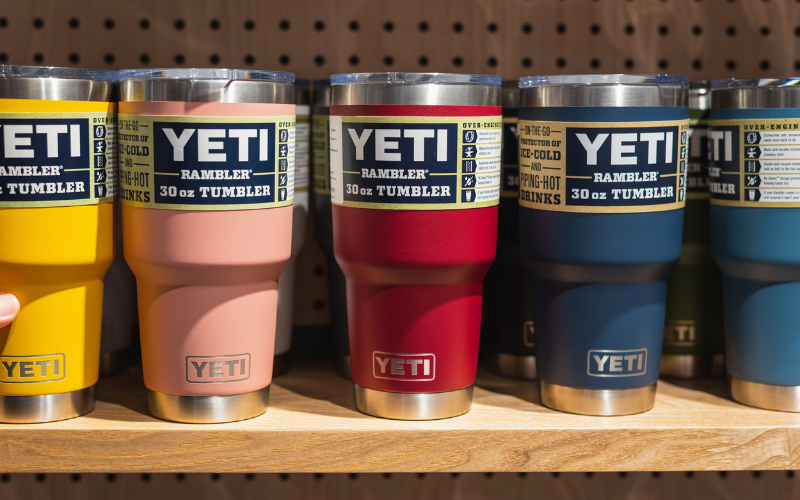
YETI CEO Matt Reintjes and CFO Mike McMullen discussed how the company is approaching product innovation, segmenting its marketing efforts and targeting international expansion at the Morgan Stanley Global Consumer and Retail Conference this week in New York.
YETI is maintaining its focus on expanding its presence in categories such as drinkware and bags.
“The strategy we’ve talked about over the last few years is the continued diversification of our drinkware portfolio, the increasing number of use cases for why a consumer, domestically and globally, would want to think about YETI as their drinkware, food storage, food transportation, food prep, and ultimately cooking solution,” Reintjes said.
The recent acquisition of a shaker bottle business is cited as one example, aimed at entering the market for protein shakes and supplements, Reintjes said.

Reintjes said he’s even more excited about bags, which YETI segments into three categories: every day, travel and activity-specific (pursuit) purposes. YETI acquired bag brand Mystery Ranch in 2024.
“All those create growth platforms for us to continue to drive underneath this brand that we’ve built,” Reintjes said.
“There are markets around the world (where) we may be more known, ultimately, as a bags/drinkware brand rather than a hard cooler/soft cooler brand,” he said. “And I think that as long as it all stays consistent under the brand umbrella, I’m perfectly fine with that. I think it’s great.”
Community Engagement, Marketing and AI
In addition to diversifying product, YETI’s marketing strategy blends traditional product marketing with community and partnership initiatives.
“We support the things that our consumers care about,” Reintjes said. “And if you look at the way we built this brand across communities, these enthusiast, active communities… we show up for our consumers in the places where they care, and then the product fits in those environments.”
Word of mouth has also been a huge boost for YETI, he said.
“The one asset that’s been true for YETI since the very beginning is peer-to-peer referral is the highest form of discovery,” he said.
Recently YETI announced a new partnership with the National Women’s Soccer League, and the company has licensing partnerships across a lot of other major sports and collegiate-level athletics.
Recent advertising efforts have been scheduled around sports events.
“This is what we believe is the start of a sequence of building top-level, keeping YETI top of mind out there in front of the consumer,” Reintjes said. “The one thing people watch real time and live is sports, and so the campaign the last few weeks has been really targeted around major sporting events.”
YETI is also integrating new technologies, including artificial intelligence, across several parts of the business such as customer service, product development, product design and marketing.
“We’ve now added an AI assistant on yeti.com that helps with the shopping experience, the discovery, and we’re starting to gather the data on the impact that has on the consumer journey,” Reintjes said.
International Expansion and Tariffs
International growth is another area of focus. Approximately 20% of YETI’s sales now come from outside the U.S., with leadership expressing an interest in increasing that share. YETI will take a market-specific approach, with flexibility to adapt to local retail conditions and consumer habits.
“One of the benefits of launching first in Europe in late 2019 was the quick disruption of wholesale there, and so we had the opportunity to focus on building a strong ecommerce business,” Reintjes said. “Over the last couple years, we’ve been filling in the wholesale piece, but the ecomm business gives us an indication of where demand is, where the brand connection is.”
Product portfolios are also fine-tuned by region, which extends to product sizing and cultural preferences, particularly as YETI expands its wholesale presence in continental Europe and following its recent launch in Japan. Product design and marketing are adjusted for “the global coffee, global tea-type markets versus, you know, cup full of ice, large-format type thing,” Reintjes said.
Reintjes said it’s tricky to comment on how consumers are doing with the current economic uncertainty.
“I would say our focus is what we know works when you drive brand desirability, when you innovate in our categories, which are premium, but they’re approachable price points — you can continue to drive consumer engagement,” Reintjes said.
It’s been a challenging year from the perspective of tariffs, Reintjes said, and the company has worked to accelerate its plan to diversify its supply chain to mitigate those impacts.
“The majority of our tariff costs this year were on goods sourced in China and imported into the U.S.,” he said. “The volume that we’ll purchase will go down in 2026 as we’ve largely transitioned. Number two, the rate recently went down from 30% to 20%. At the same time, we’ve got the tariffs that we pay rest of world where we only had a partial year this year, and we’ll have to annualize that next year.”
YETI has demonstrated it can drive costs down, and the company increased some prices earlier this year before new tariffs were announced.
“But we will continue to look at that as a lever as well,” he said, adding that more details on gross margins will come at the company’s next earnings call in February and at its Investor Day later in the first half of the year.
Kate Robertson can be reached at kate@shop-eat-surf-outdoor.com.


