
Oliver Reichert, CEO of Birkenstock, shared details about the German company’s significant wholesale growth and how the company plans to continue its mission to get every human on the planet in a pair of its shoes on its Q1 earnings call Thursday.
In the first quarter ended Dec. 31, Birkenstock reported double-digit growth across all regions and channels. And despite currency headwinds and tariff pressures, Birkenstock exceeded its growth targets.
Earnings Results by the Numbers
Birkenstock reported revenue of €402 million ($477 million) for the first quarter, an increase of 11.1% on a reported basis. When adjusted for currency fluctuations, revenue grew 18%. This figure exceeded the company’s full-year guidance range of 13% to 15%.
Net profit for the quarter reached €51 million ($60 million), an increase of 151% compared to the prior year. Earnings per share (EPS) rose to €0.27.

Adjusted EBITDA increased by 4% to €106 million. However, the adjusted EBITDA margin contracted by 170 basis points to 26.5%. Management attributed this margin compression to external factors such as tariffs and exchange rates rather than operational issues.
In-Person Shopping
Both DTC and B2B (wholesale) channel sales increased in the quarter, but B2B sales outpaced DTC, increasing 24% in constant currency, while DTC revenue grew 12%.
Reichert attributed this to consumer behavior rather than a lack of digital demand.
“B2B growth is driven by the trend towards in-person shopping,” Reichert said.
The company is responding to this preference by investing in its own physical retail footprint. Birkenstock opened nine new owned stores during the quarter, bringing the global total to 106. Reichert confirmed the company remains on track to open 40 new stores within the fiscal year. These locations allow the brand to control inventory and showcase new styles that wholesale partners may not carry.
Geographic Expansion and the APAC Opportunity
Growth occurred across all reported geographies, with the Asia-Pacific (APAC) region leading the expansion.
- Americas: Revenue grew 14% in constant currency.
- Europe, Middle East, and Africa (EMEA): Revenue increased 17% in constant currency.
- Asia-Pacific (APAC): Revenue increased 37% in constant currency.
Reichert emphasized the strategic importance of the Asian market for future growth.
“We will steer APAC growth at double the pace of the other segments over the next three years,” he said. This trajectory implies the company intends to double its APAC revenue by 2028.
In the Americas, the company’s largest segment, market penetration remains at approximately 5%. Management indicated this low saturation level suggests room for continued expansion, despite the maturity of the market relative to Asia.
Closed-Toe Growth
Birkenstock continues to diversify its product mix to mitigate seasonality. The first quarter, typically a period for cooler weather in northern hemisphere markets, saw closed-toe silhouettes account for nearly 60% of revenue.
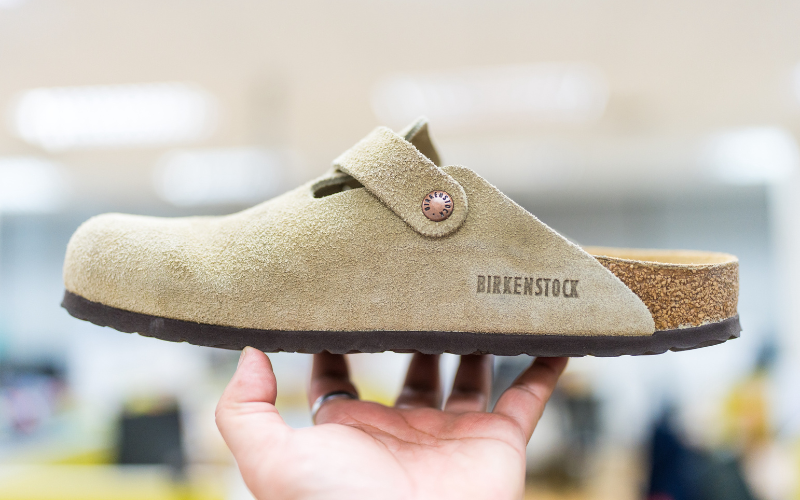
The “Boston” clog, celebrating its 50th anniversary, drove sales volume alongside newer styles.
“We saw very strong sales in clogs, including the Boston,” Reichert noted. He also highlighted the performance of other closed-toe models such as the “Naples” and the “Lutry.”
This shift supports the company’s goal to position itself as a four-season brand, reducing the revenue volatility historically associated with summer sandal sales.
Headwinds: Tariffs and Currency
Despite the revenue growth, the company faces external financial pressures. The gross profit margin decreased to 55.7%, down 460 basis points from the prior year.
Birkentstock executives identified three primary drivers for this decline:
- Currency Translation: The strength of the Euro against the US dollar and Asian currencies.
- Tariffs: Incremental U.S. tariffs impacted margins by 130 basis points.
- Channel Mix: A shift toward B2B sales, which carry lower gross margins than DTC sales.
CFO Ivica Krolo warned that these pressures would persist.
“We will see an especially strong headwind in the second quarter,” Krolo said, projecting a potential 700 basis point headwind to revenue growth in Q2 due to exchange rates.
Inventory and Supply Chain
Inventory levels remain a focal point as the company manages its growth. The inventory-to-sales ratio stood at 39% for the quarter, flat compared to the previous year.
To support future demand, Birkenstock invested approximately €38 million ($45 million) in capital expenditures during the quarter. These funds went toward expanding production capacity at facilities in Arouca, Portugal, and Görlitz and Pasewalk in Germany. Reichert reiterated that the company operates with a “scarcity by design” philosophy, keeping supply slightly below demand to maintain pricing power.
“We are capacity constrained by design,” Reichert explained. “We will steer our business by geography, channel and product to maximize profit per pair and maintain strong brand equity.”
Outlook
Birkenstock maintained its guidance for fiscal year 2026. The company projects revenue growth of 13% to 15% in constant currency and an adjusted EBITDA margin of roughly 30%.
The company remains confident in the long-term trajectory, citing the universal appeal of the product.
“The ultimate truth for the brand health is sell-through at full price, and that remains very high, over 90%,” Reichert said.


