
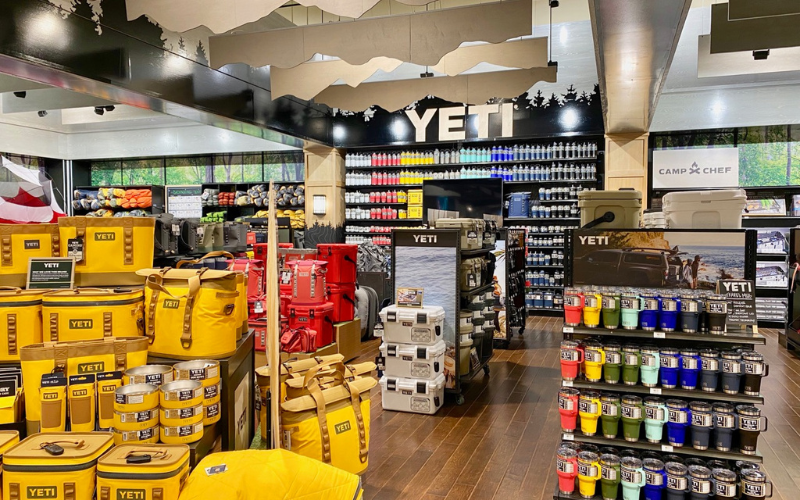
Key Takeaways:
- Yeti’s global wholesale channel grew 19% in Q1 2026, its best quarterly wholesale performance in more than three years.
- Tariffs shaved approximately $0.09 from adjusted EPS, but the company raised its full-year earnings and sales outlook regardless.
- CEO Matthew Reintjes characterized Yeti’s competitive advantages as “durable and defensible,” pointing to brand trust, scalable product platforms and a diversified global omnichannel model.
Yeti delivered a strong start to 2026, reporting first-quarter net sales of $380.4 million, up 8% year over year, with wholesale channel growth of 19% marking the company’s best quarterly wholesale performance in more than three years. The Austin, Texas-based cooler and drinkware maker raised the lower end of its full-year sales growth outlook and lifted its earnings per share guidance, even as tariff costs weighed on margins and corporate sales created a drag on the direct-to-consumer channel.
The quarter landed at the top end of the company’s initial 6% to 8% full-year sales growth range. Both core product categories, Drinkware and Coolers and Equipment, posted growth. U.S. consumer demand was described as robust across wholesale, e-commerce, Amazon and Yeti retail stores.
“Our first quarter results marked a great start to 2026, building upon and accelerating our momentum from the fourth quarter,” CEO Matthew Reintjes said in a statement. “We delivered robust top- and bottom-line execution that was broad-based across categories and channels.”

YETI Q1 2026 Financial Results
- Total net sales: Up 8% to $380.4 million compared to Q1 2025.
- Net income: Down 41% to $9.9 million, or $0.13 per diluted share, compared to $16.6 million, or $0.20 per diluted share, in Q1 2025.
- Adjusted net income: Down 23% to $19.8 million, or $0.26 per diluted share, compared to $25.8 million, or $0.31 per diluted share, in Q1 2025; adjusted EPS included a $0.09 unfavorable net impact from incremental tariffs.
- Gross margin: Down 210 basis points to 55.3%, including a 280-basis point unfavorable impact from higher tariff costs.
- Wholesale channel sales: Up 19% to $183.6 million compared to Q1 2025.
- Direct-to-consumer channel sales: Flat at $196.8 million compared to Q1 2025.
- U.S. sales: Up 8% to $293.1 million compared to Q1 2025.
- International sales: Up 9% to $87.3 million compared to Q1 2025, including approximately 800 basis points of foreign exchange favorability.
- Coolers and Equipment sales: Up 11% to $156.1 million compared to Q1 2025.
- Drinkware sales: Up 5% to $216.9 million compared to Q1 2025.
Business Trends: Wholesale Strength, Corporate Sales Softness
The headline story of the quarter was wholesale. Global wholesale grew 19%, fueled by what Reintjes described as consumer pull across both U.S. and international markets. Channel inventory remained healthy and sell-in trends aligned more closely with sell-through trends, which executives said bodes well for upcoming quarters.
“Double-digit sell-through growth in the U.S., balanced inventory positions and strong partner confidence in our expanding innovation pipeline,” Reintjes said on the earnings call, summarizing the wholesale picture. “When Yeti gets presented right, it sells.”
The direct-to-consumer channel told a different story. Sales were flat at $196.8 million as strength in e-commerce, Amazon Marketplace and Yeti retail stores was offset by a decline in corporate sales.
CFO Scott Bomar said on the earnings call that corporate sales represent approximately 25% of the DTC business and that the decline stemmed from “caution from corporate buyers, challenging comparisons to last year’s strong results and some order timing dynamics.” Bomar added that corporate sales trends improved in the early weeks of the second quarter.
International sales grew 9% to $87.3 million, though Bomar said that the first quarter is seasonally the smallest international quarter, making it more susceptible to lumpiness from wholesale partner purchasing patterns and corporate order timing. Underlying consumer demand in international markets remained strong, executives said, with Europe delivering particularly robust results and Japan continuing to build momentum following the launch of Yeti’s e-commerce platform there.
Reintjes framed the overall model in terms of resilience. “Demand is more diversified, our platforms are scaling more efficiently, and our operating system continues to execute with discipline in a dynamic and often unpredictable environment,” he said on the earnings call.
Product Performance: Drinkware Returns to U.S. Growth, Bags Build Momentum
Drinkware posted its second consecutive quarter of mid-single-digit growth, including a return to growth in the U.S. market. Reintjes said the performance was not driven by a single product but by a broadening of the platform, including stackable cups, chug bottles, ceramic mugs and the Yonder Shaker bottle.
“One of the things that was underappreciated over the last couple of years is the resilience of our Drinkware business and the execution of the strategy of diversifying our Drinkware to being something much bigger and broader and more durable,” Reintjes said on the earnings call.
Coolers and Equipment grew 11%, led by soft coolers and bags. The Daytrip and Camino lines continued to outperform, and the GoBox 1 protective case established what executives described as a foundation for future expansion in the storage category. Reintjes said that supply constraints in certain soft cooler and bag programs that ran through 2025 and into Q1 2026 are expected to ease in the back half of the year as additional capacity comes online.
On bags specifically, Reintjes said the opportunity extends well beyond 2026. “It’s really what ’27, ’28, ’29 hold for that business,” he said on the earnings call.
New Initiatives: AI Shopping, TikTok and International Expansion
Yeti continued to invest in digital capabilities during the quarter. The company’s AI-driven shopping assistant, Ranger, is designed to improve conversion rates and scale as the product assortment grows. Reintjes described it as “a long-term capability, not a short-term tactic.”
The company also launched a TikTok shop during the quarter, approaching it as a channel for reaching younger consumers. Reintjes said Yeti will scale based on performance, repeat behavior and brand standards.
On the brand side, Yeti launched a new campaign tied to its 20th anniversary, which Reintjes said is designed to resonate with a broad audience rather than drive transactional sales. “It’s about the people that are attracted to this brand and supporting the amazing things that they do,” he said on the earnings call.
Internationally, Yeti is targeting launches in China and Korea for the second half of 2026. Reintjes cautioned that initial contributions from those markets will be modest this year, describing them as “building blocks of long-term growth opportunity.” Japan is in a ramp phase, Southeast Asia continues its rollout, and the company is expanding wholesale doors across Europe.
The company’s Board of Directors also approved an increase to its share repurchase authorization, bringing the total remaining authorization to $500 million as of May 14, 2026.
Tariffs Going Down, Fuel and Transportation Costs Going Up
Tariffs were a meaningful pressure point in Q1, creating a 280-basis point headwind to adjusted gross margin and reducing adjusted EPS by approximately $0.09. Bomar said the company’s original 2026 guidance assumed IEEPA tariff rates of approximately 20% would persist throughout the year. A subsequent change lowered those rates for a period, generating a net benefit of approximately $15 million relative to the original plan, though roughly two-thirds of that benefit was offset by higher fuel, transportation and commodity costs.
“The increase reflects the benefit from lower realized tariff rates, partially offset by higher commodity and inbound transportation costs,” Bomar said on the earnings call.
Yeti Raises 2026 Outlook
Yeti raised the lower end of its full-year sales growth outlook and lifted its adjusted EPS range following the strong first-quarter results.
- Full-year 2026 net sales growth: 7% to 8%, raised from prior guidance of 6% to 8%.
- Full-year 2026 adjusted net income per diluted share: $2.83 to $2.89, reflecting 14% to 17% growth, raised from prior guidance of $2.77 to $2.83, or 12% to 14% growth.
“Our strong first-quarter performance reinforces confidence in our full-year outlook,” Reintjes said in a statement. “In our 20th anniversary year, we are building on a proven foundation, an incredibly strong brand, and significant global addressable opportunity.”


