
Key Takeaways:
- Evo is building a campus in Denver, and evo’s Rhythm business in Japan continues to accelerate.
- Founder and CEO Bryce Phillips said he has no ambition to sell the entire company and is open to partners who share its long-term view.
- Phillips says evo’s core values and purpose have stayed the same since the garage days.
Bryce Phillips, founder and CEO of evo, started the company in 2001 in his garage, selling used ski and snowboard gear. Twenty-five years later, evo describes itself as a global outdoor experiences company and is expanding in Denver by building an evo campus.
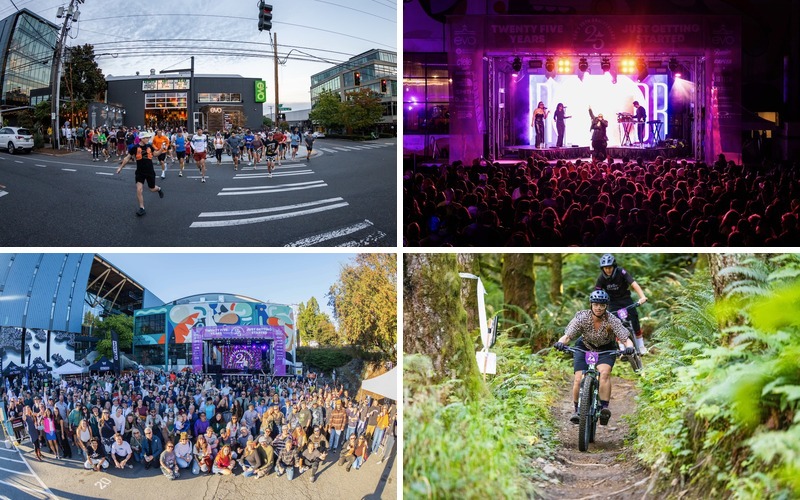
Evo marked its 25th anniversary with five events from Sept. 26 through Oct. 3 in Seattle, evo’s homebase. They included a free skate jam, a free group run, a film watch party, a bike race, and a final party and concert.
The final party included food trucks, bars, a vendor village with brands, and live music with a headline set from Drama.

The business now includes evo.com, evo stores in Seattle, Portland, Denver, Salt Lake City, Whistler, British Columbia, and Tahoe City, Calif., Rhythm stores in Japan, hotels in Salt Lake City, Tahoe City, and Hakuba, Japan, and campus developments that pair retail with restaurants, skateparks, climbing gyms, and office space.
Its evoTrip travel business offers mountain bike, ski and snowboard, surf, and Japan trips, along with education courses.
Phillips spoke with SESO about the company’s purpose, the state of the business, the Denver campus, and what he wants evo to look like over the next 25 years.
You started evo in 2001 in your garage, buying used demo skis and snowboards in Whistler and selling them on eBay. When you look back over 25 years, what stands out most about how the company got from there to here, and what core idea has stayed the same the whole time?
Bryce Phillips, founder and CEO of evo: Our core values, purpose, and the people that have been part of this journey stand out most. Without them, we’d never be where we are today.
Last weekend, prior to the big party, we had an alumni gathering. Hundreds showed up from across the country, Canada and Australia. The time was filled with joy, laughter, and love. (It was) one of the most special moments of my career.
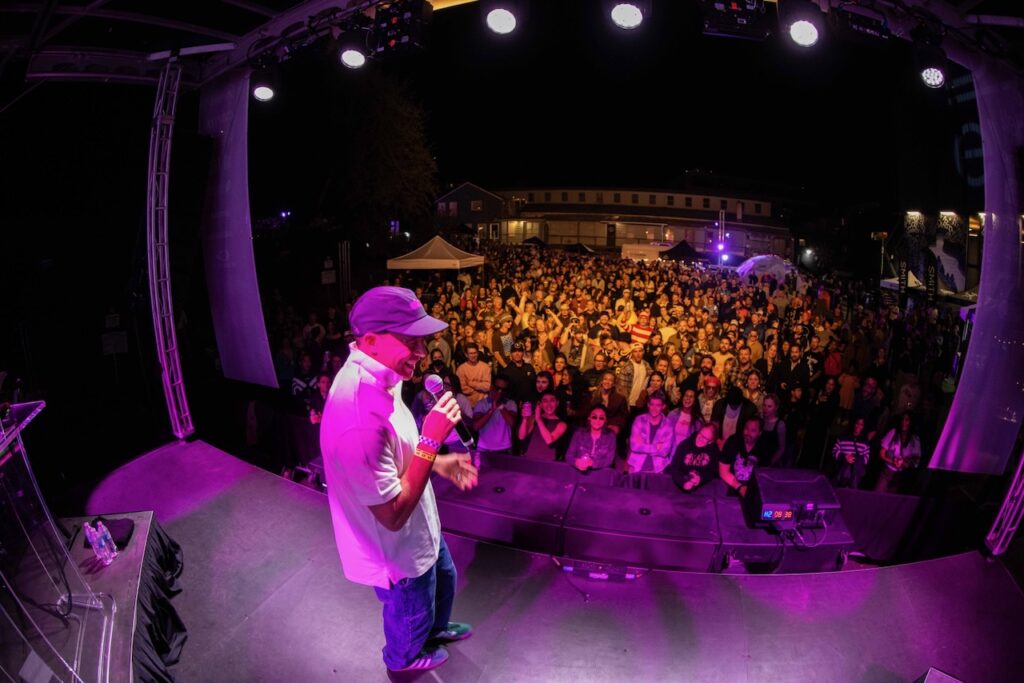
Evo founder and CEO Bryce Phillips addressing the crowd at the company’s 25th anniversary party. Photo courtesy of evo.
You mentioned “purpose.” Tell me more about that.
Bryce Phillips: I’ll answer your question with a rhetorical question: Has it ever been more important for people to connect outside? “Human Connection. Outside.” is our purpose. It’s always been an inspiration, and from our perspective, it’s never been more important given the many pressures of today.
In 2021 you told us evo ended the prior year at $188 million, and in 2024 you said revenue across retail, travel, and hospitality had topped $200 million, while also noting that “there’s revenue and there’s profit.” How would you describe the health of the business today, and how has your definition of success changed over the years?
Bryce Phillips: We’ve made big strides and still have work to do in North America. The culmination of various factors has made for a tough four years since the height of COVID, and last year’s absence of snow in the West was yet another curveball. That said, we continue to accelerate in Japan and are making important progress here in the U.S. and Canada.
The campus model, connecting retail, restaurants, skateparks, climbing gyms, hotels, and even office space, has become central to evo’s identity in Seattle, Salt Lake City, and beyond. What has that approach taught you about what customers want from a physical retail experience, and where do you see campuses going next?
Bryce Phillips: Across our campuses in Seattle, Salt Lake City, and Tahoe City, we love delivering multi-dimensional, immersive experiences meant to bring the community together. The same goes for Whistler and Portland at a different scale. These projects have reaffirmed what we’ve always believed, that people want to gather, and by bringing a 360 offering into one project, the whole is always greater than the sum of its parts.
Given this truth, we are very excited about a big project we are working on, Campus Denver.
On the other side of the world in Japan, the experiences across our Rhythm locations have so many parallels. They are filled with music, art, events, amazing gear, and integrated cafes and bars.
Evo has expanded into travel with evoTrip, into hospitality with hotels now open in Salt Lake City, Tahoe City, and Hakuba, and into Japan through the Rhythm acquisition. At this point, how would you describe what evo is? Is it still primarily a retailer?
Bryce Phillips: Yes, and. We’ve built a global, outdoor experiences ecosystem that reflects the passions of our customers, and we are just getting started. The retail business has the most scale and the biggest customer file. Aiming that file at our global offering is where we are today, and how we will grow and expand over the years to come.
You have seen the specialty ski, snowboard, and bike business go through a lot of cycles in 25 years, including the pandemic boom and the tougher years that followed in North America. What are the biggest shifts you have seen in how customers shop, including the balance between online and stores, and what do specialty retailers need to do to thrive over the next decade?
Bryce Phillips: The connection between digital and physical jumps out and is only becoming more important as time goes on. There are the practical reasons (i.e., technical service) and beyond that, there’s the feeling of human connection that we all need.
Another big theme that isn’t new but can sometimes be lost on those of us in the industry is that customers don’t define themselves like they used to. The blurred lines across activities, juxtaposed against how we used to think about “outdoor” and “action sports,” are pretty stark. Surf, camp, skate, ski, hike, yoga… sometimes all in the same day. Not to say this is a groundbreaking observation, but it’s certainly a shift from years past.
How has your role as a leader changed from the garage days to running a global company, and what have the tougher years in North American retail taught you about leading through a downturn?
Bryce Phillips: I’d like to think that I’m consistent when it comes to always going back to why we exist, never straying from our core values, especially when things are hard. I’ve changed in many ways over 25 years, but those are the non-negotiable pillars that have served as our foundation since the start.
Beyond leadership, what is the biggest lesson you have learned about business in 25 years, and about retail specifically?
Bryce Phillips: We must always live into our name, evo, which came from “evolution.” If we aren’t evolving, always looking for a better way to do things, delivering for our customers in new and extraordinary ways, we won’t continue to exist. Business is hard and the world is changing by the second. This demands that we remain tenacious, agile, and always anchored to our values.
If you were starting evo over today, what is one thing you would do differently?
Bryce Phillips: This is a tough one to answer, not because there haven’t been endless misses and learnings, but because I see it all as one journey where every part of the experience informs the next. The benefit of hindsight would certainly help me avoid certain land mines, but again, those land mines were formative and ultimately helped us to get to where we are today.
In 2021 you said you had no ambition to sell and that you look at the business “through a forever lens.” Is that still how you see it, and looking ahead to the next 25 years, what do you want evo to look like?
Bryce Phillips: I still don’t have an ambition to sell the entire company, and we will always make decisions looking through the “forever lens.”
At the same time, I can imagine a world where we grow and thrive with partners that look through the same lens and bring value to the table that can help us achieve our big goals.
This isn’t code for “we are going to take on an institutional investor/private equity, etc., with short-term directives.” We have no plans to do that.
We are, however, open-minded about who we work with as we look to maximize the positive impact that we can have on all stakeholders: our employees, shareholders, and the communities that we deeply care about.
Specific to community impact, we love the fact that as we grow and thrive, we can do more in the way of opening doors for kids that may not have the opportunity otherwise to get outside.


