
Key Takeaways:
- Food Pantry, Ltd. runs its Hawaii gift and resort stores under distinct banners, so most shoppers never realize they are shopping a chain.
- A dedicated logo shop at The Royal Hawaiian is one of the company’s best performers.
- Custom Hawaii versions of national brands and a lean toward local vendors set its assortment apart.
In a single Waikiki store owned by Food Pantry, a customer can pick up a locally made toffee, a bag of Kona coffee, a resin-and-bamboo surfboard serving board, a custom Spirit Jersey T-shirt with an Aloha theme, a Pura Vida bracelet and a poke nacho plate from the in-store cafe.
Walk into another Food Pantry store and the assortment shifts entirely: racks of pink apparel inspired by The Royal Hawaiian hotel, plus TravisMathew polos and velour robes carrying the hotel’s logo. Step a few doors down and it changes again, into Vuori, Z Supply, L*Space, Seafolly and Jellycat plush toys for the kids.
Same company. Three different names on three different doors.

Food Pantry is a Hawaii-owned company founded by entrepreneur and businessman Maurice J. “Sully” Sullivan to serve the growing number of visitors and residents in Waikiki.
It opened its first store in 1960, and today the company employs about 400 people and operates nearly 40 markets, restaurants, convenience, hotel gift and apparel stores across Hawaii. Many operate under their own distinct banners, and many more run inside the state’s best-known resorts, from Waikiki to the North Shore to the neighbor islands.
Sullivan also started the Foodland grocery chain.
Most shoppers who visit a Food Pantry gift store never realize they are shopping a chain.
“Each of our stores is curated to meet the unique needs, preferences, and purchasing behaviors of the travelers,” said Alyson Winters, General Manager of the Gifts & Convenience Division of Food Pantry.
Winters runs the company’s tourist retail division, the collection of resort, hotel and visitor-facing stores that stretches across Oahu, Maui, Kauai and the Big Island. It is the piece of the business built almost entirely around the traveling public, and it is where the strategy of one company running many different storefronts is most visible.
A Portfolio Built for Every Tier of Visitor
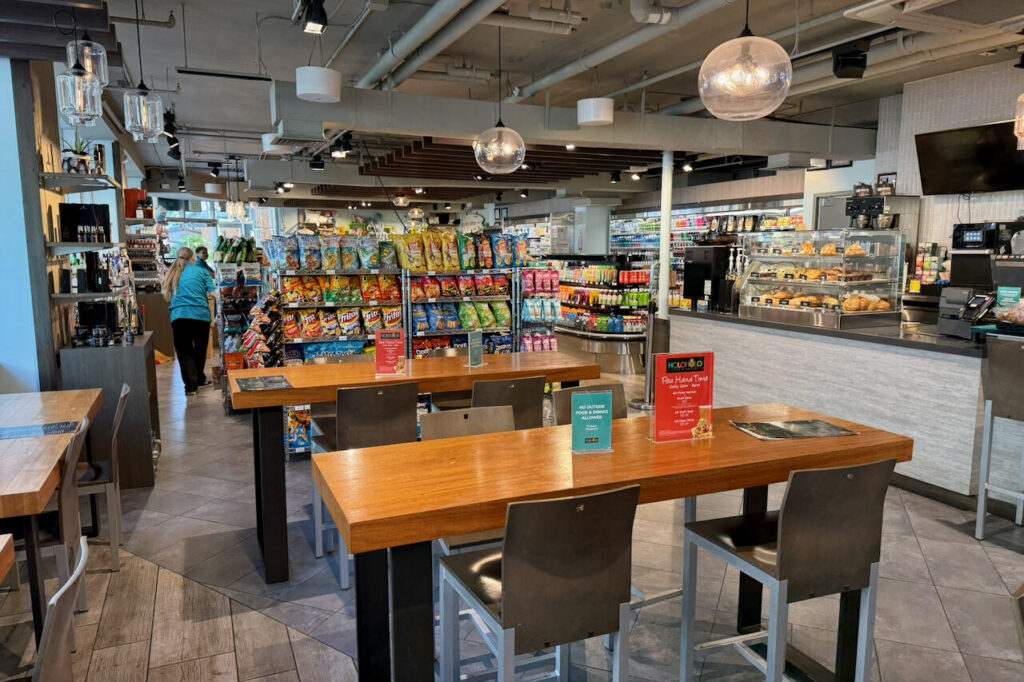
The Holoholo Café and Market in Waikiki operated by Food Pantry sits inside a hotel and features food, drinks, sundries and a wide range of gifts and apparel. Photo by SESO.
The store list runs from street-front convenience to full resort apparel, and the assortment is tiered accordingly.
At Holoholo Café and Market in Waikiki, a hybrid store that sits inside a hotel but pulls heavy foot traffic off the street, the mix leans local and impulse driven. One aisle holds Mauna Loa macadamia nuts, locally roasted coffee, jams, jellies, granolas and candies.
Nearby sit made-in-Hawaii soaps, Surfer’s Salve and Hawaii-made fragrances, including Artful Scents, a locally made line of reed diffusers, room sprays and candles in island scents like Maui Nui and Lahaina.
The store also carries an exclusive private label line, the Plumeria Collection, developed in-house and merchandised as a feature at the front of the store: acacia serving bowls and plates, plumeria-print table linens and napkins, and coordinating gift pieces.
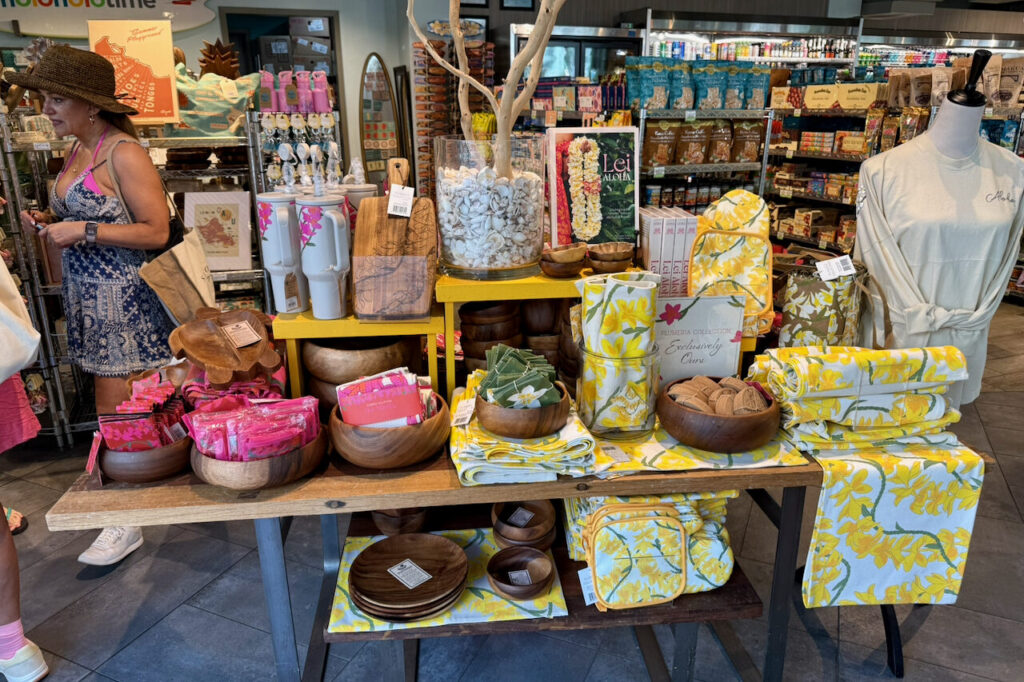
Holoholo Café and Market in Waikiki carries the Plumeria Collection, an exclusive private label line of home goods. Photo by SESO.
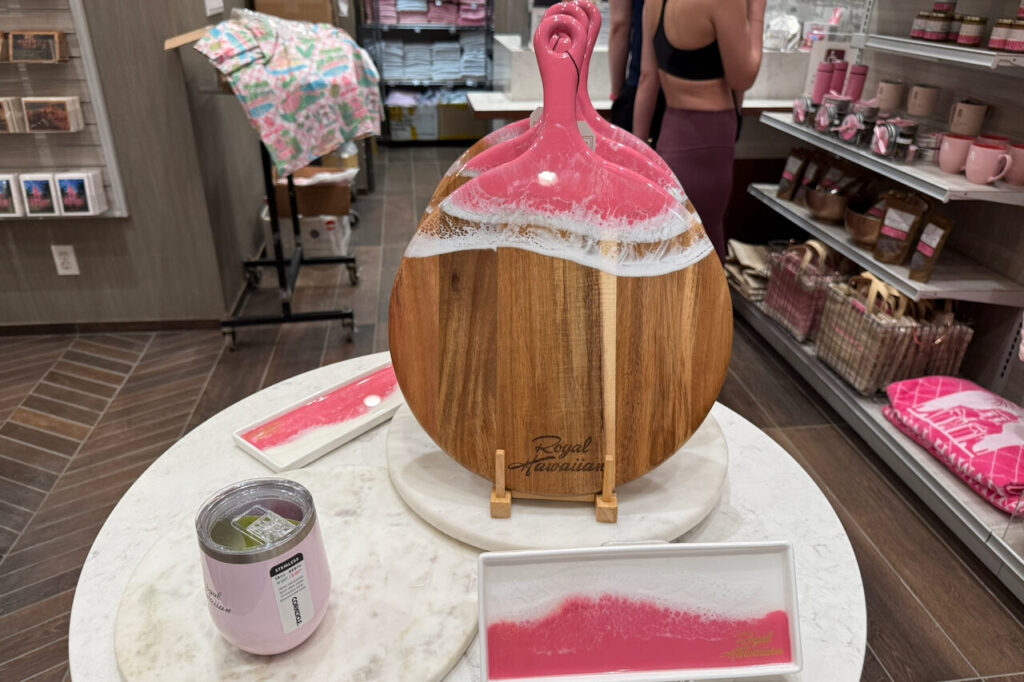
Alongside it are handcrafted bamboo serving boards shaped like surfboards and finished with a resin ocean-wave pour, graphic aloha T-shirts, and brands such as K’lani, Lotus and Luna, Pura Vida, Reef and Slowtide. The cafe counter serves poke nachos and banana bread.
“We aim to be an elevated convenience retailer, curating high-quality products over mass-produced offerings to create a distinctive shopping experience,” Winters said.
At The Royal Hawaiian, the Merchandise Is Pink
Food Pantry operates two stores on the same property level at The Royal Hawaiian Resort Waikiki, and both are built around one of the most recognizable brands in Hawaii hospitality.
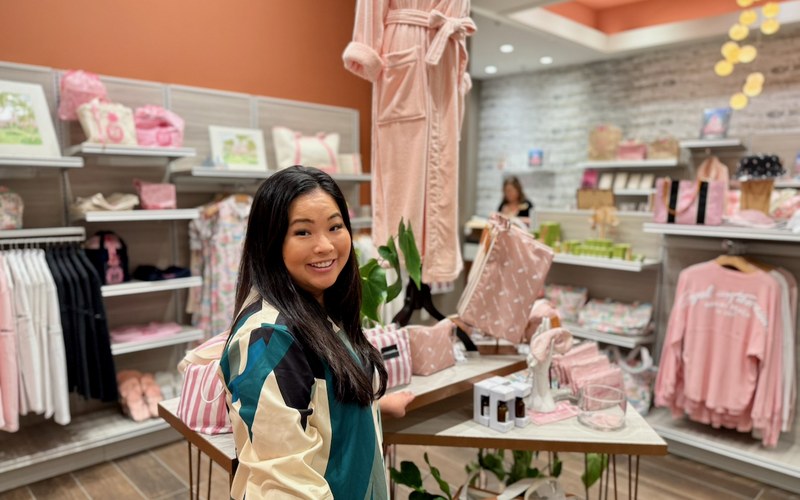
TRH Inspired, The Royal Hawaiian’s logo shop, is where that shows up most literally. The Royal Hawaiian has been the Pink Palace of the Pacific since 1927, and the assortment reflects it. Racks of logo apparel come in the hotel’s signature pink, alongside pink-themed jewelry sets. Kids’ product and accessories are carried in pink where other Food Pantry stores would run blue or neutral.
Nearly everything is pink at TRH Inspired, The Royal Hawaiian’s logo shop run by Food Pantry at the resort in Waikiki. Photo by SESO.
The rest of the store is built the same way. TravisMathew and Bugatchi carry the TRH logo, with a more muted palette on the men’s side. Melin supplies headwear, including a floatable, antimicrobial style that performs well with resort guests.
Spirit Jersey, one of the company’s strongest performers chainwide, gets a Royal Hawaiian treatment. There are spa items, gua sha tools, silk eye masks and pillow sprays, plus Birkenstock.
Running a dedicated logo shop is not a common retail model, and Winters said it only works when the property has real equity behind the mark.
“That’s something different that not all retailers do,” she said. “Not all logos can translate into a successful retail collection. But The Royal Hawaiian is so iconic that it’s one of our best.”
A few steps away sits Accents at The Royal Hawaiian, the elevated end of the portfolio and a completely different assortment. The brand list reads like a resort specialty floor: 7Diamonds, Feather 4 Arrow, Baja Llama, Kahala Sportswear, Tori Richard, Billy Aloha, Toes on the Nose, Vuori, Z Supply, L*Space, Seafolly, Vitamin A, Melin, Malvados, Reef, Jellycat and American Needle.
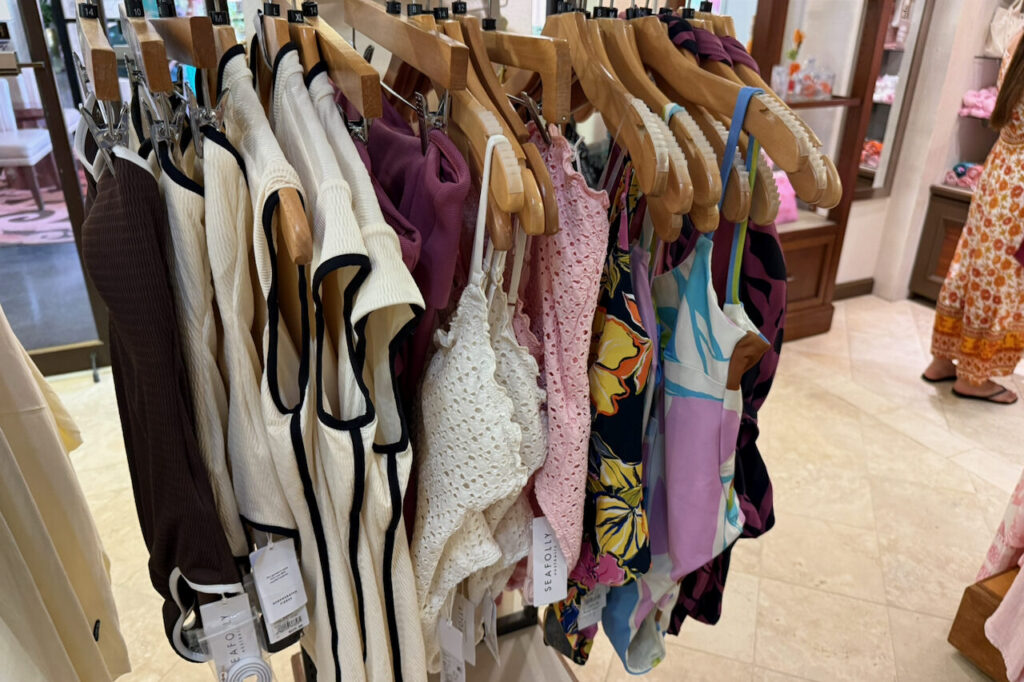
The more upscale Accents boutique at The Royal Hawaiian operated by Food Pantry carries higher-end swim brands such as Seafolly. Photo by SESO.
Wallaroo Hat Company, Sun N Sand Accessories, The Duck Company, Tag Aloha Co., Thread, Salty Cali, Beach Bros / Mr. Swim, Ipanema, Fair Harbor and Wild Republic are a few of the other brands that round out the wider portfolio across stores.
Many Banners Under One Roof
Several other hotel properties carry multiple Food Pantry stores under different banners. The Grand Hyatt on Kauai has three. The Moana Surfrider has two, a logo shop and a sundry shop, each with its own assortment. The company recently completed a major renovation of its swimwear store on Kauai.
The structure is deliberate, and it is built around a specific piece of hotel retail math.
“When you’re in a hotel, because we carry sundry items, you’re going to visit at least 15 times in your stay,” Winters said.
Mixing categories is what turns that traffic into a bigger basket.
“It brings people in because people will shop the necessities, but then they’ll catch their eye on these other things,” she said. “If you’re carrying just one category, the customer might just come in and walk out, and they’ll never come back again.”
Eight Buyers, Many Assortments
The tourist retail division is managed by a team of eight buyers, supported by a visual merchandising team that keeps floors consistent across islands.
“They handle all different tiers, all different sizes, all different assortments,” Winters said.
Each buyer owns a specific department across the full portfolio, which means one buyer might be sourcing for a beachfront convenience store and a five-star resort logo shop in the same season.
The buy leans local wherever possible.
“We always try our best to do business with local brands, and we feel like our visitors want things that are authentically local, too,” Winters said.
Food Pantry has also become an informal partner for Hawaii’s small vendor community. Its buyers are regularly asked to attend mentorship events like Mana Up, a Hawaii accelerator program, to provide feedback through the lens of a buyer.
“That’s also how we get a lot of the connections with local vendors,” Winters said.
Where Custom Product Becomes the Advantage
The other half of the Food Pantry strategy is customization. Food Pantry works with specialty programs from national brands, then adds Hawaii elements.
The treatment tends to be subtle by design.
“The modern customer is drawn to Hawaii inspiration presented in a more understated way,” Winters said.
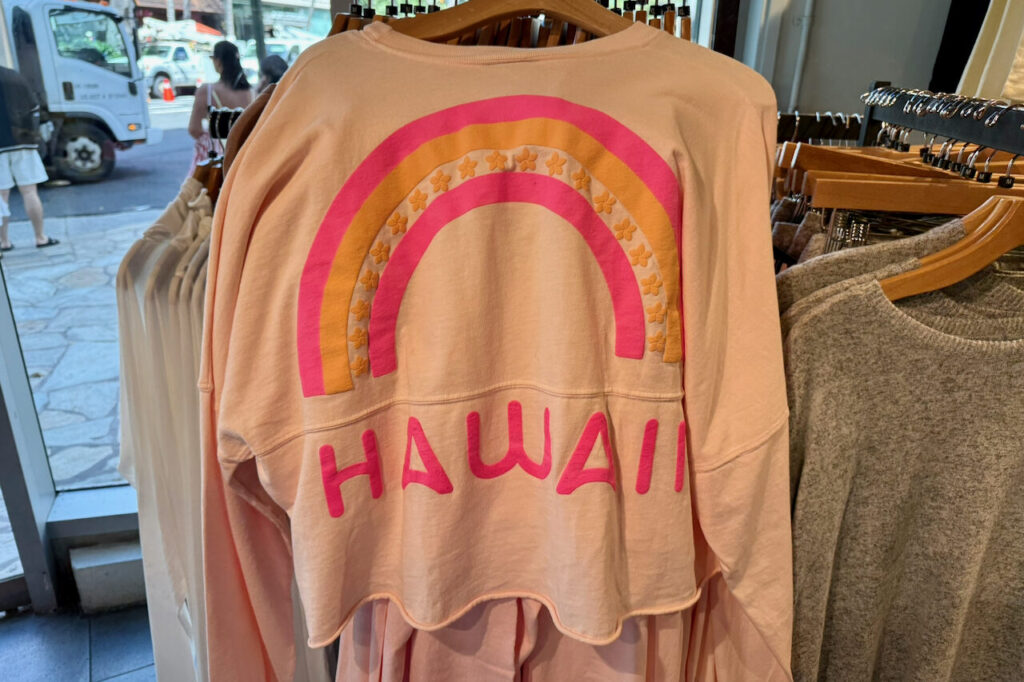
Holoholo Café and Market in Waikiki carries a wide range of customized, Hawaii-themed apparel. Photo by SESO.
One of her own creations came out of a conversation with a vendor about typography.
“I asked the vendor to make the font like the Alo brand, but with the word aloha,” she said. “And it sells so well.”
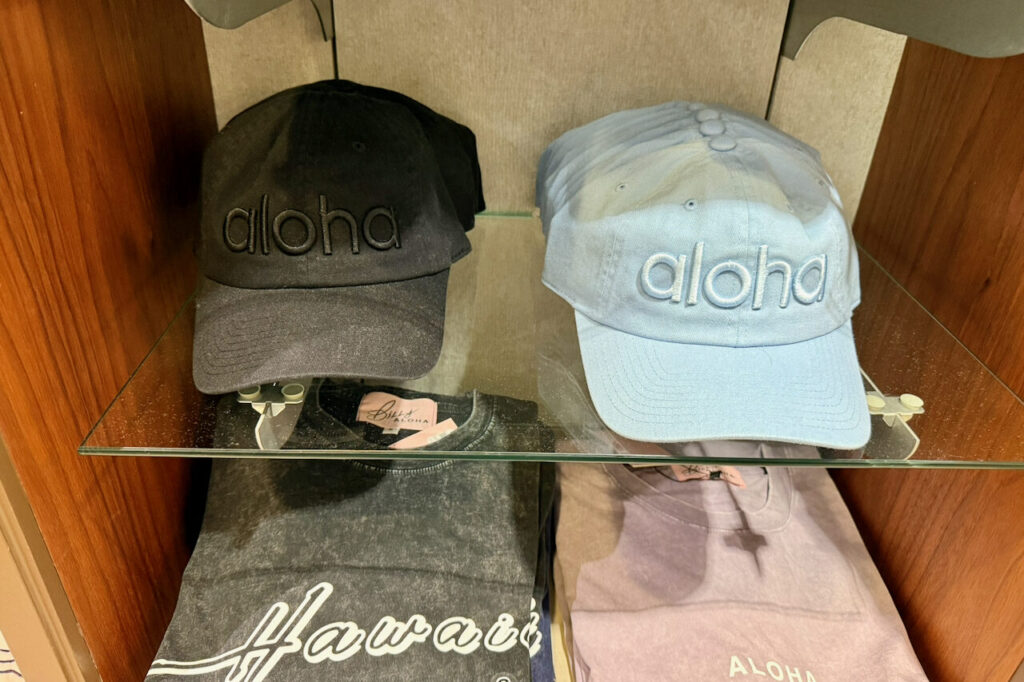
Hawaii-themed “aloha” hats inspired by the Alo brand font at Food Pantry’s Accents boutique. Photo by SESO.
Scale is what makes the program viable.
“We can meet the minimums for custom products because we have so many locations,” Winters said.
One of the hottest sellers across the entire portfolio, from convenience stores to hotel gift shops, is a handcrafted macadamia nut toffee made on the Big Island.
Hunting for Brands Others Don’t Have
For all the depth of the existing assortment, the mandate Winters gives her buyers is to keep finding what is not already on the islands.
Regional shows on the islands bring brands to Hawaii, which is convenient. It also means every retailer in the state is seeing the same lines at the same time.
“It’s great that they come here, but we’re also trying to find brands that other people don’t have,” Winters said. “We want to be the first.”
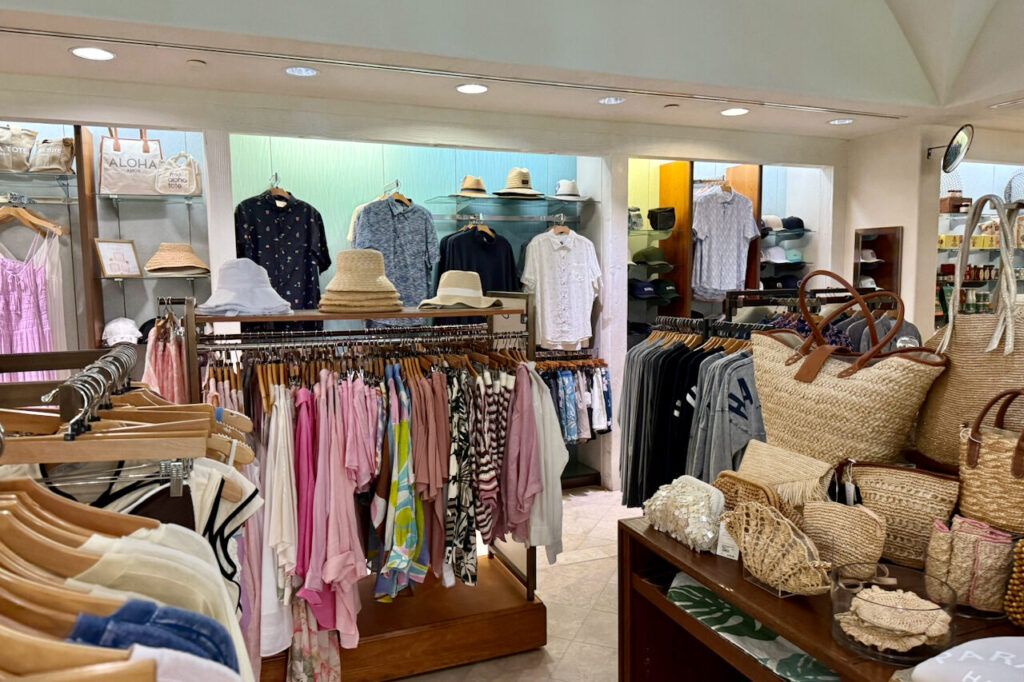
The Accents boutique at The Royal Hawaiian operated by Food Pantry stocks a wide selection of apparel and accessories. Photo by SESO.
That sends Food Pantry buyers to the mainland. Their calendar includes MAGIC, Chicago Collective, Collective Shows in Huntington Beach and Surf Expo, which has been part of the rotation for years, including before the pandemic.
“Surf Expo provides us a convenient way to meet with all of our mainland and national vendors that don’t often make their way to the islands,” Winters said. “Many of these are existing brands that we’ve built a relationship with for years.”
After the show, Winters’ buyers visit other retailers and hotel operators to see what’s trending, since most trends quickly make their way to Hawaii.
A Company That Grows Its Own
Winters’ own path is the company’s culture in miniature. She started as a district manager, became a buyer, then a senior buyer, managed the soft goods buying team and now runs the division.
“The company really prides itself on hiring from within and promoting from within,” she said. “We’ve had many sales associates who started off as cashiers that are now store managers or work in our buying office. The sky is the limit.”
Hawaii’s visitor mix has shifted in recent years, with Japanese travel, historically among the highest per-person daily spend of any visitor group, still below pre-pandemic levels and mainland traffic carrying more of the load. Food Pantry has adjusted buys accordingly and kept investing, mainly in remodels.
Winters said the company is actively looking to expand its store count, with nothing announced publicly yet. More stores mean more assortments, more banners and more doors to fill.
“There are must-haves in every category, and we are always on the lookout for what’s new to bring relevance and excitement,” Winters said.
Retailer registration is open for Surf Expo, Jan. 6-8, 2027, in Orlando, Fla.


