
Key Takeaways:
- Complex CEO Aaron Levant shared a revenue milestone the company had never reported publicly.
- Levant says leaving the B2B trade show world in 2018 was his biggest career gamble.
- The Agenda founder says the action sports and surf industry taught him that business is based on relationships, a lesson he wished he would have learned earlier.
Long before he became CEO of Complex, Aaron Levant founded Agenda, the streetwear and action sports trade show that eventually helped drive ASR out of business.
In its early days, Agenda tried to get attendees by having someone hold up a sign outside of ASR and hiring a run-down limo to shuttle people back and forth.
Now 43, Levant runs a company that he says will do about $250 million in revenue this year. Complex spans content, a portfolio of more than 75 events globally, experiential stores in L.A. and New York and commerce, its biggest business, led by the Complex Shop marketplace.

The company has about 350 employees and offices in cities including Seoul, Shanghai, Hong Kong, Tokyo, and Dubai.
In February, Complex reached 88 million people a month in the U.S., Levant said. The company just held its largest ComplexCon ever, drawing around 80,000 people for the event’s 10th anniversary.
He acquired Complex media for $108 million in a deal announced in February 2024 and merged it with NTWRK, the livestream shopping company he co-founded in 2018 after leaving the B2B trade show world.
Levant travels in some heady circles these days. Complex investors include Universal Music Group, Goldman Sachs, and Live Nation. Jimmy Iovine, who founded Interscope Records, Beats headphones, and the music streaming platform Beats Music, is chairman of the board and an investor.
Even with all his success, Levant said some of his key business lessons came from his action sports and surf industry days, especially when it comes to the importance of building relationships.
“I never went to lunch with (surf industry insider) Paul Naude until I’d been doing Agenda for almost a decade,” Levant said. “I spent a lot of time being the fight, fight, fight outsider in the action sports business.”
The Agenda founder talked with Shop Eat Surf Outdoor about his path to Complex, the gambles and mistakes along the way, and how he would position a B2B trade show today.
You sold Agenda to Reed Exhibitions in 2012 and stayed on for five years. What else were you building during that time?
Aaron Levant, CEO of Complex: I had an earnout there, and I sold them my remaining portion of the company three or four years into that deal, and I stuck around a full five years, two years past my earnout period. I was enjoying myself, but I was also simultaneously launching other businesses and investing.
I co-founded a hot sauce company called Truff with a couple friends, which has gone on to be a pretty successful business. We sold a big portion of the company to a large private equity firm backed by Kim Kardashian last year. I’m still sitting on the board and still very involved in that business, and that’s become a global food business.
I also co-founded another company in the B2B trade show space called Hall of Flowers. Both of those launched in 2017. Hall of Flowers is essentially what Agenda was, but for the cannabis industry.
How did you get from there to launching NTWRK?
Aaron Levant: Some guys from the action sports industry, like P-Rod (pro skateboarder Paul Rodriquez), had started that beer company Saint Archer, and I was one of the early investors, and I kind of just got the taste for that industry. I thought that’s what I was going to do.
Around that time, I met Jimmy Iovine for a random meeting, and he and his son Jamie, who’s now one of my business partners, had this very rough idea, like QVC meets Comic-Con. That was it. They had that on the back of a napkin. It was the second year of ComplexCon (which Levant launched while at Reed Exhibitions), and it was taking off like a rocket ship.
There were structural challenges in the Agenda business because it’s B2B, and wholesale was kind of imploding in the surf and skate industry. Around that same year, I also made the successful pivot to turn Agenda into a consumer-facing event, Agenda Festival. I was pretty satisfied.
But this meeting with Jimmy was so eye-opening, and in February of 2018, I left the trade show industry to go pursue launching NTWRK, which was a very early iteration of livestream video shopping, or what people call social commerce today.
In the U.S., I think I was literally first. Unfortunately, we were the MySpace of social commerce. This other company, called Whatnot, has come along to be the Facebook, but I was two years before them.
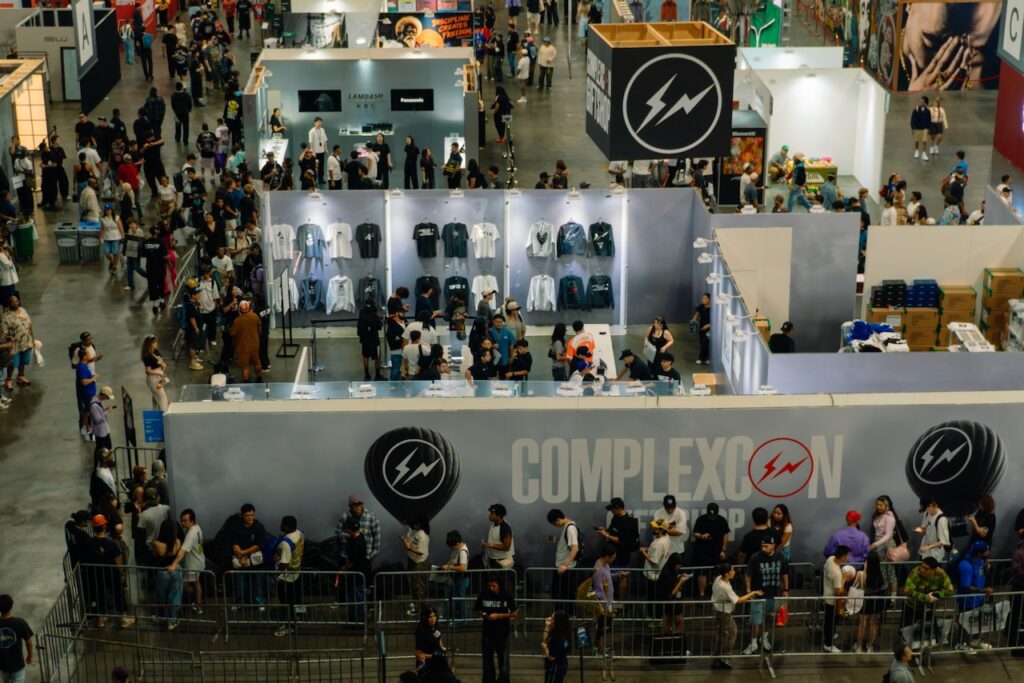
Floor scenes from ComplexCon in Los Angeles this month. Photo courtesy of Complex.
Why did you decide to acquire Complex?
Aaron Levant: I had a great friendship with Complex through creating ComplexCon with them. I saw what I built with NTWRK was technically, financially way bigger than Complex at the time, believe it or not, because Complex had fallen underneath BuzzFeed’s management, both valuation and revenue and brand-wise.
I said, “Look, I’ve got something with this NTWRK thing, but I need a bigger brand catalyst, a bigger, more famous consumer audience, just a bigger brand.” So I saw the opportunity to buy Complex.
I raised the money from Universal Music Group. I raised $150 million into NTWRK. I then acquired Complex for $108 million and merged the two companies, and then basically turned what I was doing at NTWRK into the Complex shopping business.
Even though NTWRK was bigger (by revenue), I put their name on the front door because Complex has more name recognition. You can say Complex anywhere in the world. People know it.
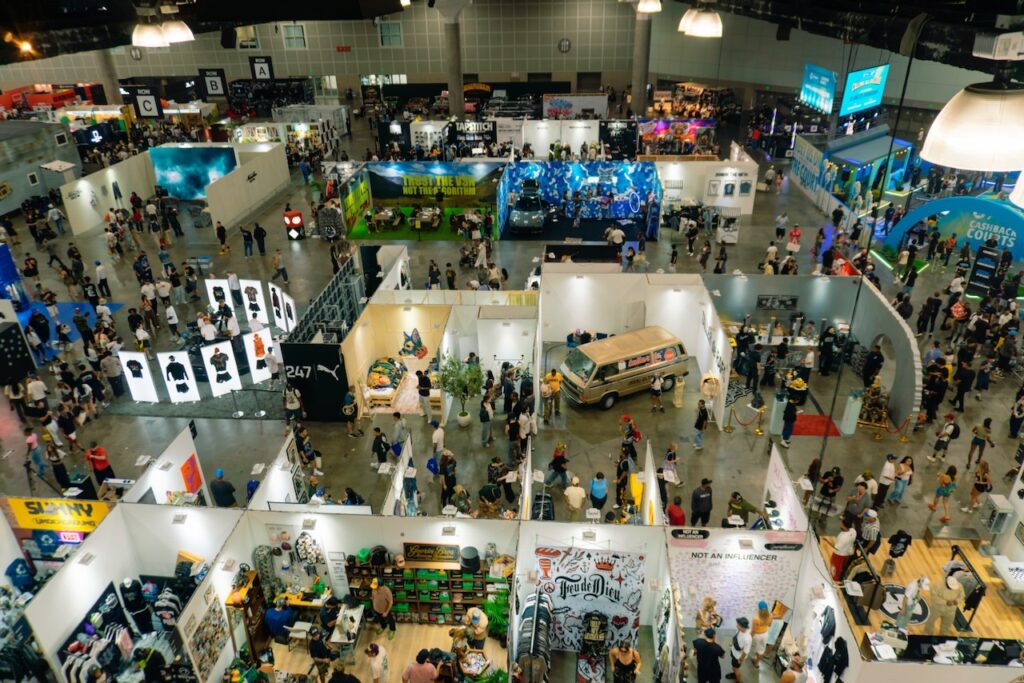
Part of the show floor at the consumer-focused ComplexCon in Los Angeles this month. Photo courtesy of Complex.
What does Complex look like today?
Aaron Levant: The company’s gotten quite large. We’ll do over a quarter billion in net revenue this year, which I’ve never actually publicly reported to anyone.
We have three different businesses. We have a content business, which Complex has been in for 25 years in different versions, starting as a magazine, moving into digital, social. Complex has been really good at keeping up with whatever wave is happening. We’re now huge on TikTok.
We have an events business. I’ve developed a portfolio of over 75 events globally. We have ComplexCon in Asia. We’re going into our fourth year in Hong Kong. We have a food festival business called Family Style that’s going to do over 10 events this coming year. Imagine a food festival through the lens of Complex, a really cool outdoor thing. That’s a really fast-growing part of our business.
And then the biggest part of the business is really our e-commerce and shopping business. We have an online marketplace, Complex Shop, where we sell over 350 different brands and artists. We sell other people’s stuff, and we also create a lot of our own exclusive and proprietary products. We have a massive licensing and product creation business, and that is actually the biggest part of our business now, which is really what the NTWRK business was, now folded into Complex.
We believe this can be a billion-dollar company over the next few years as we start to scale it. In February of this year, we reached 88 million people a month in the U.S. who are watching and engaging with our content. On a global basis, it’s much bigger than that. We’re reaching probably over 120 to 150 million people a month, and we’re just getting started in those other countries with localization of language and content.
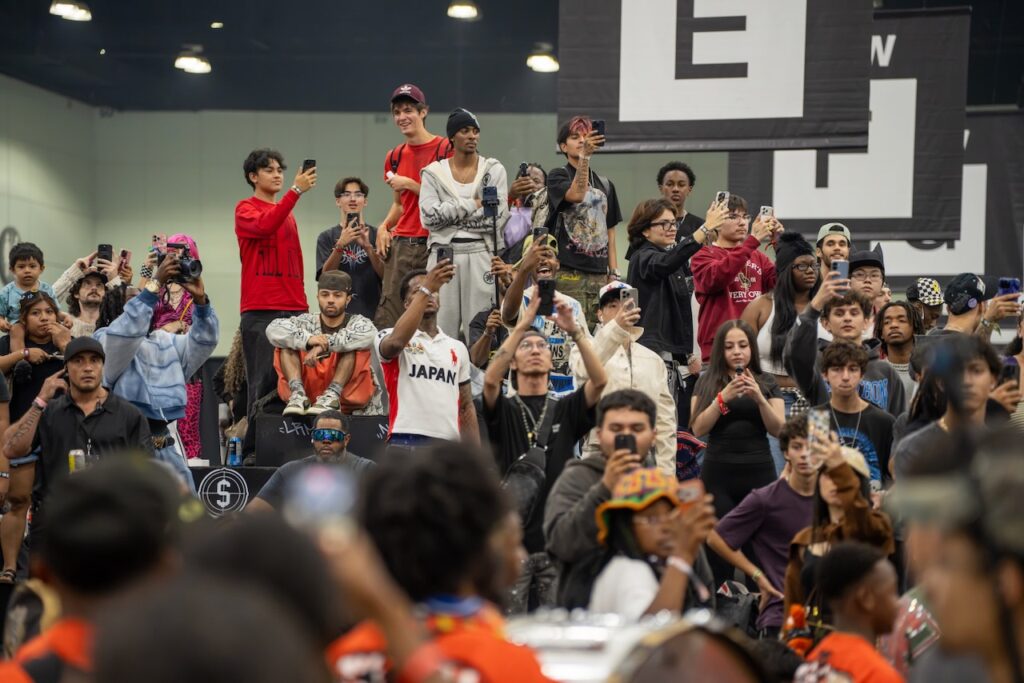
Attendees at ComplexCon in Los Angeles, which attracted 80,000 over a weekend. Photo courtesy of ComplexCon.
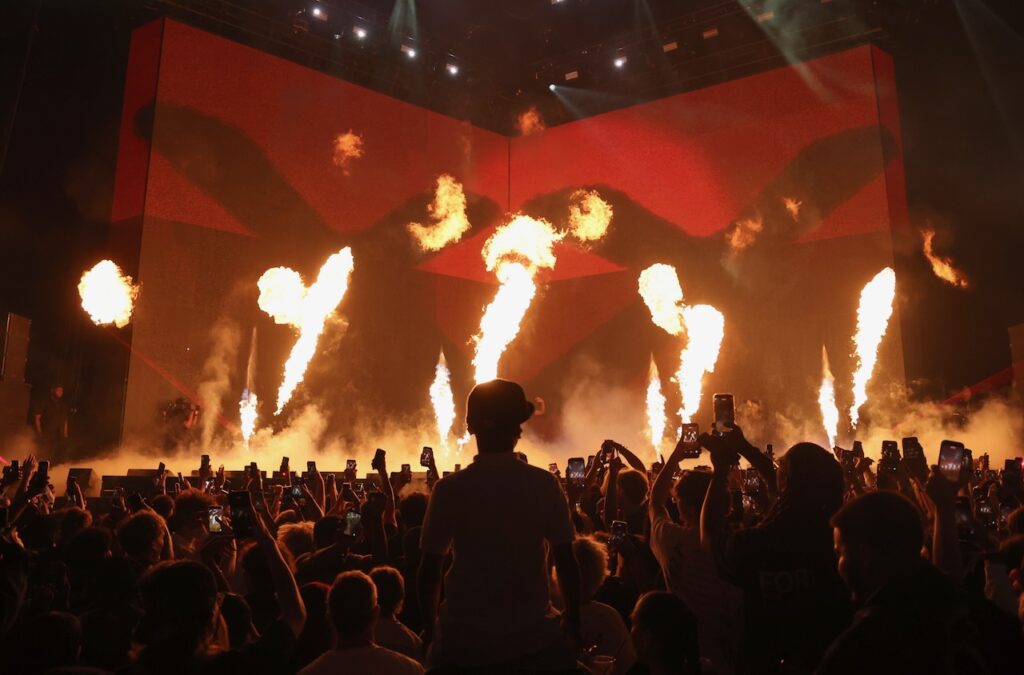
Ken Carson performs at ComplexCon’s 2026 10-Year Anniversary Festival at Crypto.com Arena on October 3. Photo courtesy of Complex.
You’ve attracted some big-name investors to both NTWRK and Complex. What do you think they see in you?
Aaron Levant: I don’t want to say it’s anything about me, but I’ll take it. I think the things we’re working on are meaningful. I’ll give all the credit to Jimmy Iovine for helping believe in me and that one chance meeting that we had in 2017.
I can take an idea and bring it to fruition. I have a real entrepreneurial mindset, and I’m ambitious, and I try to go after things that seem hard or impossible and have a chance of pulling them off. The likelihood that I’d be able to put ASR out of business was probably a one-in-a-million lottery ticket.
But it’s just extreme perseverance and pushing forward every day against impossible odds. I think people identify with that, and people like entrepreneurs.
You’ve long been known as the idea guy. Is that still how you see yourself?
Aaron Levant: I used to think of myself as the idea guy and the creative guy. Even my Agenda partnership with my cousin Seth (Harber), I was creative and brand, and he was ops and finance, and we had this great right brain, left brain thing going.
I never went to college. I didn’t finish high school. When I sold my company to Reed, I dropped in as an entrepreneur with no college experience into a publicly traded company, and I was sitting in the boardroom. I didn’t know anything about finance. I didn’t know anything about forecasting. I didn’t know anything about P&L. That was my college or my MBA experience. I learned how to work well with others and also still be a rebel entrepreneur in residence at the company.
Then it was like starting again with NTWRK, with both sides of my brain fully formed. I still am creative, but I’m definitely more on the business side these days than I was in the past.
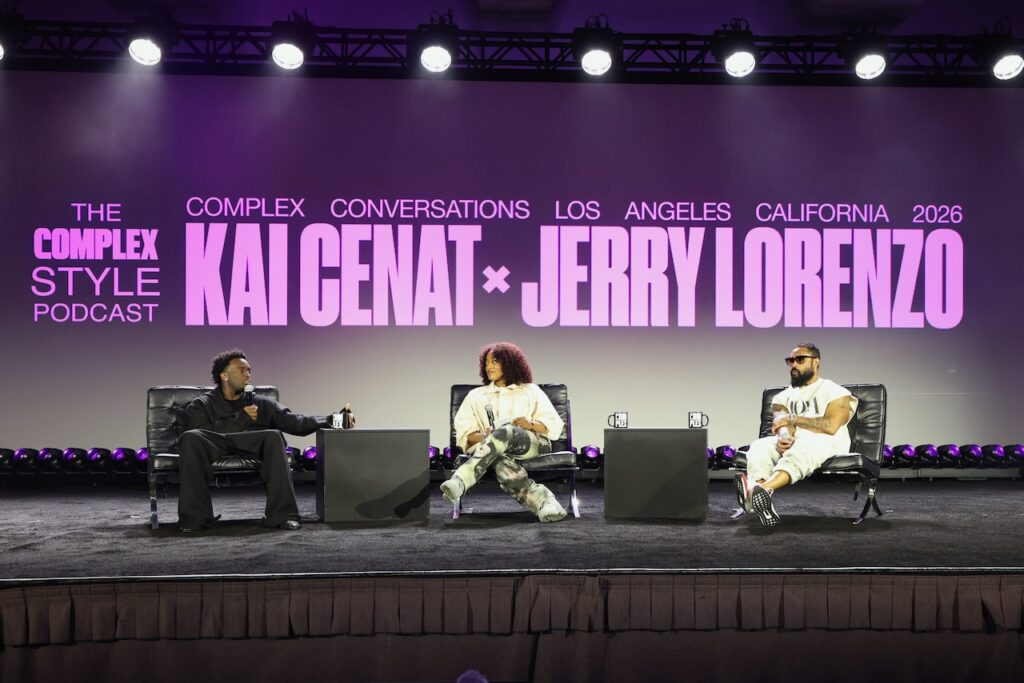
Kai Cenat, Aria Hughes, and Jerry Lorenzo speak onstage at “The Complex Style Podcast” Conversation at the ComplexCon(versations) Stage during the ComplexCon 2026. Photo courtesy of Complex.
What was the biggest gamble you took that paid off?
Aaron Levant: Launching ComplexCon in 2016 was a huge gamble. That was a $13.5 million bet that I took with other people’s money, Reed’s money. Actually, I’m more comfortable gambling my own money than other people’s.
Raising $150 million from Universal Music Group to acquire Complex for $108 million, that was probably the largest individual bet that I’ve ever made, and that really had to pay off, and so far it has.
A non-financial gamble was having the courage to walk away from running Agenda and ComplexCon, basically being the events guy. When I actually left in February 2018 (to launch NTWRK), that was a huge gamble to me. I felt a little bit of imposter syndrome, like I’m going to go be the CEO of a technology e-commerce business, two things that I didn’t really know, and this group of people was betting on me. We had raised $23 million in our seed round to get the company started. That was probably my biggest career gamble, to walk away from everything that I knew and I knew I was really good at.
I’ve learned more in these last eight years than I learned in the previous 15, and I probably learned more in the first two years than I learned in the decade previous, just because it’s so different, and it’s at such a different vantage point of business and scale and the people I’ve gotten to meet and the CEOs I’ve gotten to meet.
What mistakes have you made along the way?
Aaron Levant: Endless mistakes. I take a lot of chances, and I never look at them as mistakes. But I try a lot of things that fail, and I have unlimited courage to jump off the cliff and see if I’m going to land in a soft spot.
I don’t always land in a soft spot, and that could be a decision that I made that cost the company money, a decision that cost us time, which equals money, or a road that I went down that I believed in that didn’t end up paying off. And I also had the courage then to say, we’re going to stop doing X, Y, or Z and go back.
To me, none of them are ones I’m worried about. I’d be more worried about not trying stuff. If you’re standing still and doing the same thing, you just might as well be dead. I’m unapologetically moving forward on all fronts all the time, for better or worse. Some are going to work, some aren’t going to work, and one of them may be the thing that ends up being bigger than everything I’ve ever done.

A skateboarder at ComplexCon. Photo courtesy of Complex.
Looking back at your time in the action sports and surf world now, what do you see?
Aaron Levant: I learned so much, and what I learned in the action sports business that I didn’t learn early enough is that everything in life and in business is based on relationships. I was rubbing up against the surf guys, the Orange County guys, SIMA (the Surf Industry Members Association), because I knew I had a better product or a differentiated product, price point, curation at Agenda.
I spent so much time being the outsider. I should have tried to figure out how to build relationships with the right people earlier, and I would have had a lot less of an uphill climb.
I’m trying to be a lifelong learner. Who I am now as a person, as an executive, I’m a completely different human than I was, and I’m hopefully going to continue to be that. Don’t just get stuck in your ways and not evolve. I’m trying to evolve even at 43 years old. I’m trying to be a different person by the time I’m 45.
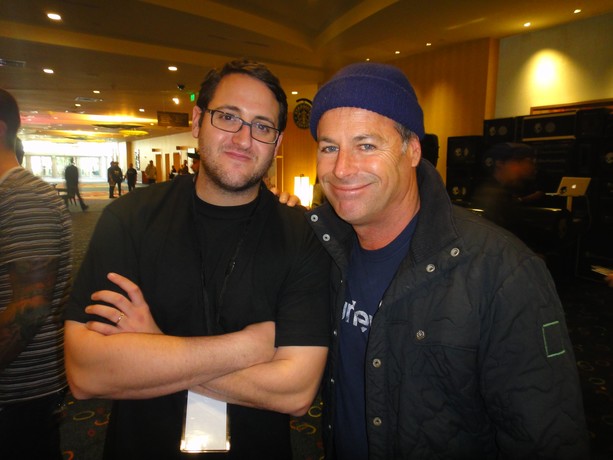
Agenda Show Director Aaron Levant and Hurley Founder Bob Hurley in 2017. SESO file photo.
How are you different now than you were in your Agenda days?
Aaron Levant: I still work as hard or harder, but I’ve found a little bit of work-life balance. I have a kid now. There are other things that I care about that aren’t work, while still being able to do the largest amount of work that I’ve ever done.
During the Agenda period, literally all I cared about was work, 24/7. Having my son four years ago gave me a meaningful purpose.
Before, I was just working for the sake of work, and then I got money from selling the company and other things that I’d done, and it didn’t give me the sense of fulfillment. So now I’m working for different reasons, not necessarily for money.
I was very narrowly focused on this little world and industry (action sports) back then, and I want to have a much bigger global effect and a much bigger aspiration. I want to do things that are bigger and more impactful on a global basis and affect people’s lives in a positive way.
I don’t know if I had big enough goals before. I might have been thinking too small.

Agenda owners and cousins Aaron Levant and Seth Haber back in the day. File photo courtesy of Agenda.
How do you think you went from standing outside ASR with signs and limos to where you are now?
Aaron Levant: You’ve heard the phrase “ignorance is bliss.” I have this idea, ignorance is rich, meaning I go into industries where I don’t know anything. I didn’t know anything about action sports. I didn’t know anything about trade shows.
I’ve actually ended up being successful because the way I approach it is so out of the box. There’s just a pure full forward push, aggression and entrepreneurial nature, plus being fearless to go after something, even if I have no reason on paper.
Those things remain. I just have a lot more knowledge now. I actually understand finance and business. I actually understand the power of grace and relationships. I would say I was probably an asshole for a long period of my time in my previous work. Some of that was helpful. Some of that was very hurtful.
I approach things with a different mindset while still being equally aggressive towards the goal, doing that in partnership with people as opposed to being adverse with people. My mom calls it oppositional defiant behavior that I exhibited in high school and lasted through a lot of my career, which helped me in some ways.
Now I’m just a totally different person and more collaborative with my team and with partners.
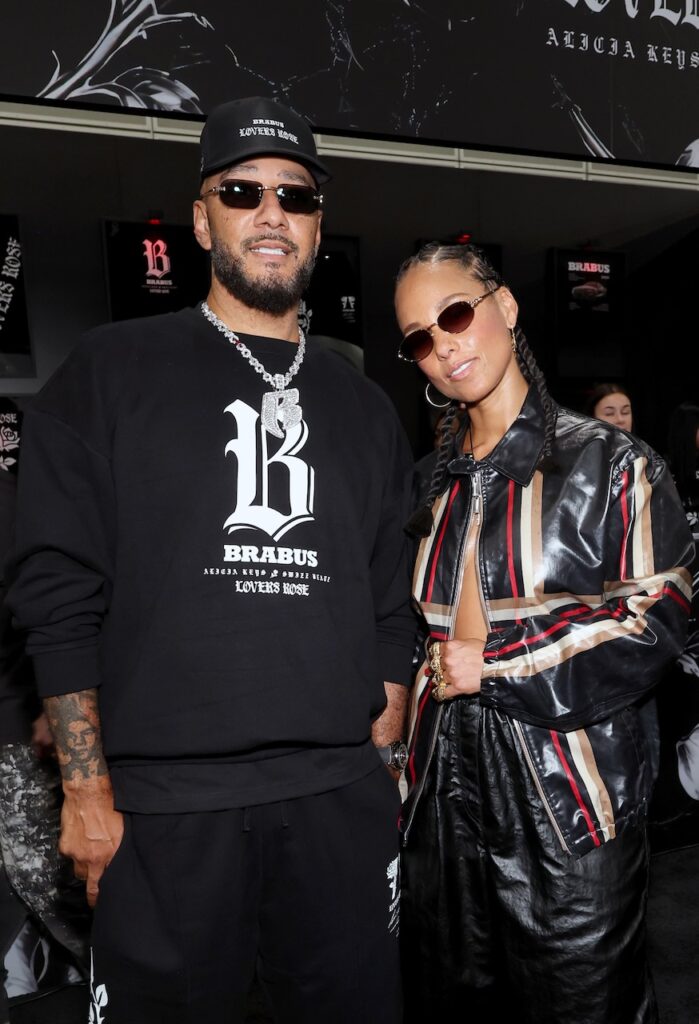
Swizz Beatz and Alicia Keys attend ComplexCon 2026 10-Year Anniversary Festival at The Los Angeles Convention Center on October 3. Photo courtesy of Complex.
If you were starting a B2B trade show today, what would you do?
Aaron Levant: I have thought about it. Bringing people together in person is one of the core throughlines of my entire career, and I still believe in the importance of it. All the people I met at Agenda or going to Surf Summit, those relationships that were forged in person are so much more important than the digital relationships, the emails that were sent, the Zooms that were had.
We went through this phase, especially during the pandemic, where the internet’s everything, e-com’s everything, social’s everything, and now AI is everything. The power of getting those 80,000 people in the room for ComplexCon, or even the power of getting the 300 people in the room at Agenda in Long Beach in 2003, those are equally powerful things.
I believe the pendulum is swinging back to community, to relationships, to even IRL retail, because e-com is hard. Customer acquisition is hard. It’s expensive. Your best billboard might be being on the street and people walking into your store versus spending millions of dollars on customer acquisition with Meta and Google.
So I believe there’s an opportunity, but it would really be about helping rebuild the industry and helping retailers get better at what they’re doing. Education would be a big part of it. Compared to the big retailers, the industry that I came from, that you still work in, is probably undereducated and not using the modern tactics that they could be to make their businesses better. Local mom-and-pop or chain or even mall-based retailers could all be doing a better job.
It’s about a lot of education on how to do your job and function well, education on trend and where youth culture is moving, and then facilitating that in real life. Some people have horse blinders on in the industry that I came from.
I appreciate being a purist, being focused on a category, but I think that’s the biggest weakness of those industries and those brands. They were scared.
You don’t need to completely pivot. You don’t need to chase every trend that comes. But if you’re not at least 15 degrees more open, I think you’re susceptible to die. It’s all about how you stay in tune with where the youth is going and not let the foundation you’re standing on tip you over.
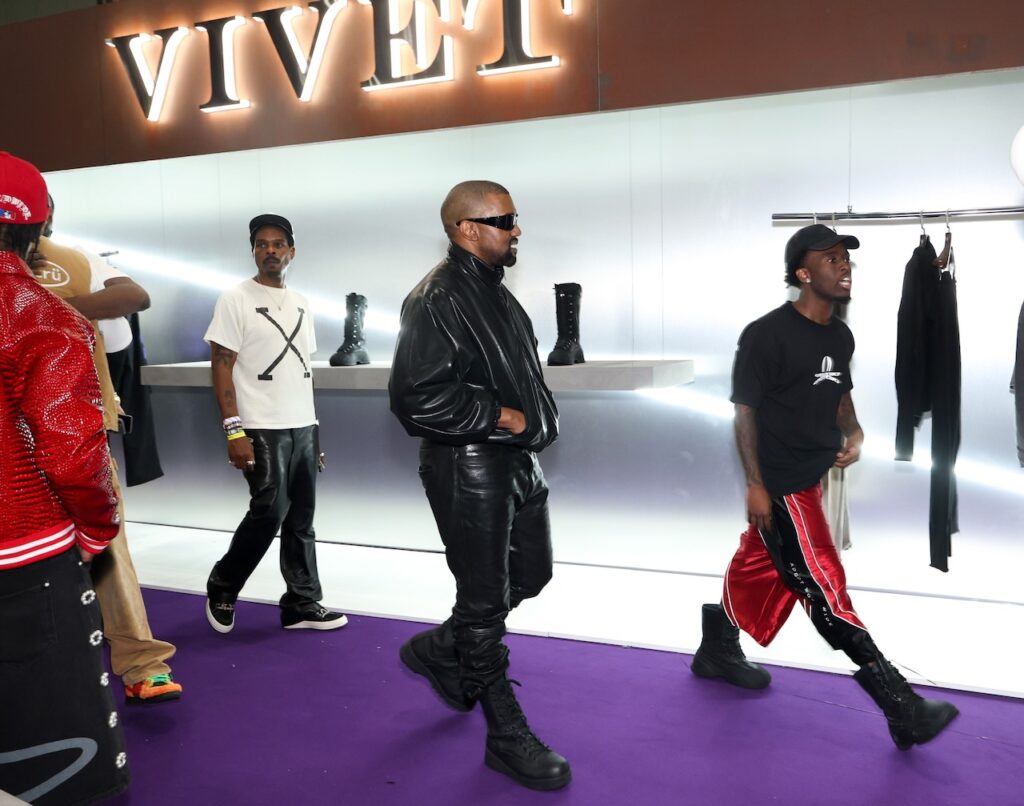
Kanye West and Kai Cenat attend ComplexCon 2026. Photo courtesy of Complex.


