
Key Takeaways:
- Minus33 President Lawson Glidden says an offer of machine-washable merino turned a shrinking mill toward base layers.
- A newly purchased building will free up the historic mill to make more New Hampshire products.
- Glidden says more first-time customers are trying merino and not going back.
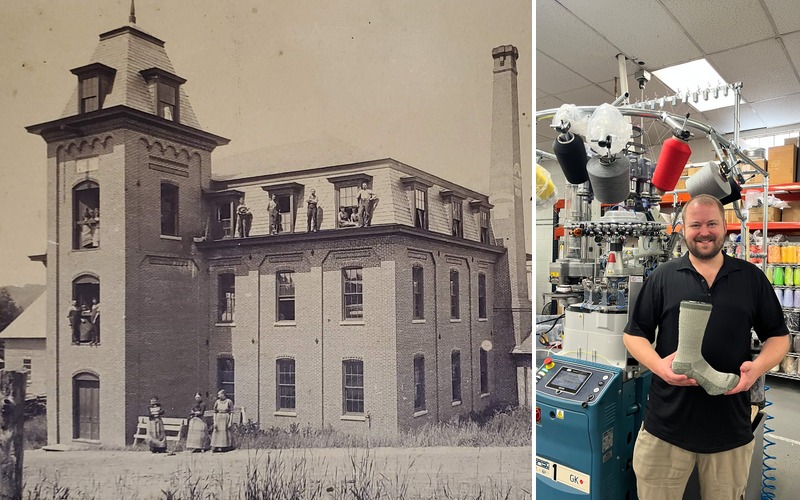
In its heyday, textile company L.W. Packard was the biggest employer in Ashland, New Hampshire. The Glidden family founded Packard in 1916. It supplied wool broadcloth to companies like Saks Fifth Avenue and L.L.Bean, as well as to the U.S. military.
But like countless American manufacturers, Packard lost business to overseas competition. By the early 2000s, the once-robust operation had shrunk from 300 employees at its peak to just three.
That wasn’t the last act for the family-owned business. John Glidden, the fourth-generation owner to run the company, took his expertise in wool and applied it to products made less for Fifth Avenue fashionistas and more for mountain-bound outdoorspeople. He launched the Minus33 brand and passed the leadership torch to his son, Lawson Glidden.

Now the company is not only back on its merino-clad feet, but expanding. In October, the company acquired a 15,000-square-foot building that will allow it to double its business space and grow from about 24 employees to 40, all as the company celebrates its 110th birthday.
Amid the festivities, Minus33 President Lawson Glidden spoke with Shop Eat Surf Outdoor about how his family has managed, over more than a century, to not only survive but thrive. He also shared why he believes wool is the best fiber, what consumers want, and how the company’s search and rescue program works.
About 25 years ago, L.W. Packard had shrunk to just three employees and was at a real crossroads in terms of the business. What inspired the pivot to making base layers and outdoor apparel?
Minus33 President Lawson Glidden: Honestly, it was a mix of necessity and a little luck. We went from a roughly 300-person mill in the early ’90s to a three-person company around 2002. The textile supply chain went overseas and took our customers with it. My dad tried a lot of things to keep the lights on, like a steam laundry and making snow-machine jackets.
Then an overseas supplier offered us high-quality merino that was machine washable. That was a game changer. My dad made some pieces for his hunting buddies, and they told him, “You should sell this.” So he did. The wool base layer turned out to be something we were really good at. We had all the textile engineering and wool expertise, we had employees that knew the industry, and the space to scale.
I always say it’s better to be lucky than good, but it’s best to be lucky and good.
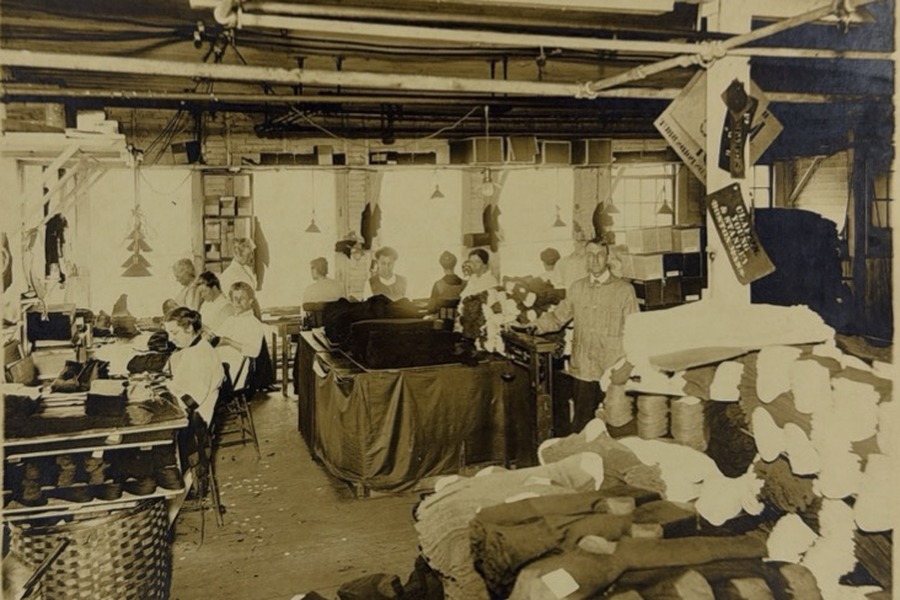
Workers inside L.W. Packard in an undated photo. Photo courtesy of Minus33.
What are your thoughts on the advantages of wool over, say, synthetics? Are you seeing any market trends with respect to consumers opting for natural materials?
Lawson Glidden: Wool is the best fiber, period. Every technical fiber out there is trying to do what wool already does. It keeps a sheep warm in winter and cool in summer, and it does the same for people. It stays warm when it’s wet, it wicks moisture, and it’s naturally odor-resistant, so you can wear it for days without it getting funky. It’s also renewable and free of the chemicals you find in a lot of synthetics.
On trends, we have been seeing more first-time customers, people trying merino for the first time. I think people are paying more attention to what they put against their skin, and once they try merino, they don’t go back.
Your business contracted significantly when textile manufacturing largely moved overseas. What do you see as the advantage of manufacturing in the U.S.? What would allow more apparel companies to use American-made textiles?
Lawson Glidden: Twenty years ago, we had to nearly close our factory because the rest of our domestic supply chain moved overseas. Now, in the right applications, domestic manufacturing can work. Our Mountain Heritage sock line, made right here in Ashland, is just the beginning.
The advantage is control. When you make it in your own building, you can walk down the hall, look at the product, and fix a problem the same day. If a sock doesn’t fit right on my hike, I go to the sock department and check the QC boards myself. You can’t do that from 7,000 miles away.
For more brands to use American-made textiles, we need to rebuild the supply chain: spinning, knitting, and finishing, plus skilled people to run the machines. That takes brands willing to commit to domestic production and invest in training the next generation.
At your 110th anniversary as a company, you’re set to double your business operating space. What part(s) of the business are fueling that growth?
Lawson Glidden: Our Made in New Hampshire merino wool socks are one big part of the engine, and our base layer products like T-shirts and long-sleeve crew necks are also year-after-year best sellers. About 30% of our customers have bought from us before, usually starting with a pair of socks, before realizing the quality and value we offer.
Between our 150 different product lines, we’re just outgrowing our space, so we’ve bought an additional building to house operations and inventory. That frees up our historic mill to make more Made in NH products. Next up are scarves and hats, alongside the socks. Our base layers and the search and rescue program are growing too.
Your family has, of course, been running L.W. Packard for 110 years. What are a few of the key lessons you’ve learned across the generations that inform your approach to business?
Lawson Glidden: It’s simple: love your product, use your product, and invest in your people. I personally test nearly everything we make and put it to use on the trails and in the backcountry of New Hampshire. That’s true across our team. If we don’t love it, we don’t sell it.
Your dad, John, is now your employee (more or less!). What is it like working with your father? What are the challenges, and the benefits?
Lawson Glidden: It’s great. We joke that he’s always off hunting. The challenge is that he’s a stubborn New Englander, and so am I, so you can guess how that goes. But it’s amazing to work with him. He brings decades of knowledge and textile expertise. He’s one of two textile engineers on our staff. And he’s been a constant source of support. He’s the reason we’re still around.
Minus33 now gifts search and rescue teams with base layer kits. Could you tell us more about what inspired that idea, and how the program works?
Lawson Glidden: In 2017, our operations manager was leading search and rescue missions in his off-time. He kept coming back from rescues without his Minus33 wool base layers because he was giving them up to keep patients warm in the field, literally taking the shirt off his back to help someone in need.
Wool is the best material for the backcountry because it stays warm, even when wet, so we decided to make an official program to repurpose our gently used returns and factory seconds, so SAR teams don’t have to sacrifice their own gear to save a life.
We outfit teams with a head-to-toe base layer kit they can use to dress and warm a patient, and we accept wool base layers from any brand. We support nearly 200 SAR teams across the country, and demand keeps growing faster than we can keep up with. Now, you can send us gently used wool from any brand. We’ll clean it, patch it, and put it back out for one last lifesaving use.
Finally, what’s ahead for your business? Where do you see your company going over the next year, or 110?
Lawson Glidden: First, we’re about to double our business space in Ashland. With this growth, we hope to add 20 jobs over the next five years across the business.
As for 110 years from now, I hope we continue to provide the best value wool, best comfort to our customers, with a team in New Hampshire.


