
Key Takeaways:
- Arc’teryx’s first System Zero jacket brought in a sizable share of first-time customers.
- Salomon expects to widen its U.S. distribution considerably by the end of 2027.
- Executives discussed the China consumer, traffic in Europe, and early ski season demand.
Amer Sports, the parent company of Arc’teryx, Salomon, and Wilson, reported third-quarter revenue up 24% to $2.17 billion, or 23% on a constant currency basis, with every segment and region growing by double digits.
Salomon’s footwear and apparel business and Arc’teryx led the gains, and the company raised its full-year sales and earnings forecast. It also announced a $1 billion share repurchase authorization.
Gross margin rose 250 basis points to 59.3%. Net income attributable to shareholders rose 67% to $240 million, or $0.41 per diluted share, compared with $0.25 a year earlier. Adjusted earnings were $0.42 per share, up from $0.33.

What Executives Said About Demand
“Looking forward beyond this year, given the broad-based momentum across our portfolio, the healthy premium sports and outdoor market, and our world-class team, I am very confident in the future outlook for our company,” CEO James Zheng said on the company’s earnings call Tuesday.
Adjusted gross margin rose 150 basis points to 59.4%, driven mainly by favorable channel, segment, region, and product mix and also by less discounting and off-price sales, CFO Andrew Page said on the call.
Arc’teryx grew in EMEA despite slower tourist traffic, Page said.
Salomon CEO Guillaume Meyzenq said on the call that traffic is a challenge in EMEA, but the sports, outdoor, and running segment remains dynamic as people focus on being more active.
“There are challenging trends within the China market broadly,” Arc’teryx CEO Stuart Haselden said when asked about China on the call. “I would say Arc’teryx is well-positioned. We are in a unique market position between luxury and the sport market as the premium pinnacle competitor within the outdoor market.”
“Demand for ski vacations in the mountains remains high and consistent, and the core Alpine ‘en piste’ market is healthy despite inconsistent snow conditions,” Page said.
The raised forecast implies fourth-quarter revenue growth of 17% to 20%, against 28% growth a year ago.
“This has enabled us to reinvest in our brands from a position of strength over the last four years at a challenging time for others in the industry without sacrificing operating margin expansion,” Page said, noting that gross margin has expanded more than 1,000 basis points since 2022.
“Should better-than-anticipated demand materialize, we believe we are well positioned to deliver financial performance ahead of our expectations,” Page said.
Arc’teryx Draws New Customers with Sperro SV
Revenue in the Technical Apparel business, which includes Arc’teryx and Peak Performance, rose 26% to $861 million, or 24% on a constant currency basis. Direct-to-consumer sales grew 32%, including a 16% omni-comp, and wholesale rose 14%.
The segment’s adjusted operating margin rose 210 basis points to 21.1%, helped by favorable material costs, less inbound air freight, and product mix.
Zheng said the launch of the Sperro SV hardshell jacket, made with recycled and recyclable materials, was “a huge brand moment.” It is the first product under System Zero, Arc’teryx’s new framework and business model for designing, manufacturing, repairing, and regenerating technical apparel.
“The consumer response has been very strong too, with one in four Sperro buyers coming in totally new to the brand,” Zheng said.
A capsule celebrating the 25th anniversary of Arc’teryx’s collaboration with Japanese retailer Beams nearly sold out in its first 72 hours, with especially strong interest in North America and APAC.
Women’s continues to grow faster than any other Arc’teryx category, the CEO said. Women’s-only models and seasonal colorways made up 50% of women’s sales in the quarter.
Its Clarkia franchise has grown from one pant two years ago to five products.
Early in the fourth quarter, Arc’teryx launched the Postour, an insulated, waterproof recovery boot with a removable built-in slipper for wearing after a day of skiing. The men’s version has sold out in most sizes.
Heading into ski season, Haselden said snow conditions have been mixed, especially in North America, but interest has been strong in the returning Sidewinder, one of the brand’s original ski-focused hardshell jackets. The Postour boot went viral on TikTok, he added.
“We’re seeing healthy demand for our products at this stage in the season that gives us a lot of confidence as we look at the outlook for the rest of the fourth quarter and into Q1 next year,” Haselden said.
Peak Performance also had solid growth as it repositions as a full-price premium outdoor brand. It will open a pop-up in New York’s Nolita neighborhood in December.
Arc’teryx Store Growth from Montreal to Seoul
Arc’teryx opened nine net new stores in the quarter, mainly in China, Japan, and North America, bringing its year-to-date total to 17. It still plans 30 to 35 net new stores for the year.
In North America, where Arc’teryx posted strong double-digit omni-comps, the brand now has 77 stores and believes that could reach more than 200 over time, Page said.
Haselden said Arc’teryx has roughly the same number of stores and the same size business in the U.S. as in Canada, and that brand awareness, traffic, and comps are improving in its epicenters of New York, Los Angeles, San Francisco, and Chicago.
“We see the U.S. specifically as likely our largest market opportunity into the next several years with a clear runway of growth,” Haselden said.
Arc’teryx relocated its first-ever store, on Sainte-Catherine in Montreal, to a nearly 10,000-square-foot, three-floor space that also carries Veilance and ReBIRD.
Early in the fourth quarter, the brand opened a flagship at Valley Fair mall in San Jose, Calif., and its first climbing-focused store, on Abbot Kinney Boulevard in Los Angeles, with an indoor climbing wall and an open-air patio.
Arc’teryx ended the quarter with 144 owned and franchise partner stores in Greater China, which it believes could reach 200. EMEA, its most underpenetrated market, has 20 stores and could support more than 75 over the long term.
“We are very excited for the potential of Arc’teryx in Korea, which we consider to be one of the best outdoor markets in the world, with very high outdoor spending per capita, but still a small market for us,” Page said.
Arc’teryx plans to open a four-level Alpha flagship in Seoul in fall 2027 that will be the first to rival its Shanghai Museum flagship in size and scale.
Amer Sports raised its 2026 Technical Apparel revenue growth forecast to 27% to 28%, from 25% to 26%.
Salomon Widens Its U.S. Footprint
Outdoor Performance revenue, which includes Salomon, Atomic, and Armada, rose 27% to $917 million, or 26% on a constant currency basis. DTC sales grew 48% with a 28% omni-comp, and wholesale rose 18% on strong sell-through and reorders for Sportstyle plus more doors.
The segment’s adjusted operating margin rose 80 basis points to 23.1%. Footwear and apparel are expected to make up 77% of Outdoor Performance sales in 2026, up from 54% in 2022, according to the company’s investor presentation.
“Lastly I’ll mention the U.S., which is the largest single sneaker market in the world, but still a small business for us,” Zheng said. “We know there is strong demand for Salomon here, but still very limited distribution for consumers to find our products.”
Salomon has begun expanding into a small number of key wholesale doors in epicenter cities with modern premium sneaker retailers such as Nordstrom, Foot Locker, and JD Sports.
“Our sell-through performance has been very strong, and we will continue to thoughtfully and selectively expand with these and other modern sneaker retail channels over the next couple of years,” Page said.
Asked whether retailers are turning cautious in a competitive U.S. sneaker market, Meyzenq said partners are responding well because Salomon’s sell-through is very strong.
“I would say that, yes, we hear exactly the same things as you hear about the challenge in the market, but I would say that today we are currently building a space which is quite dynamic in the market,” Meyzenq said.
He said Salomon expects to grow its U.S. distribution “quite a lot” by the end of 2027 with key partners, while staying full price. U.S. supply is better than it was a year ago, he said, when Salomon was caught by surprise by demand. The brand also plans eight to nine stores in key U.S. epicenters.
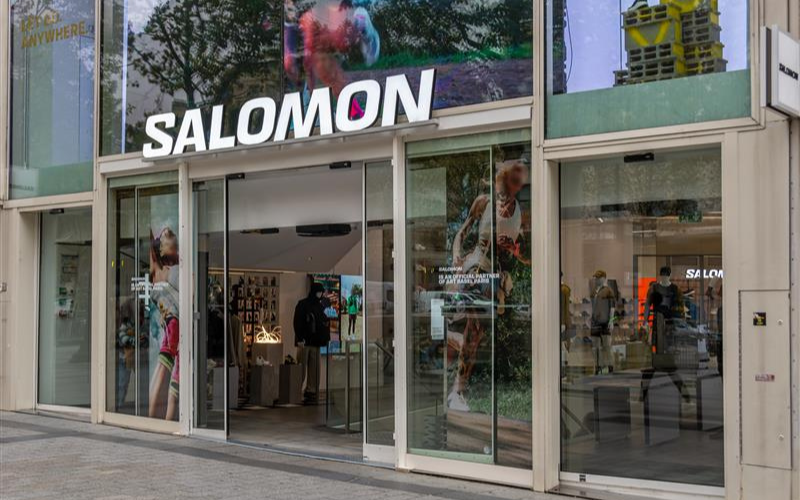
Salomon’s Flatiron store in New York has performed very well since opening in July, and a Beverly Hills location is planned for later this year.
Salomon plans to expand its epicenter approach to Berlin, Seoul, Miami, San Francisco, Chicago, and Boston.
Salomon Sportstyle, Running, and China
The XT-EVO, a more premium evolution of Salomon’s Sportstyle line, has gained traction in key epicenters, especially with a younger audience. Salomon also launched a global winter campaign starring brand ambassador Jisoo, the singer and actress, who drew a large crowd at the brand’s new Beijing flagship opening. That generated 2 billion impressions in one month, Zheng said.
Meyzenq said Salomon is building a new category, the outdoor sneaker, which remains a small niche of the sneaker market. In 2027, Salomon will launch a Sportstyle shoe inspired by early-2000s adventure racing. A running innovation is coming for Spring/Summer 2027.
On the performance side, Salomon launched the second-generation S/LAB Genesis trail shoe at UTMB, where it accounted for one in five shoes and two of every three hydration packs worn. Salomon will become Ironman’s Global Premier Partner starting in 2027.
Salomon opened 15 net new shops in Greater China in the quarter, bringing its total to nearly 330 owned and franchise partner doors. It expects to open about 50 net new stores there this year, increasingly in larger formats that include apparel, and sees potential for 400 to 500 doors in China long term.
In APAC, Salomon opened seven net new stores in Japan and Australia. In Europe, it opened shops in Barcelona in July and Liverpool in September, and Sportstyle remains its biggest growth driver there.
Amer Sports raised its 2026 Outdoor Performance revenue growth forecast to 28% to 29%, from 27% to 28%.
Winter Sports Equipment and an Atomic Leadership Change
Winter Sports Equipment had a very strong third quarter, with strong early-season shipments and solid order books for the winter, and continued to gain market share in a competitive market, executives said.
Atomic-Armada President Wolfgang Mayrhofer is retiring after 41 years with the company. Atomic-Armada CFO Michael Absmaier, who has 22 years at the company and in the industry, including the last three as CFO, will become President in January. Atomic has more than doubled in size over the last 10 years under Mayrhofer, Zheng said.
Wilson Tennis 360 Leads Ball & Racquet
Ball & Racquet revenue rose 12% to $391 million, or 11% on a constant currency basis, led by Wilson Tennis 360 softgoods and racquets. Zheng said the Defyer was the No. 1 performance racquet in the U.S. in September, and Wilson now has nine of the 15 top-selling racquets in the U.S. tennis specialty market.
Wilson’s full Tennis 360 offering is now in 450 Dick’s Sporting Goods doors, and the brand opened its first store in Miami at Aventura Mall.
The segment’s adjusted operating margin fell 210 basis points to 6.1%, mainly due to investment in Wilson softgoods, including tennis tour pros.
Forecast and Share Buyback
Amer Sports now forecasts 2026 revenue growth of 25% to 26%, including about 200 basis points of currency benefit, up from its prior forecast of about 24%. It expects adjusted earnings of $1.32 to $1.35 per share, up from $1.27 to $1.30.
For 2027, the company expects revenue growth at the midpoint of its long-term range of low double digits to mid-teens, with adjusted operating margin expansion at the low end of its 30 to 70-plus basis point long-term range.
The new $1 billion buyback has no expiration date, and Amer Sports expects to repurchase up to $200 million in shares before the end of 2026.


