
Key Takeaways:
- A warm October cut into fleece and outerwear sales, President and CEO Lauren Hobart said, but the core business still gained share.
- Executive Chairman Ed Stack said more underperforming Foot Locker stores will close.
- Stack said Nike’s Jordan reset will be painful for Foot Locker in the short term.
Dick’s Sporting Goods, Inc. raised its full-year 2026 forecast Tuesday after its core Dick’s business gained market share in the third quarter, even as an unseasonably warm October slowed sales of fleece and outerwear.
Executive Chairman Ed Stack said on the company’s earnings call Tuesday that more underperforming Foot Locker stores will close in North America, Europe, Australia, and New Zealand. He added that Nike’s reset of its Jordan brand will weigh on Foot Locker into next year.
For the quarter ended Oct. 31, consolidated net sales rose 23.2% to $5.13 billion, mainly because the company owned Foot Locker for the full 13 weeks versus about eight weeks a year earlier. Net income rose to $161 million, or $1.87 a diluted share, from $75 million, or 86 cents, a year earlier. Excluding one-time items, earnings were $1.94 a share, down from $2.07. Gross margin was 32.4%, down from 33.1%.

The Dick’s business posted comparable sales growth of 2.6% on top of a 5.7% gain a year ago, with net sales up 3.1% to $3.34 billion. The Foot Locker business had net sales of $1.80 billion, proforma comparable sales growth of 0.5% and an operating loss of $40.9 million.
Shares of Dick’s rose 13.9% to $152.22 in morning trading Tuesday, up $18.55 as of 10:11 a.m. Eastern time.
“One of the great advantages of the company we’ve built is the breadth and flexibility of our portfolio. If the consumer moves between brands or categories, we move with them,” Stack said.
House of Sport and Newer Brands
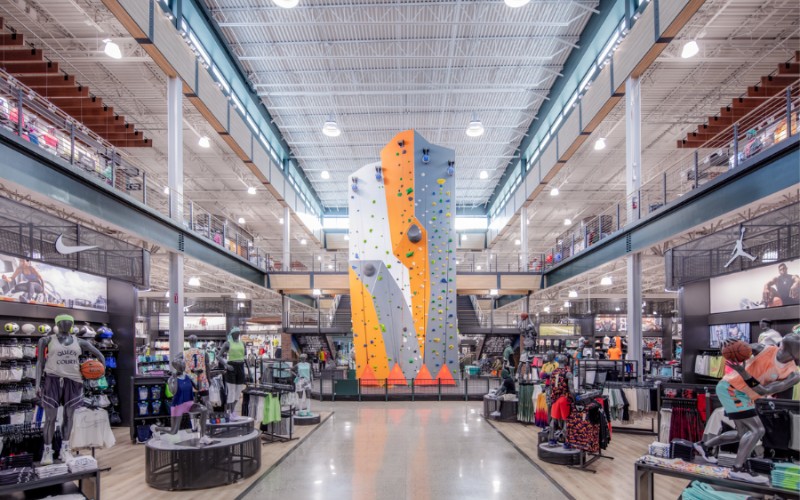
Dick’s ended the quarter with 47 House of Sport stores, its experiential format built around experience, service, community, and product, after opening six stores in the quarter.
“House of Sport is creating more opportunities for unique collaborations and access to differentiated products, while serving as an increasingly important platform for our brand partners,” President and CEO Lauren Hobart said on the call.
“For newer brands, it provides a powerful platform to launch and build their business with us before expanding across our broader portfolio,” she said. “We’ve seen that with brands like Hoka, On, and FP Movement, and we’re excited about newer relationships with brands including Gymshark, Vuori, and Arc’teryx.”
The company also opened three Dick’s Field House locations in the quarter, bringing that total to 55. Field House brings the best of House of Sport to the company’s traditional 50,000-square-foot store. Chief Financial Officer Navdeep Gupta said the company expects to end the year with 49 House of Sport stores and well over 50 Field House locations.
Stack said the company still expects each House of Sport to generate about $35 million in omnichannel sales in its first year. Hobart said Field House locations are now expected to generate about $17 million in first-year omnichannel sales, stronger than the company initially expected.
The format is also opening doors with landlords, according to Hobart.
“As a result, we now have access to some of the best real estate in the country, including locations like Tysons Corner, Palm Beach Gardens, and Topanga in L.A., opportunities that simply were not available to us five years ago,” she said.
Warm October Hits Fleece and Outerwear
Hobart said the Dick’s business had a very strong back-to-school season. Footwear outperformed the overall comp, and team sports, licensed products, and trading cards also grew. Soccer saw higher demand following this summer’s FIFA World Cup.
The weather turned in the final month of the quarter.
“In October, as we all know, it was a very unseasonably warm October, and for us at Dick’s, that’s a time when the cold weather apparel categories are very heavy in our mix, so fleece is a big driver in October,” Hobart said. “That warm weather certainly affected our comps for the quarter and our transactions for the quarter, but base business is doing really, really well.”
Asked by UBS analyst Michael Lasser to quantify the weather impact, Hobart said the company would not break it out. Gupta said average ticket rose 3.7%, while transactions fell 1.1%.
Hobart said the company is not seeing shoppers trade down.
“This quarter, we did also see all income demographics grow, and we didn’t see trade-down from best to better or better to good,” she said.
In the Dick’s business, gross margin declined 26 basis points, Gupta said. Higher occupancy and supply chain costs, including fuel, and pricing investment in athletic footwear outweighed gains from the Dick’s Media Network and GameChanger.
GameChanger Approaches $200 Million
This month marks 10 years since Dick’s acquired GameChanger, its youth sports mobile platform for live streaming, scheduling, communications, and scorekeeping. The company expects GameChanger revenue to approach $200 million in fiscal 2026.
“GameChanger’s annual revenue has grown from approximately $8 million when we acquired the business to nearly $150 million in fiscal 2025, a compound annual growth rate of nearly 40%,” Hobart said.
Responding to BTIG analyst Bob Drbul, Hobart said GameChanger launched a basketball product this past season. She noted that more than 13 million U.S. kids ages six to 17 play basketball.
“While we remain excited about continued growth in diamond sports, basketball is our next significant opportunity,” she said.
Caitlin Clark Partnership
Dick’s recently signed a multi-year partnership with Caitlin Clark. She is the first brand partner across both Dick’s and Foot Locker. Stack said the Caitlin 1 shoe launch contributed to the quarter.
“Caitlin was probably more important for Dick’s than it was for Foot Locker, to be honest with you,” Stack said.
Foot Locker Store Closures
“We also made solid progress at Foot Locker, despite the athletic footwear market continuing to be challenging,” Stack said. “Global Foot Locker comps increased 0.5% for the quarter, with the U.S. Foot Locker banner, where we focused our efforts first, comped over 4%.”
Gupta said the U.S. banner’s comparable sales rose 4.1% and North America rose 1.3%. International comps fell 1.8%. Stack said the company added about 75 Fast Break stores in the quarter, its capital-light approach to revitalizing stores. That brings the total to about 390 globally, and he said they continue to outperform the rest of the fleet.
Asked by Goldman Sachs analyst Kate McShane about underperforming stores, Stack said closures are coming.
“There are stores in North America, in Europe, in Australia, and New Zealand that aren’t meeting our profitability expectations, and we don’t see a path by which we could get them there,” Stack said. “So, they’ll be closed, and we’re starting to have these conversations with landlords about how we’re going to go about that.”
The Foot Locker business has closed 125 company-operated stores so far in fiscal 2026, according to the release. That includes 75 Foot Locker stores identified in the company’s review of unproductive assets. The WSS banner shrank to 98 stores from 143. The Foot Locker business ended the quarter with 2,203 company-operated stores, plus 271 licensed stores. Across both businesses, the company operated 3,097 stores.
Dick’s has recorded $520 million in pre-tax charges tied to that review and integration work so far. It expects total charges of up to $750 million.
Stack singled out WSS. “The team delivered positive comps and a profitable quarter,” he said.
D.A. Davidson analyst Michael Baker asked why the U.S. was ahead of the rest of Foot Locker. Hobart said the company started its work in the U.S. and that Europe faces a harsher geopolitical and economic backdrop.
“EMEA is going to be a longer slog than North America, and we are continuing to take the lessons of things that are working here and translate them,” she said.
Jordan Reset and Promotional Footwear
Morgan Stanley analyst Simeon Gutman asked about the promotional footwear market and Nike’s planned Jordan reset.
“As far as the Jordan piece goes, I think it should be known that the Nike business at Foot Locker is really doing quite well. It’s the Jordan business that’s been difficult,” Stack said.
“We’re going to be a big beneficiary of the Jordan change longer term, but it is going to be a little bit painful, and more so for Foot Locker than for Dick’s going forward into next year,” he said.
Stack said too much legacy product remains in the market, but newer styles and brands such as On, Hoka, Birkenstock, and Ugg are performing well.
“It’s going to continue to be promotional through the balance of the quarter and maybe a little bit into next year as everybody kind of cleans through that inventory,” he said.
Inventory totaled $6.15 billion at quarter-end, up 9% from a year earlier. It rose 6% in the Dick’s business and 16% in the Foot Locker business. Responding to Barclays analyst Adrienne Yih, Stack said Foot Locker’s excess is concentrated in legacy silhouettes.
“We will clear through that inventory, and it’ll take through 2027, because we don’t want to just dump that inventory in the marketplace,” he said.
Full-Year Forecast
For the full year, Dick’s now forecasts:
- Consolidated net sales of $22 billion to $22.2 billion, up from $21.9 billion to $22.2 billion.
- Earnings of $11.40 to $12.25 a diluted share, up from $10.94 to $11.94. Excluding one-time items, earnings of $11.45 to $12.30, up from $11 to $12.
- Comparable sales growth of 3.3% to 4% in the Dick’s business, up from 2.5% to 4%. Net sales for that business of $14.6 billion to $14.7 billion.
- Unchanged expectations for the Foot Locker business: proforma comps down 2% to flat and an operating loss of $40 million to $80 million. Net sales for that business of $7.4 billion to $7.5 billion.


