

Walking the exhibitor floor at the National Retail Federation’s Big Show this year, one thing was clear: the experimental phase of artificial intelligence being integrated into the retail industry is over. Large retailers and brands are no longer just dipping their toes in the water. From the warehouse floor to the retail floor, AI is being operationalized to solve specific, gritty business problems.
In conversations with executives from major technology providers who were exhibiting at the show, several clear themes emerged. First, the industry is moving toward “agentic” commerce — where AI agents act on behalf of both consumers and employees. Second, there is a renewed, urgent focus on data foundations because an AI agent is only as smart as the inventory data it accesses, companies said. Finally, technology is being used to arm retail floor employees with better, actionable data rather than simply automating their jobs away.
Here is a sampling of some of the AI retail-related products that companies were talking about at NRF.
Aptos: Data Before Agents
While the industry buzzes about “agentic AI,” POS company Aptos offered a grounding perspective: you cannot run advanced AI on bad data.

“When everybody was like jumping up and down and saying, ‘agentic, agentic,’ we said, ‘you’re not going to get very far if your data is not good,’” said Nikki Baird, Aptos VP of strategy and product, who explained Aptos spent the last year partnering with Snowflake and Tableau to ensure their data foundation was AI-ready.
Agents to Help Retail Employees and Drive Sales
Aptos is focusing on customer intelligence at the point of sale, including three distinct Super Agents coming to Aptos ONE POS.
- Concierge Agent: With this agent, retailers can bring “black book” clientele capabilities, including personalized product recommendations, offers and high-touch engagement, to every customer.
- Store Associate Agent: This agent provides information needed to effectively serve customers — from product details and inventory positions to return options, making every store employee as productive as the best store employee.
- Store Manager Agent: This agent automatically identifies the top challenges within a given store and provides proactive guidance and next steps for resolution to store and district managers, resulting in higher-performing stores chainwide.
The Key Insight:
“For me, what’s important is that as AI becomes more prevalent, customers are now walking into stores with tools like ChatGPT on their phones — just like they once walked in with web-enabled phones to compare prices before buying,” Baird said. “ChatGPT isn’t just the internet on your phone; it’s like having a store associate, knowledgeable about every retailer, right in your pocket.
“Any retailer not thinking about it this way is essentially handing their customer over to ChatGPT or Google Gemini. That’s why we focus on empowering the store associate — creating tools and strategies that truly connect them with the customer. This ensures that the intent, discovery, and conversations don’t go dark for the retailer but instead remain visible and within their sphere of influence.”
Blue Yonder: The Supply Chain Revolution
The pace of change in supply chain management is accelerating at a rate the industry has never seen. Tim Robinson, Blue Yonder SVP of commerce and returns, compared the current AI shift to containerization, which revolutionized the supply chain by using standardized containers to streamline transport, reduce costs, enhance security, and enable seamless global trade.
While containerization took 20 years to mature, AI adoption is “happening in months, not decades,” he said.
Backed by $2 billion invested in supply chain AI and innovation over the last several years by parent company Panasonic, Blue Yonder is moving the industry away from siloed point solutions toward end-to-end platforms.
Robinson gave an example of how end-to-end platforms could impact the issue of returns in retail.
Previously seen as a customer experience topic focused on loyalty and convenience (e.g., free and fast returns), returns are now recognized as valuable inventory rather than a cost burden, he said. This shift emphasizes the importance of integrating returns into the planning process to improve accuracy, reduce inventory costs, and enhance overall operations. The approach enables better profitability, sustainability, and customer experience, he said.
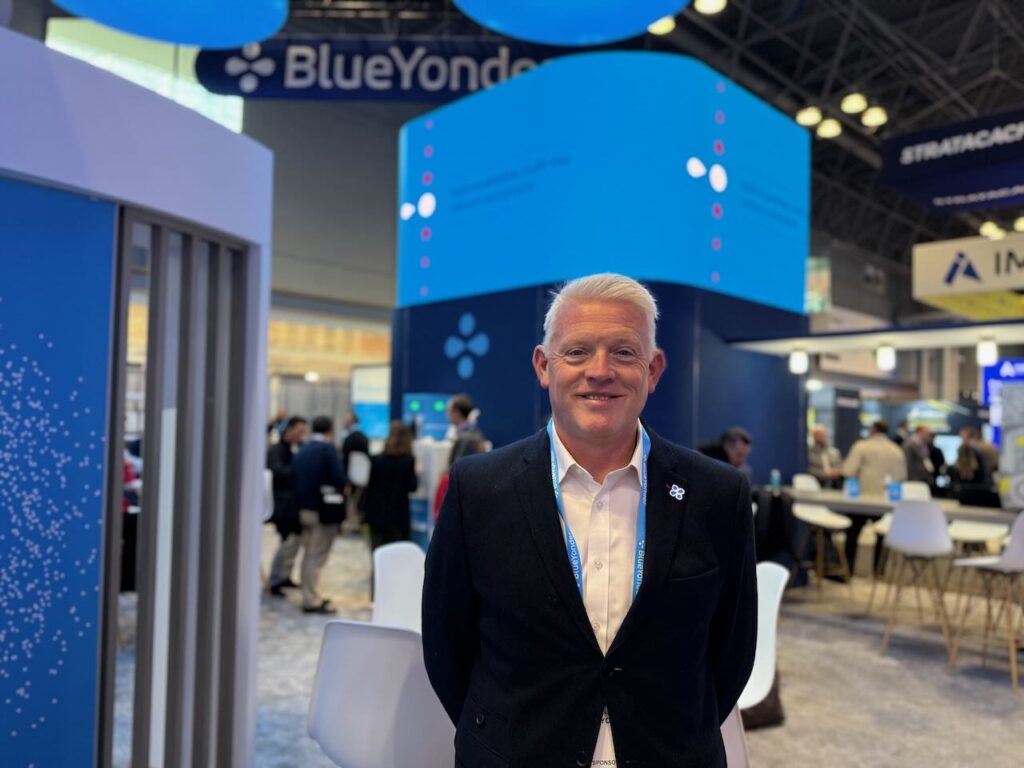
Tim Robinson of Blue Yonder. Photo by SESO.
The Key Insight:
“You don’t really come across anybody that is an AI skeptic anymore,” Robinson said. “AI skeptics in supply chain are now few and far between because they’re seeing it over time, they’ve seen it happen.”
Algolia: Real-Time Data vs. The Crawl
Through a partnership with Microsoft, Algolia allows brands to present products in Copilot and Bing using real-time data rather than relying on web crawlers.
According to Piyush Patel, Algolia chief ecosystem officer, web crawlers provide data from yesterday, while Algolia provides data from right now. This ensures that when an AI agent recommends a product, it is actually in stock and the price is correct.
Brands Maintain Control Through Opt-In Program
Unlike other initiatives that automatically include merchant catalogs, Algolia emphasizes brand control through an opt-in system that allows retailers to choose which platforms to participate in and which products to showcase.
2026 Focus on Grounding AI for Business Reliability
As far as what’s next for the AI landscape overall, Patel anticipates that 2026 will be crucial for “grounding” AI systems to make them more predictable and reliable for business applications, moving away from the current probabilistic nature of AI responses.
“Now, if you ask the same question twice, it’s going to give you two different answers sometimes,” Patel said, referring to the larger AI LLMs. “That’s not acceptable in the business world.”
The Key Insight:
“Why is the LLM (like ChatGPT or Google’s Gemini) going to choose the data Algolia provides over the crawl data? Because we’re going to be able to give real time inventory, real time pricing. And that crawl data is from yesterday,” he said. This reliability is what will separate successful AI commerce from frustrating consumer experiences, he believes.
Nedap: The Inventory Foundation
Nedap is undergoing a significant evolution, transforming from a traditional RFID provider into a comprehensive inventory platform. The driver for this change? The realization that AI agents need a flawless map of inventory to function.
“Retailers want to unlock unified commerce … and understand that they do not have the right inventory foundation for that,” said Nedap General Manager iD Cloud Hilbert Dijkstra.
To solve this, they introduced overhead sensors that provide a real-time picture of exactly where an item is located in a store — not just if it is there, but where it is.
“So you can identify an item being picked up (and examined) in the store (by a shopper), maybe not yet being sold. If an item is being picked up, maybe you don’t want to promise that item to a customer that’s shopping online,” Dijkstra said.
The Key Insight:
Dijkstra was blunt about the relationship between AI and data infrastructure. “I believe that if you had AI on top of a strong, reliable inventory foundation, it is super powerful. If you add AI on sh**ty, low data quality infrastructure, it is a horrible experience.”
Microsoft: Scaling AI Across Functions
The narrative at Microsoft has moved toward scaling AI across the complete retail ecosystem. Microsoft’s Kathleen Mitford, corporate vice president of global industry marketing, emphasized that retailers are now looking to integrate AI not just in isolated silos, but across marketing, merchandising, store operations and supply chain logistics.
The company introduced several new tools designed to weave AI directly into the fabric of commerce. A notable launch was Copilot Checkout, which allows customers to complete purchases directly within the Copilot interface. This system is already being adopted by major players like Etsy, allowing a user to search for “blue and yellow themed birthday party decorations” and purchase them without ever leaving the chat interface.
They introduced “Brand Agent,” an out-of-the-box personal shopping assistant for Shopify sites, and a catalog enrichment agent template that automatically extracts product attributes from images to clean up data.
Microsoft also introduced the store operations agent template. By analyzing internal signals like sales trends and foot traffic alongside external factors such as weather, local events, and holidays, it delivers contextual recommendations for staffing, KPIs, and operational priorities.
The Key Insight:
“One of the things that really differentiates Microsoft is doing all this in a responsible way,” Mitford said, emphasizing security and trust as major selling points for enterprises wary of data leaks.
Stripe: The Financial Processor of Agentic Commerce
While others are building the agents, Stripe is building the rails they run on. Stripe’s Chief Revenue Officer for AI Maia Josebachvili highlighted a massive shift in sentiment: retailers are ready to implement real AI solutions now.
“Six months ago, there was a lot of wait and see… the last meetings we had just in Q4, 19 out of 20 companies we met with are all actively doing something,” Josebachvili said
Microsoft has partnered with Stripe to integrate its payments infrastructure into Copilot Checkout, allowing users to buy products from some retailers directly within the chat interface, ensuring the merchant retains control of the transaction while the AI handles the discovery.
Stripe also co-authored the Agentic Commerce protocol with OpenAI, a move that positions them as an important node between AI platforms and merchants. They also launched an Agentic Commerce Suite focused on three pillars: giving AI systems visibility into products, allowing retailers to retain control over the checkout experience, and preventing AI-specific fraud.

Maia Josebachvili of Stripe. Photo courtesy of Stripe.
The Key Insight:
“I think that’s what puts us in a really unique position, is because we do partner with both sides, and so we’re able to be a trusted node between the AI platforms and the merchants,” Josebachvili said. This trust is essential as retailers navigate the new territory of having machines purchase on behalf of humans, she said.
First Insight: Meet Ellis, the AI “Octopus”
With major clients including Under Armour and Wolverine, First Insight’s technology helps retailers and brands predict product success, optimize inventory allocation, and reduce market misses through consumer sentiment analysis and predictive algorithms, said Viki Zabala, First Insight chief strategy and growth officer.
Now, the company has launched “Ellis,” a new agentic AI platform that allows retailers and brands to query 18 years of proprietary consumer data using natural language.
The key differentiator for Ellis is the depth of historical data, she said. First Insight mines nearly two decades of its consumer sentiment and testing data to help merchants understand regional trends and category performance. Unlike generative tools that might “hallucinate” trends, First Insight closes the loop by matching their predictions with actual sales data from customers. (In AI, “hallucinate” refers to generating false or nonsensical information that appears plausible but is not based on actual data or facts.)
The Key Insight:
“Instead of looking at reporting and multiple dashboards, we now have [Ellis], and basically you can ask Ellis anything,” Zabala said.
Zebra Technologies: Empowering the Frontline
Zebra Technologies focused its NRF presence on making jobs “better, faster, easier” for frontline workers. Their approach integrates AI into the devices and workflows employees already use.
They showcased new technology that allows warehouse workers to scan multiple barcodes simultaneously, capturing data from an entire pallet in a single pass rather than scanning box by box. On the retail floor, they are piloting conversational AI assistants with wine retailer Total Wine. Employees can ask natural language questions on a handheld device about wine pairings or inventory levels and get immediate answers.
The Key Insight:
Zebra is also pushing the boundaries of visibility with “always-on” RFID. “If you make the move to automated sensing, always on everywhere, reading RFID, you can now do some things with your associates that you couldn’t even imagine before,” said Matthew Guiste, Zebra global retail technology strategist. This moves RFID from a periodic auditing tool to a real-time operational sensor, he said.
Oracle: The Connected Journey
Oracle Retail is moving away from selling siloed products to offering a “connected journey.” Their strategy is to embed AI into existing workflows — planning, supply chain, and customer experience — to make them more efficient.
“I’m going to help the shopper have a better experience by utilizing AI. I’m going to help the merchandiser be able to get better efficiency through AI,” said Paul Woodward, Oracle global vice president, retail product. Oracle is also focusing heavily on the human element, redesigning solutions to support store associate well-being by reducing the number of out-of-stock items, which is a leading cause of employee stress.
The Key Insight:
“One-third of store associates at least go home once a week crying,” Woodward said. “And the reason for it is when the product’s not in the shop, we take it out on the person telling us it’s not in the shop.” By using AI to ensure inventory accuracy and supply chain transparency, Oracle aims to improve the daily life of the human worker.


