

Key Takeaways:
- Wolverine Worldwide posted Q1 revenue of $457.6 million, up 11% year over year, beating expectations across all key financial metrics as Merrell and Saucony drove broad-based growth.
- Saucony delivered a record quarter with 15% revenue growth, while Merrell grew 9% and extended its U.S. hike market share gains to 12 of the last 13 quarters.
- The company raised its full-year profit outlook, citing lower expected tariffs, while flagging $36 million in potential IEEPA tariff refunds and monitoring the impact of the Iran conflict on supply chains.
Wolverine Worldwide delivered a first-quarter performance that exceeded expectations on every major financial metric, with its two biggest brands, Merrell and Saucony, leading what CEO Chris Hufnagel described as a company that is becoming a better brand builder.
Revenue rose 11% to $457.6 million, beating the high end of the company’s own guidance, while adjusted operating margin expanded 140 basis points and adjusted diluted earnings climbed 32%.
The results came despite a 270-basis-point unmitigated tariff headwind on gross margin, which held flat at 47.6% year over year, a result Hufnagel and CFO Taryn Miller pointed to as evidence that structural improvements are taking hold.

“The first quarter was a good start to the year, exceeding our expectations across all key financial metrics,” Hufnagel said on the earnings call. “I believe we’re better brand builders today, led by Merrell and Saucony, with encouraging progress now evident across our broader portfolio.”
The company also disclosed it has paid approximately $36 million in IEEPA tariffs and is actively pursuing refunds, though those potential proceeds are not included in current guidance. At the same time, management flagged the conflict in the Middle East as a new variable, noting that the region represents roughly 1% of total revenue and that disruptions to date have been incorporated into the outlook.
Wolverine Worldwide Q1 2026 Financial Results
- Total revenue: Up 11% to $457.6 million compared to Q1 2025; up 7% on a constant-currency basis.
- Merrell revenue: Up 12.7% to $169.7 million; up 8.7% on a constant-currency basis.
- Saucony revenue: Up 20.1% to $155.9 million; up 15.2% on a constant-currency basis.
- Wolverine brand revenue: Down 2.5% to $36.4 million.
- Sweaty Betty revenue: Up 1.5% to $38.6 million; down 4.4% on a constant-currency basis.
- International revenue: Up 20.1% to $249.6 million; up 12.8% on a constant-currency basis.
- Direct-to-consumer revenue: Up 3% to $99.3 million; approximately flat on a constant-currency basis.
- Gross margin: 47.6%, flat compared to Q1 2025.
- Net income: $20.2 million, up from $12.1 million in Q1 2025.
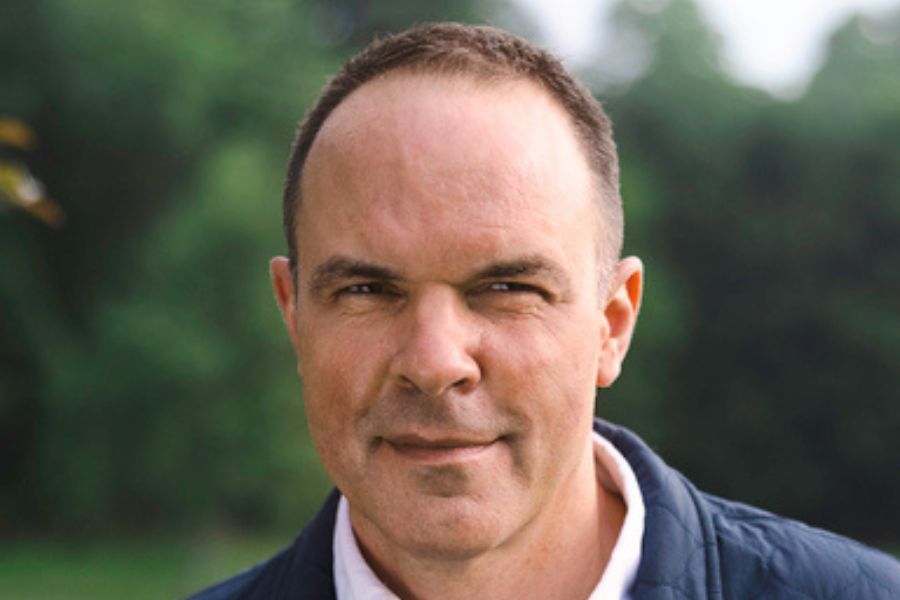
Wolverine Worldwide CEO Chris Hufnagel has led a turnaround at the company.
Merrell: Hike Category Returns to Growth, Brand Hits Its Stride
Merrell posted revenue of $169.7 million in the quarter, up 12.7% on a reported basis and 8.7% on a constant-currency basis, comping against a 14% increase in the same period of 2025. Growth was broad-based across most regions and categories, with both wholesale and direct-to-consumer contributing.
The U.S. hike category, which had been under pressure for several quarters, returned to growth. The hike category industry-wide was flat in the fourth quarter of 2025 and rose 6% in the first quarter of 2026, according to Hufnagel. Merrell gained market share in 12 of the last 13 quarters in the category.
“Hike being up 6% is encouraging for the category in general,” Hufnagel said on the earnings call. “And Merrell gaining share 12 of the last 13 quarters and being the industry leader, I think that bodes well for Merrell’s prospects as we work our way through ’26 and beyond.”
The Agility Peak 6, described as the brand’s premier trail run franchise launch of the quarter, drove growth in the trail run category. The Moab Speed 2 and the iconic Moab 3 both continued to deliver strong growth, supported by fresh colorways and enhanced storytelling. Lifestyle extensions on those franchises, including a woven slide version of the Moab 2, have performed well in Tier 0 distribution and on merrell.com.
Merrell also executed a collaboration on the Moab 3 with South Korean lifestyle brand Khakis, which sold out in Japan and South Korea within minutes. The move reflects a deliberate push to expand the brand’s relevance in influential trend markets across Asia Pacific.
On the marketing front, Merrell launched its new brand platform, “It Starts Outside,” in the first quarter, which Hufnagel said generated strong year-over-year increases in brand search interest. The company is also planning record marketing investment in Merrell this year and kicked off a title sponsorship of the Skyrunner series, a global trail running circuit.
“As Merrell celebrates its 40th anniversary this year, the brand’s momentum is strong,” Hufnagel said on the earnings call.
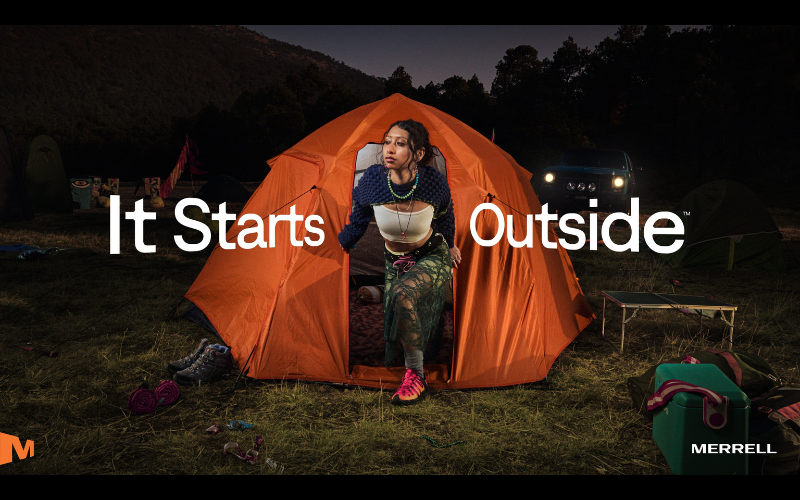
Merrell’s “It Starts Outside” campaign. Photo courtesy of Merrell.
Saucony: A Record Quarter and a Long Runway
Saucony posted its highest-ever quarterly revenue, reaching $155.9 million, up 20.1% on a reported basis and 15.2% on a constant-currency basis. Growth was broad-based across all channels, regions, and categories, with both performance and lifestyle contributing.
Hufnagel described Saucony as “uniquely positioned as a disruptive challenger brand at the intersection of two of the fastest-growing categories in the market, performance and lifestyle running.”
On the performance side, Saucony launched the Endorphin Azura in February, a lightweight super trainer that immediately became a top seller on saucony.com and at wholesale. The Endorphin Pro 5 followed in March. Both products drove strong growth for the Endorphin collection at U.S. retail. At the Boston Marathon, Saucony ranked as the second most-worn brand among women.
In lifestyle, the brand continued to build heat through strategic collaborations, including drops with Sneaker Politics, 316, Greyson, Engineered Garments, and Studio Nicholson. Sell-through rates in the Saucony lifestyle category in the U.S. were higher than the prior year, a data point management cited as supporting confidence in the brand’s trajectory.
“I remain confident we have a very special opportunity in Saucony,” Hufnagel said on the earnings call. “Consumer interest in the brand is reaching record levels around the world.”
The brand is also extending its key city strategy, which began in London, into Paris this year, with a new pioneer store planned, a title sponsorship of the Eiffel Tower 10K, and a series of activations on tap. DTC growth was led by EMEA and the U.S., driven by marketing investment and new product launches.
Saucony faces its toughest comparable quarter of the year in Q2 2026, lapping over 40% growth from Q2 2025. Miller said Q2 will represent the lowest growth rate of the year for the brand but noted the full-year outlook of low- to mid-teens growth remains intact.
“We’re very excited about what we’re seeing for the brand in the U.S. and internationally,” Miller said on the earnings call. “We expect Saucony to grow the full year low- to mid-teens.”

The Saucony SILO AW25. Photo courtesy of Saucony.
New Initiatives: AI, E-Commerce Modernization, and the Key City Strategy
Beyond brand performance, Hufnagel highlighted several strategic initiatives gaining traction across the company.
Wolverine Worldwide is embedding artificial intelligence into its operations, with a stated goal of becoming “faster, more agile and more efficient.” The company is also modernizing its e-commerce platform, a move Hufnagel described as central to becoming a better direct-to-consumer retailer.
The key city strategy, which concentrates marketing investment and brand activations in high-influence urban markets, is expanding. Originally launched with Saucony in London, the approach is now being extended to Paris for Saucony and applied more broadly across the portfolio. Hufnagel said the strategy has been “vital in driving outside brand heat and growth in Europe.”
The company has also been deliberately shifting its marketing investment up the funnel, reducing reliance on performance-driven conversion spending in favor of broader awareness campaigns. Hufnagel acknowledged this shift puts near-term pressure on DTC results but said it is the right long-term move for building premium global brands.
“When you make that shift up the funnel and you become less promotional, it certainly does put pressure short term on the DTC business,” Hufnagel said on the earnings call. “We think it’s the absolute right thing to do for the business for the long term.”
Business Trends: Confidence With Eyes Wide Open
Miller framed the quarter as proof that the company’s operational discipline is translating into financial results. Adjusted operating margin came in 110 basis points above the company’s own projections, driven by expense leverage from revenue growth and what she called “disciplined cost management.”
“We’re encouraged by our first quarter performance, which reinforces our belief that the business is operating from a stronger foundation,” Miller said on the earnings call. “Brand momentum is becoming more evident and the benefits of the work we’ve done are translating into improved financial performance.”
Hufnagel echoed that confidence while acknowledging the uncertainty ahead. He pointed to clean inventory levels at retail, a supported order book for the balance of the year, and continued market share gains across key brands as reasons for optimism. Still, he said the company is staying “appropriately grounded” given the current operating environment, which includes potential consumer headwinds and disruptions tied to the Iran conflict.
“We’ve demonstrated the ability to successfully navigate a variety of challenges over the past three years,” Hufnagel said on the earnings call. “While we’re encouraged by the progress, we’re still not satisfied, and we believe there’s much more opportunity ahead.”
On tariffs, Miller noted that the unmitigated 2026 tariff impact is now estimated at approximately $50 million, down from a prior estimate of $60 million, reflecting a temporary reduction in rates through July. The company has paid approximately $36 million in IEEPA tariffs and is actively engaged in the refund process, though that potential benefit is not reflected in guidance.
The Iran conflict introduced additional complexity. Miller confirmed the Middle East represents approximately 1% of total revenue, and that order cancellations and forecasted reductions from certain distributor markets in the region have been incorporated into the full-year outlook.
Rising oil prices tied to the conflict are also pushing freight costs higher, a factor the company has embedded into its revised gross margin guidance.
Wolverine Worldwide 2026 Outlook
Wolverine Worldwide maintained its full-year revenue guidance and raised its profitability outlook, citing lower expected tariff costs partially offset by higher freight expenses from elevated oil prices.
Full-year 2026:
- Revenue: $1.96 billion to $1.985 billion, representing approximately 5.2% reported growth at the midpoint; unchanged from prior guidance.
- Adjusted diluted earnings per share: Raised to $1.43 to $1.58, up from prior guidance of $1.35 to $1.50.
Second quarter 2026:
- Revenue: $495 million to $500 million, representing approximately 4.9% reported growth at the midpoint.
- Adjusted diluted earnings per share: $0.35 to $0.38.


