
Key Takeaways:
- Vans came in slightly below VF’s second-quarter target as wholesale declines deepened, even as global DTC grew for the first time in almost five years.
- VF now launches new Vans product in e-commerce first, then in select stores and the wider DTC fleet, with wholesale getting it months later.
- Some retailers SESO has talked to say they have not seen Vans improve yet. VF executives say confirmed orders support their second-half forecast.
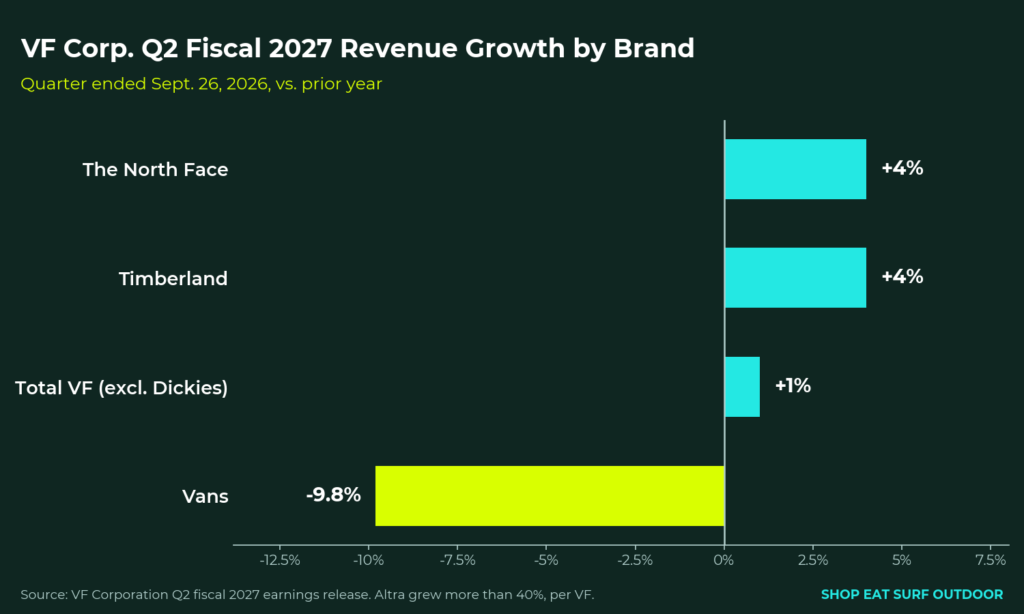
Vans revenue fell 9.8% to $547.6 million in the second quarter ended Sept. 26. That came in slightly below what parent company VF Corporation had told investors to expect. The shortfall came from wholesale, which declined more than it did in the first quarter.
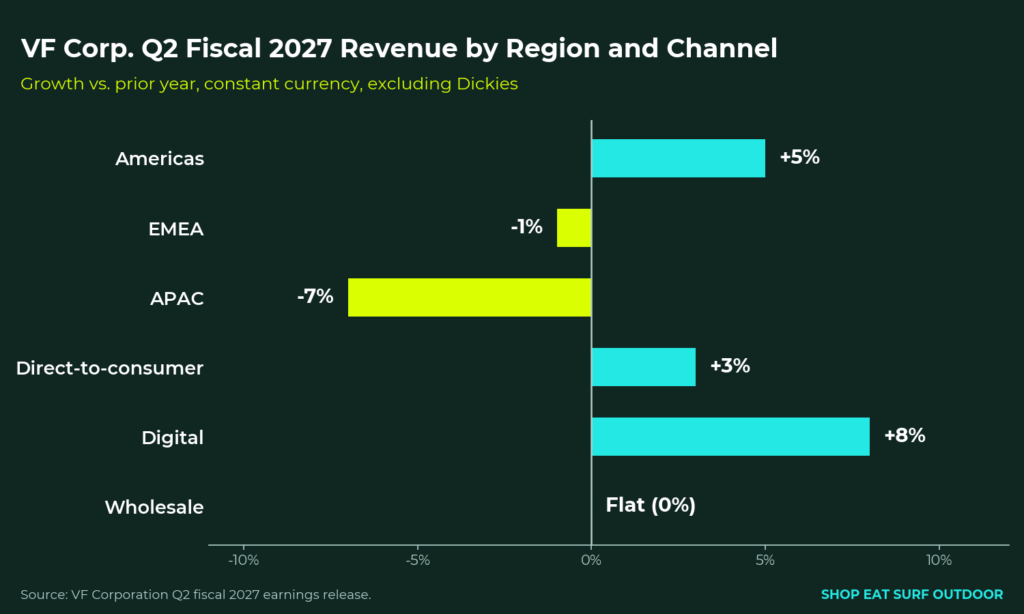
The brand’s direct-to-consumer business moved the other way. Global DTC grew for the first time in almost five years.
VF President and CEO Bracken Darrell attributed the DTC gains to the product engine Vans has built.

“We are introducing new ideas first with small batches in e-com as well as with appropriate partners and cultural platforms, quickly introducing a few of those ideas into limited stores, then scaling a subset of those products into the wider fleet,” Darrell said on the company’s earnings call Wednesday. “Only after that, the product flows into wholesale where sell-in follows six to nine months behind DTC.”
Abhishek Dalmia, VF’s Chief Financial Officer and Chief Operating Officer, said the brand’s second-quarter revenue was “about $3 to $4 million softer than indicated, driven by the wholesale softness in Q2.”
For the first half, Vans’ revenue declined 9% both as reported and in constant currency, to $1.01 billion. That was in line with the forecast VF gave in July.
Vans Wholesale Partners Wait for DTC Momentum to Reach Retail Shelves
Some specialty and larger retailers SESO has talked to said they have not seen Vans’ sales improve yet. However, VF expects Vans’ wholesale to improve in the second half of the fiscal year.
VF executives said visibility into confirmed wholesale orders is why the company reaffirmed its second-half Vans forecast. They also gave a new third-quarter forecast for the brand.
VF expects Vans’ revenue to decline 4% or better in the third quarter and 2% or better in the second half. That would leave the brand down mid-single digits for fiscal 2027.
“We are three months from when we gave the initial expectation of the second half and have better visibility into the confirmation of our orders for Fall/Winter 2026 and Spring/Summer 2027,” Dalmia said.
In a research note, Laurent Vasilescu, an analyst with BNP Equity Research, estimated that Vans’ wholesale fell 20% in the second quarter.

VF Chief Financial Officer and Chief Operating Officer Abhishek Dalmia, left, and President and CEO Bracken Darrell, right, during VF Corporation’s Q2 earnings call Wednesday. Photo from VF Corporation’s earnings webcast.
On the call, Evercore analyst Michael Binetti asked how Vans’ wholesale could recover so quickly from its current declines. Binetti noted that retailers usually don’t increase orders until a brand’s sales improve in their own stores.
In response to a separate question, Darrell said a little destocking is still happening.
“I think that’s kind of natural, and it might continue for a little bit longer,” he said.
A Barclays analyst asked what supports the expected jump in Vans’ wholesale.
“We’re not going to give exact numbers on our order books, but… we’re looking at firm orders,” Darrell said.
Dalmia said sell-in for Spring/Summer 2027 began around the middle of this year. That was after Vans had started launching many of its new styles in e-commerce in the third quarter of last fiscal year.
“It is a natural progression where wholesale will only catch onto this heat on a six-to-nine-month lag,” Dalmia said.
He said the third quarter is typically a heavy DTC quarter for Vans, so the bigger wholesale swing will come in the fourth quarter, when Spring/Summer 2027 product starts shipping.
Darrell said the order strength comes mostly from existing Vans partners. He added that there is some door expansion, but the increase comes mainly from higher sell-through expectations and new styles. Dalmia said the biggest driver is existing stores giving Vans more shelf space.
“Our direction at Vans is clear, and I am confident that we will see acceleration,” Darrell said.
Old Skool, Authentic and New Silhouettes Lead DTC Growth
Darrell said the Vans turnaround is being driven primarily by product, through refreshed icons and new silhouettes.
Icons grew in DTC during the quarter, led by Old Skool, with fresh expressions such as Pearlized and Souvenir driving demand. The Pearlized Old Skool Yacht Club achieved 100% sell-through in the Americas in less than 24 hours, according to Darrell. Authentic posted strong double-digit growth across channels, and Slip-On returned to growth in DTC. Half Cab and Era grew strongly off a smaller base.
New styles include the Super Lowpro, mules, and a loafer. Darrell said there are many categories the product refresh has not touched yet, especially apparel and women’s footwear, and that the pace of new product could accelerate.
Darrell also pointed to recent consumer recognition:
- ComplexCon: Demand for a Satoshi collaboration launch was strong enough that Vans briefly shut down its booth. A follow-up DTC-only drop sold out in five minutes, and the shoe made the top 10 list for ComplexCon’s Sneaker of the Year 2026.
- AlixPartners: The firm named Vans the No. 2 fashion footwear brand in its Consumer Sentiment Index.
- Teen survey: Darrell said a teen survey named Vans one of the top brands among its target consumer.
“You can feel throughout our organization that Vans is getting its mojo back,” Darrell said. “There’s beginning to be a swagger in Costa Mesa that was missing for some time.”
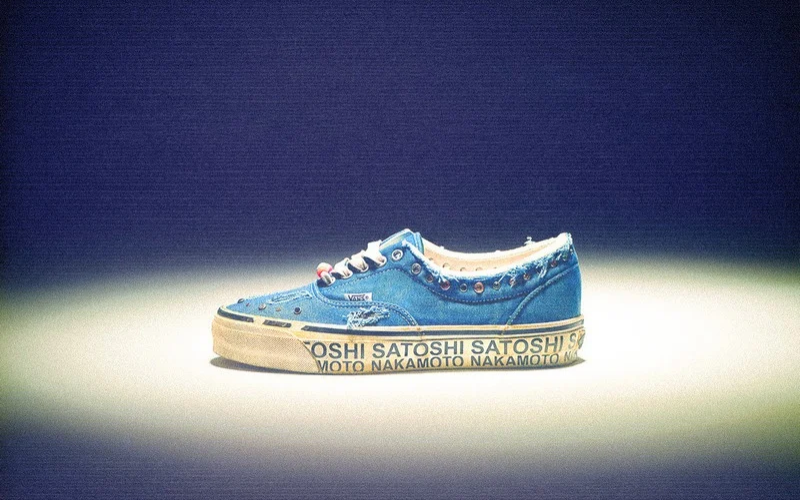
OTW by Vans x Satoshi Nakamoto. Photo courtesy of Vans.
By channel, Darrell said Vans e-commerce is stronger than its physical stores, which in turn are stronger than wholesale. Last quarter about 60% of the Vans store fleet was growing, and the share is a little better this quarter, he said. Darrell added that VF will probably eventually do “the tail-end cleanup” of stores that are not delivering, though he does not expect that to be a big number.
Darrell said Vans products priced at $120 and above are getting some of the brand’s highest recognition, while it also sells product at $60 to $70. That range leaves the company protected, though not totally insulated, from economic uncertainty, he said.
Vans Declines Across All Regions
Vans revenue fell in every region during the second quarter:
- Americas: Down 6% as reported, or 7% in constant currency.
- EMEA: Down 15% as reported, or 14% in constant currency.
- APAC: Down 18% as reported and in constant currency.
Darrell said the global DTC gain reflected continued growth in Americas DTC, improved performance in EMEA DTC and encouraging signs in APAC DTC.
VF Corp. Q2 Results at a Glance
Data verified by Shop Eat Surf Outdoor, visualized using AI.
VF’s total second-quarter revenue fell 4% as reported and in constant currency, to $2.70 billion. Excluding Dickies, which VF sold in November 2025, revenue rose 1% both as reported and in constant currency.
The North Face and Timberland each grew 4%, and Altra grew more than 40%.
Darrell said that while Altra is still relatively small, its footwear growth is expected to fully offset the decline in Vans footwear for fiscal 2027.
Gross margin rose 320 basis points to 55.4%. Excluding Dickies on an adjusted basis, gross margin was also 55.4%, up 290 basis points. Net income rose to $285.3 million from $189.8 million a year earlier.
Net inventories rose 7%, which VF said is to support demand in the second half.
VF maintained its fiscal 2027 forecast for revenue growth of 2% or better in constant currency, adjusted operating margin of about 8%, and a year-end leverage ratio of 2.6x to 2.9x.
Data verified by Shop Eat Surf Outdoor, visualized using AI.


