
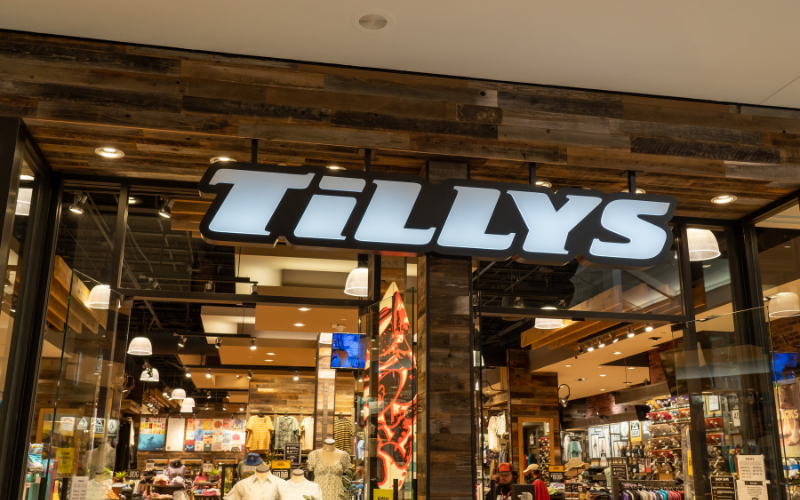
After years of losses and a prolonged sales slump, Tilly’s is turning a corner, according to executives on the company’s fourth-quarter and full-year earnings call on Wednesday.
In fiscal 2025, the specialty retailer:
- Closed 21 stores.
- Brought on new CEO Nate Smith in July.
- Overhauled its merchandising and invested in price optimization technology.
The result: seven consecutive months of comparable net sales growth and the company’s first profitable fourth quarter since fiscal 2021. On the company’s Wednesday earnings call, Tilly’s executives said they’ll open new stores in 2026.
Comparable net sales turned positive in August 2025 and built momentum from there. CFO Michael Henry laid out the monthly progression, noting comp net sales were:

- +1% in August and September.
- +6% in October.
- +8% in November.
- +10.6% in December.
January and February 2026 have come in at +12.4% and +20.1%. respectively, Henry said, and March is off to an even stronger start.
“[We’re] really excited to see this kind of performance,” Henry said. “Our conversion rate has been super strong. It’s been high teens, double-digit percentage increase compared to last year. Traffic has been improving, both stores and e-com performing — all departments positive. So pretty much everything is moving in a favorable direction.”
That momentum drove full-year fiscal 2025 comparable net sales to increase 0.3% — the first positive full-year comp since fiscal 2021.
Fewer Stores, Better Economics
Tilly’s closed 21 stores across fiscal 2025, ending the year with 223 locations. Closing underperforming stores reduced occupancy costs and concentrated sales in higher-performing locations.
The effect was visible in the fourth-quarter numbers. Despite operating with 17 fewer net stores than the prior year, total net sales from physical stores increased 3.6%. Comparable store net sales from physical stores increased 10.3%.
Gross margin expanded to 33.2% of net sales in Q4, up from 26.0% the prior year — a 720 basis point improvement. Product margins improved by 470 basis points, driven by higher initial markups and lower total markdowns. Buying, distribution, and occupancy costs improved by another 250 basis points.
Tilly’s plans to open four to six new stores in fiscal 2026.
Sales per square foot are approximately $260 per square foot — well below historical levels, Henry said.
“We would expect ourselves to continue to improve on that metric,” Henry said. “And as we do, it will continue to give us greater confidence in even expanding the rate of store expansion that we’ve noted for this year to even higher levels in future years.”
Henry acknowledged the recovery is still in its early stages. “We struggled a lot through fiscal ’22, ’23, ’24, first half of ’25, and we’re just beginning to regain that lost ground that we struggled with for that three- to four-year period. So we’ll walk before we run.”
What Tilly’s Changed in the Assortment
CEO Nate Smith, who was appointed CEO in July 2025, was direct about the root cause of the company’s earlier struggles: the assortment. Tilly’s had been carrying aged, excess inventory and selling a disproportionate amount of product at off-price. The fix required overhauling the brand mix, clearing that inventory, and rebuilding with fresher, full-price merchandise.
“It really is across every category,” Smith said on the earnings call. “We’re not seeing any spike in any particular category. We’re seeing strength across the board, both genders and kids … our private label is working as well.”
Smith credited Michael Cingolani, who Tilly’s promoted to chief merchandising officer on March 10, for leading much of that work. The shift to healthier inventory levels and stronger assortments across categories contributed directly to the product margin improvement the company reported.
Technology, AI and Price Optimization at Tilly’s
Tilly’s invested in operational technology in the second half of fiscal 2025. A price optimization tool contributed to the fourth-quarter product margin improvement, while new warehouse management software implemented in mid-fiscal 2024 is driving labor efficiencies in store and e-commerce distribution centers.
Looking ahead, the company is rolling out an AI-driven merchandise allocation tool developed with Impact Analytics in the latter part of fiscal 2026. Tilly’s also plans to launch RFID technology, which Smith said will improve inventory accuracy, reduce stockouts and cut manual inventory counting time by approximately 80% to 90%.
“We’re approaching this from both sides,” Smith said, “not only sales per square foot, but what we would consider to be efficiency on the back end.”
Tilly’s Q4 and Full-Year Financial Results
In the fourth quarter, total net sales increased 5.3% to $155.1 million. Net income reached $2.9 million, or $0.10 per diluted share, compared to a net loss of $13.7 million, or $0.45 per share, in the prior year — an improvement of $16.6 million, or $0.55 per share.
SG&A expenses declined $3.5 million to $48.9 million, or 31.5% of net sales, down from 35.6% the prior year. Operating income improved to $2.6 million from an operating loss of $14.1 million.
For the full fiscal year, total net sales declined 2.8% to $553.6 million, reflecting the deliberate reduction in store count. Full-year net loss was $17.5 million, or $0.58 per share — an improvement of $28.7 million compared to the prior year’s loss of $46.2 million. Gross profit improved to $164.5 million, or 29.7% of net sales, up from $149.7 million, or 26.3%.
The company ended fiscal 2025 with $87.8 million in total liquidity, including $46.3 million in cash and $41.5 million of available borrowing capacity. Inventories were 10.8% lower year over year with improved aging.
Tilly’s Path to Full-Year Profitability
Tilly’s is not yet profitable on a full-year basis. Henry estimated that an annualized comparable net sales increase of approximately 8% to 9% would be required to generate profitability for fiscal 2026 as a whole, which is a threshold the company’s recent comp trajectory puts within reach, assuming current trends hold.
For the first quarter of fiscal 2026, Tilly’s is anticipating total net sales of $119 million to $125 million, translating to a comparable net sales increase of 16% to 22%. The company expects product margin improvement of approximately 310 to 330 basis points and SG&A of $44 million to $45 million. Net loss is projected at $8.0 million to $10.1 million, compared to a loss of $22.3 million in last year’s first quarter.
“We believe our turnaround is real,” Smith said. “The fundamentals are fixed. Our top line is growing. We are looking to reinitiate store growth. We must continue to build upon the progress made thus far. The team has done the hard work, now we’re optimizing.”


