
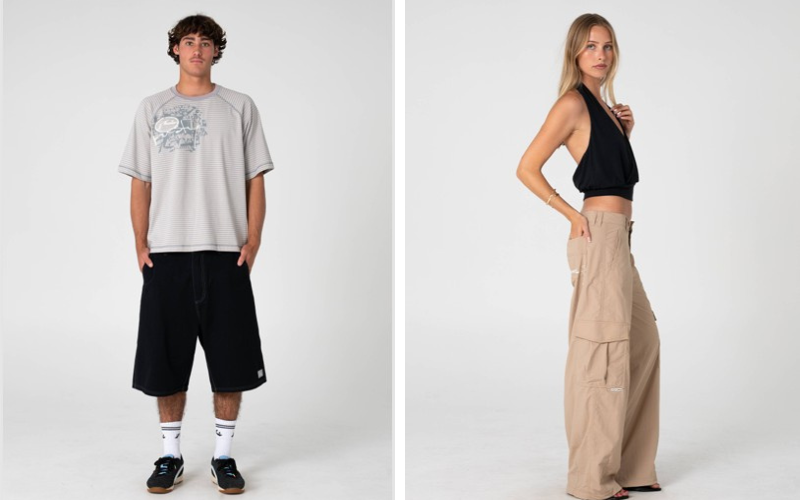
Rusty Apparel is rebuilding its North American presence under a licensing arrangement with Rhythm, leveraging the heritage brand’s four-decade catalog to target a younger surf and skate consumer.
Aaron Griffiths, North America sales manager for Rusty USA, spoke with SESO about the brand’s operational structure, product strategy, and how its account base has evolved over the past year.
Here at SESO, we have heard from several influential retail accounts that the brand – and its retro styles – are selling well with younger shoppers interested in fashion.
How does the current operational structure for Rusty differ from previous iterations of the brand, and how is Rhythm involved?
Aaron Griffiths, North America Sales Manager, Rusty USA: We are a licensee of Rusty Australia. As head of sales in North America, I report directly to Josh Barrett, who is both the global GM of Rhythm and the GM of Rusty USA. In past iterations of the brand, the head of sales in the U.S. would report directly to the president of Rusty Australia.

We use the strength of brand and design creative from the Rusty head office, while also utilizing Rhythm’s experience in the North American marketplace.
We share a supply chain, our Irvine warehouse and operational departments with Rhythm, but the brands remain separate from a design, marketing and creative perspective. We feel the brands very much complement each other and don’t directly compete, which is why this structure works well.
How would you describe Rusty’s current aesthetic, and how is the brand trying to differentiate in a crowded market?
Aaron Griffiths: Rusty’s current aesthetic is probably best described as Y2K streetwear for the surf and skate crowd. As a heritage brand that’s been around for over 40 years, we’re able to draw from past catalogs and maintain a legitimacy that most brands can’t.
We offer a standard four-season buy like everybody else, but on top of that we’ve got the Rusty Experimental Division, or R.E.D., which drops four times a year. R.E.D. is our quick-to-market program — it ships 60 days after the product is ordered, allowing us to supplement seasonal buys with the latest product. We share a global release date with Australia, which helps us stay on top of constantly changing trends.
We’re bringing fun, loud, branded product to an industry that needs it. Our target customer is the high school and college-age kid that doesn’t want to look like their dad or mom. Ironically, their dad and mom wore almost the same looks from Rusty back in the day.
What types of accounts is the new version of Rusty resonating with?
Aaron Griffiths: Right now, we’re resonating with any accounts that carry our product. I’ve spent most of my life in this industry with some great brands, and I’ve never seen sell-through at the account level like what we’re seeing now.
We have the unique opportunity to reset our account base while the brand is a hot commodity. We’re focused on top accounts in the surf and skate world and keeping our distribution clean.
What are the strongest Rusty categories for men?
Aaron Griffiths: Long boardshorts and oversized cut-and-sew tees are on fire for spring. Our jorts and oversized denim also continue to be strong sellers.
What is Rusty’s women’s strategy?
Aaron Griffiths: Our women’s strategy is to stay on top of market changes with our R.E.D. collection. We’ve already seen some changes to our women’s bestsellers. We still sell women’s jorts well, but our micro miniskirts, baby tee cut-and-sew tops and wide-leg denim have been driving our women’s growth. We’ve also got a small but growing women’s swim collection.
Given the many changes with Rusty over the years, have you faced challenges getting into certain accounts?
Griffiths: I started with Rusty in July 2024, and the first six months were tough. We were ahead of the market, our product mix wasn’t quite right, and customers tend to be resistant to change.
In the second six months, we were able to get influential accounts like Jack’s Surfboards, Sun Diego and Tilly’s to give the brand another shot. We also started pulling our lines directly from Australia, which gave us a more cohesive look.
Over the last eight months, things have really taken off for the brand. We’re now in top surf and skate retailers across the country. Along with the accounts I mentioned, we are also in Hansen’s, Proof Lab, Brave New World, Farias, 17th Street, WRV, Aqua East, Innerlight, The Room and Hanalei Surf Co., just to name a few.


