
WATCH AN ON-DEMAND REPLAY OF THE WEBINAR HERE
Key Takeaways:
- Active lifestyle brands say LLMs are currently favoring authentic storytelling and deep community ties over SEO-style shortcuts.
- Skullcandy uses a custom AI chatbot for copywriting but still requires human editors to preserve brand voice.
- Research that once took a month now takes a week and a half, according to Unlisted founder Candy Harris.
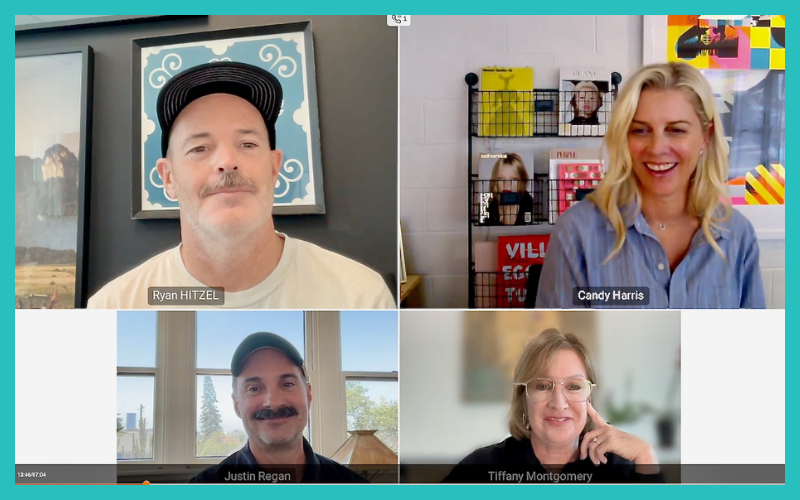
Last week, three company leaders joined Shop Eat Surf Outdoor to talk everything AI: how they’re adopting it at their own companies, the AI trends they’re seeing in the active lifestyle industry, and the tools and applications that have been game-changing so far.
They also talked about what isn’t changing, why human talent still matters, and how some of the active lifestyle industry’s fundamentals: authenticity, deep community connection, rich storytelling, are more important than ever.

Tiffany Montgomery, SESO’s Group Director of Content and Editorial, led the conversation with Candy Harris, Founder and CEO, Unlisted Brand Lab; Justin Regan, Vice President of Global Marketing, Skullcandy; and Ryan Hitzel, Founder and Chief Brand Officer, Roark.
The timely discussion was sponsored by Noto Group.
AI Is the Biggest Shift in Brand Building Yet
To kick things off, Harris discussed how, exactly, AI is disrupting business and whether there will be clear winners and losers.
“Usually when you see big shifts happen in commerce, and specifically, if we’re talking brand building, it comes alongside major technological advances,” she said. “For instance, when social media came into the picture, it was during my time at Stance. I always felt like it was the brand that Instagram helped build because that shift allowed us to bring up a brand that was built on creative originality and storytelling.
“I think the shift that’s happening now in AI is probably 10 times what it was when social came into the mix, because it’s affecting every aspect of building a business these days.”
For Harris, AI can serve as a great leveler: new brands can launch with far fewer people, and existing brands can do more. The possibilities, to her, bring a mix of both fear and excitement.
Brand Discovery Is Being Rebuilt from the Ground Up
Another place that AI is changing the game is in brand discovery. According to an October 2025 McKinsey report, “New Front Door to the Internet: Winning in the Age of AI Search,” 50 percent of consumers are already using AI-powered searches and 20 to 30 percent of traditional search traffic is at risk of being captured by AI. In financial terms, $750 billion in U.S. revenue is projected to flow through AI-powered search by 2028.
Hitzel, whose career has spanned active lifestyle and advertising, knows that traditional search is on the way out. As it wanes, he said, there will be companies that rush to meet the new criteria with shortcuts.
“They’re going to flood the internet with new content and manufacture stories and virtue signaling,” he said. “But I think most great businesses and great brands don’t rely on bots and keywords, it’s just part of the picture and at the end of the day the consumer is always going to search for truth.
“The scary part,” Hitzel added, “is going to be when (AI companies) figure out how to monetize it, when it really becomes a search engine, and they figure out how to make money on it. But to me it points back to the fundamentals and a modern era of how we interact with search and the consumer, and we’re just executing in some different ways.”
Why Authenticity Is Winning with the Algorithms, for Now
The success of those fundamentals is already playing out at Skullcandy. For Regan and his colleagues, storytelling through earned press, partnerships with athletes and creators, and affiliate reviews are all helping to surface the brand as search is transforming. In contrast to the era of discovery from SEO and paid search, the company is working with AI search visibility tools to help it identify where consumers are looking things up and what the LLMs deliver.
Like Hitzel, Regan was bullish on what that means for active lifestyle brands.
“The good news is that our job is to lean harder into the things we own, like our own communities across skate, snow, and our own relationships,” he said.
“The big takeaway for me, and that I love seeing it as a brand marketer, is that the authentic brand fundamentals are being favored by the LLMs. That’s one of the most exciting things that I see emerging from this new era with AI.”
One concern that came up, however, is how long that dynamic, that built-in reward for deeper and existing storytelling, will last.
“That’s part of that tension,” said Regan. “Candy referenced that with the fear and excitement, and then Ryan said the same thing about once they start to monetize it. Those are the big mysteries that I think we’re all wondering about.”
What AI Is Actually Doing Inside These Brands
In the meantime, Regan, Hitzel, and Harris have seen other, positive changes at their own companies, as well as the limits of what the technology can or should actually do.
AI adoption at times can serve as a Rorschach test for executives’ values.
“You see what they feel is really important, because they’re very quick to take the efficiencies of AI to cut things that they maybe don’t think are the game changers,” said Harris, of some of the brand leaders she’s observed.
“For example, if someone’s like, ‘Oh, cool, we don’t have to do photo shoots anymore… we don’t have to actually go to Tahiti, we can just make it look like it’s Tahiti. Or we don’t have to actually use this athlete, we can just use… this avatar.’… Those are the ones who (are going) to bolster AI and push it and look for cost savings in other parts of the business.”
In her own business, said Harris, those opportunities and limits have quickly become apparent, too.
“Research used to take us a month, and now we can do it in a week and a half,” she said. “But it also doesn’t replace the focus groups, and… all the other human connection learnings that come from actually doing store visits, old-school methods… that I think actually give you the heartbeat of… a general market that you… can’t really get from AI.”
AI has also been a boon to speeding up creative development at both Skullcandy and Roark.
“The more of a base-level kind of idea or concept or territory you have, the better (AI) can help flesh out ideas, good and bad,” said Hitzel. “We’ve been testing and experimenting with… enhancing the studio experience and the product, the actual quality of the product… ideating and storyboarding. I mean, it’s amazing.”
AI’s other superpower for Roark? Translating concepts into shareable demos.
“It’s one thing to look at a CAD,” said Hitzel. “But if you can bring that CAD to life and share it with your sales team and your planning team and your CEO… a whole breadth of people that are trying to imagine what a product looks like… it’s an insane tool when you think about it in terms of communicating ideas internally.”
Humans Still Have to Steer the Ship
The key, all three said, was that a brand’s human creatives were still essential for steering the branding ship.
At Skullcandy, for example, Regan said that AI is embedded into numerous operational and creative functions, even in copywriting, where the company uses a custom chatbot it created. But, he added, they still need a copywriter to go through outputs line by line to preserve brand voice.
“That’s what the AI doesn’t understand,” he said. “The AI also doesn’t understand what a 17-year-old skateboarder on the street prefers, so we need the humans in the building to be able to shape the AI. That’s what’s been a learning experience for us.”
As brands continue to integrate AI and experiment, Harris pointed back to the mother of all first steps in AI, and otherwise: having a strong brand story. Without it, she said, “you’ve just optimized slop.”
“I’m with Ryan and Justin in that it all comes back to brand awareness; creating what your brand stands for, what makes you unique versus everybody else. It all starts there.
“It’s going to be so exciting to see how everybody… utilizes this in a different way.”


